QUESTION IMAGE
Question
select the correct answer from each drop-down menu.
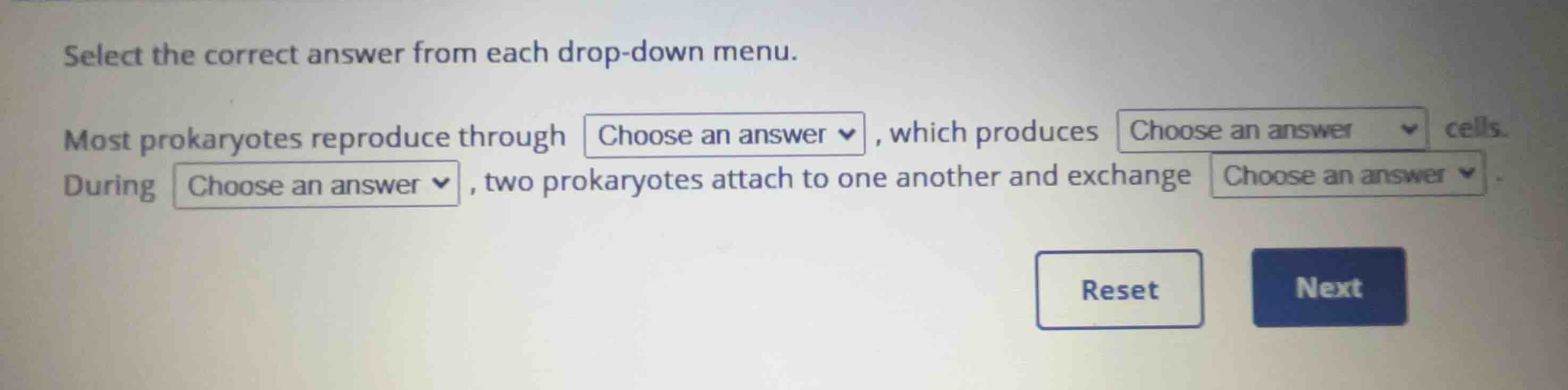
most prokaryotes reproduce through choose an answer, which produces choose an answer cells. during choose an answer, two prokaryotes attach to one another and exchange choose an answer.
Identify prokaryotic asexual reproduction
Prokaryotes (bacteria and archaea) primarily reproduce asexually. The main mechanism of asexual reproduction in these single-celled organisms is binary fission, where a single cell duplicates its genetic material and divides into two equal parts.
Determine the cellular outcome of binary fission
Binary fission is an asexual process. Because the parent cell replicates its DNA and divides equally, it produces two genetically identical daughter cells.
Identify the mechanism of genetic exchange
While prokaryotes do not reproduce sexually, they can share genetic material horizontally. The process where two prokaryotic cells physically attach to one another and exchange genetic material is called conjugation.
Determine the material exchanged during conjugation
During conjugation, prokaryotes typically transfer non-genomic, circular DNA molecules known as plasmids (or genetic material/DNA) to one another, which often carry beneficial genes such as antibiotic resistance.

Snap & solve any problem in the app
Get step-by-step solutions on Sovi AI
Photo-based solutions with guided steps
Explore more problems and detailed explanations
Most prokaryotes reproduce through <blank>binary fission</blank>, which produces <blank>identical</blank> cells. During <blank>conjugation</blank>, two prokaryotes attach to one another and exchange <blank>genetic material</blank>.