Sovi.AI - AI Math Tutor

Scan to solve math questions

QUESTION IMAGE

select the correct answer. a celestial body orbits the sun. it consists…

Question

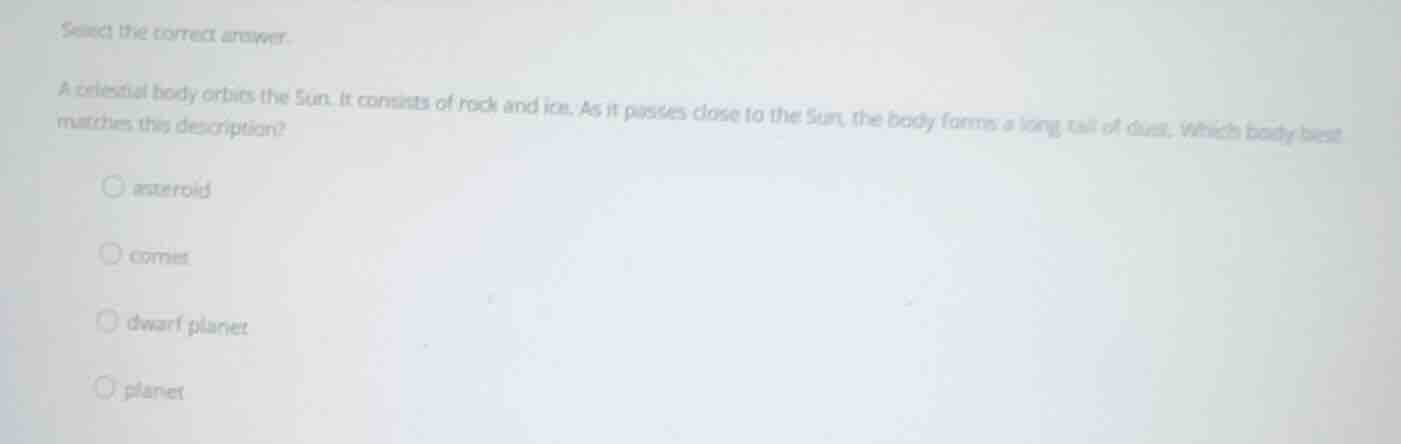
select the correct answer.

a celestial body orbits the sun. it consists of rock and ice. as it passes close to the sun, the body forms a long tail of dust. which body best matches this description?

  • asteroid
  • comet
  • dwarf planet
  • planet

Explanation:

Response

<pre_analysis>
{
"quality": "clear",
"question_count": 1,
"skills_matched": [
"direct_cot",
"multiple_choice_formatter",
"explain_then_answer",
"quick"
],
"needs_drawing": false,
"concepts_used": [
"Celestial Bodies",
"Comets and Asteroids"
],
"new_concepts": [],
"current_concepts": [
"Celestial Bodies",
"Comets and Asteroids"
]
}
</pre_analysis>

<reasoning>

Analyze the physical composition

The question describes a celestial body consisting of rock and ice. While asteroids are primarily rocky or metallic, comets are composed of rock, dust, and frozen gases (ice).

Evaluate the behavior near the Sun

As the body passes close to the Sun, the ice heats up and sublimates, releasing gases and dust. This process forms a visible atmosphere (coma) and a long, characteristic tail of dust and gas pointing away from the Sun.

Match with the options

Among the choices (asteroid, comet, dwarf planet, planet), only a comet fits the description of a rock-and-ice body that develops a long tail of dust when passing near the Sun.
</reasoning>

<answer>
<mcq-option>asteroid</mcq-option>
<mcq-correct>comet</mcq-correct>
<mcq-option>dwarf planet</mcq-option>
<mcq-option>planet</mcq-option>
</answer>

<post_analysis>
{
"subject": "Natural Science",
"question_type": "Multiple Choice",
"knowledge_point": [
"Natural Science",
"Astronomy",
"Comets and Asteroids"
]
}
</post_analysis>

Answer:

<pre_analysis>
{
"quality": "clear",
"question_count": 1,
"skills_matched": [
"direct_cot",
"multiple_choice_formatter",
"explain_then_answer",
"quick"
],
"needs_drawing": false,
"concepts_used": [
"Celestial Bodies",
"Comets and Asteroids"
],
"new_concepts": [],
"current_concepts": [
"Celestial Bodies",
"Comets and Asteroids"
]
}
</pre_analysis>

<reasoning>

Analyze the physical composition

The question describes a celestial body consisting of rock and ice. While asteroids are primarily rocky or metallic, comets are composed of rock, dust, and frozen gases (ice).

Evaluate the behavior near the Sun

As the body passes close to the Sun, the ice heats up and sublimates, releasing gases and dust. This process forms a visible atmosphere (coma) and a long, characteristic tail of dust and gas pointing away from the Sun.

Match with the options

Among the choices (asteroid, comet, dwarf planet, planet), only a comet fits the description of a rock-and-ice body that develops a long tail of dust when passing near the Sun.
</reasoning>

<answer>
<mcq-option>asteroid</mcq-option>
<mcq-correct>comet</mcq-correct>
<mcq-option>dwarf planet</mcq-option>
<mcq-option>planet</mcq-option>
</answer>

<post_analysis>
{
"subject": "Natural Science",
"question_type": "Multiple Choice",
"knowledge_point": [
"Natural Science",
"Astronomy",
"Comets and Asteroids"
]
}
</post_analysis>