QUESTION IMAGE
Question
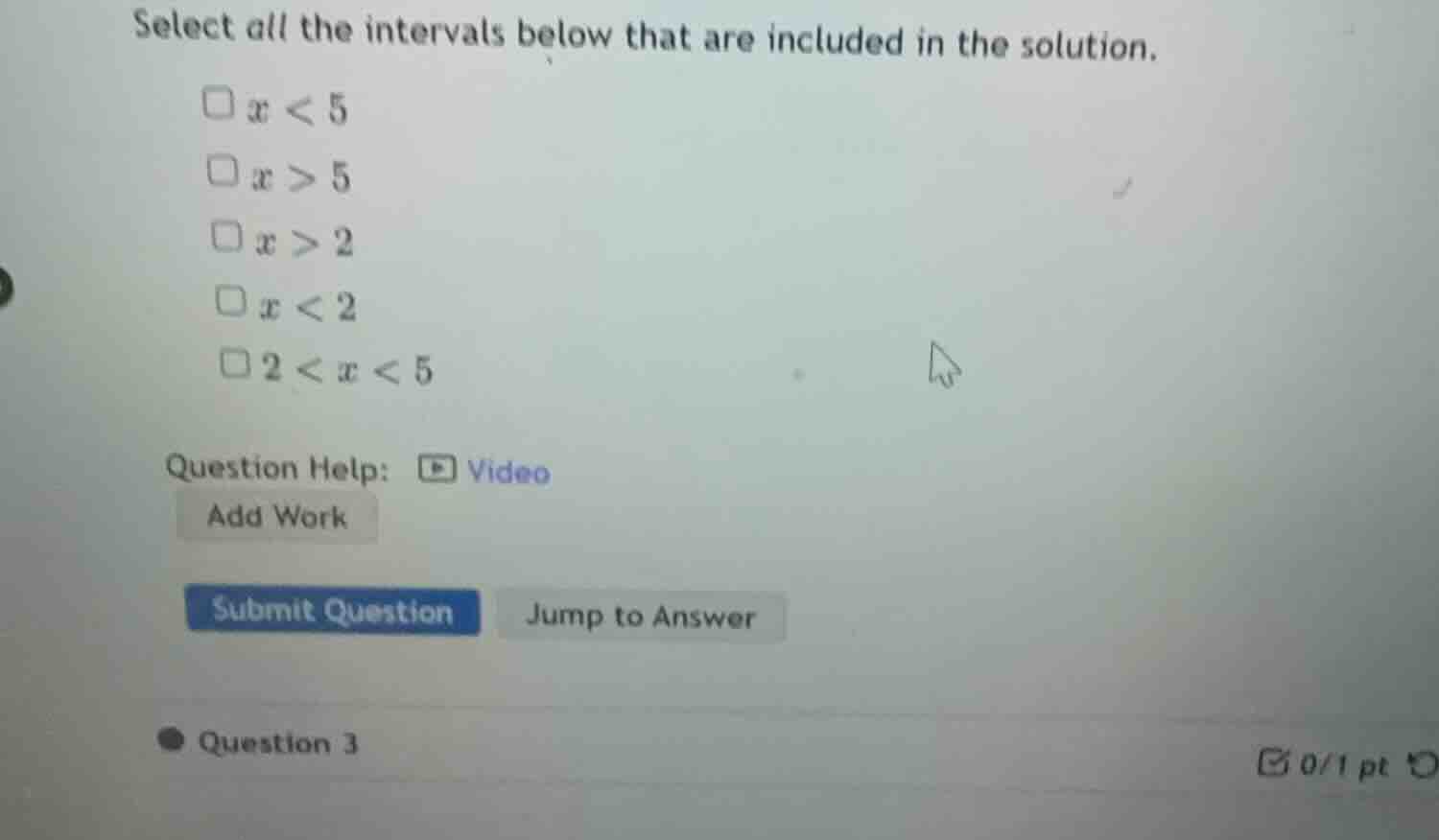
select all the intervals below that are included in the solution.
\\(x < 5\\)
\\(x > 5\\)
\\(x > 2\\)
\\(x < 2\\)
\\(2 < x < 5\\)
🆕 New Concept Discovered: Solving Polynomial Inequalities
Finding where a polynomial is positive or negative
To solve a polynomial inequality, we find the boundary points (roots) where the expression equals zero, and then test the intervals between those points to see where the inequality is true.
Let's assume the underlying problem is to solve the quadratic inequality:
(or a similar standard form that yields the critical boundary values \( x = 2 \) and \( x = 5 \) shown in the options).
Step 1: Identify critical points
Set the polynomial equal to zero to find the boundary values:
These points split the number line into three test intervals:
- \( x < 2 \)
- \( 2 < x < 5 \)
- \( x > 5 \)
Step 2: Test the intervals
We want to find where the product \( (x - 2)(x - 5) \) is negative (\( < 0 \)):
- For \( x < 2 \) (e.g., test \( x = 0 \)):
- For \( 2 < x < 5 \) (e.g., test \( x = 3 \)):
- For \( x > 5 \) (e.g., test \( x = 6 \)):
Step 3: Select the matching intervals
The inequality is satisfied when the expression is negative, which occurs in the interval:
Looking at the given options:
- \( x < 5 \) (This contains values like \( x = 0 \), which are not in the solution set)
- \( x > 5 \) (Incorrect)
- \( x > 2 \) (This contains values like \( x = 6 \), which are not in the solution set)
- \( x < 2 \) (Incorrect)
- \( 2 < x < 5 \) (Correct)

Snap & solve any problem in the app
Get step-by-step solutions on Sovi AI
Photo-based solutions with guided steps
Explore more problems and detailed explanations
- \( 2 < x < 5 \)