QUESTION IMAGE
Question
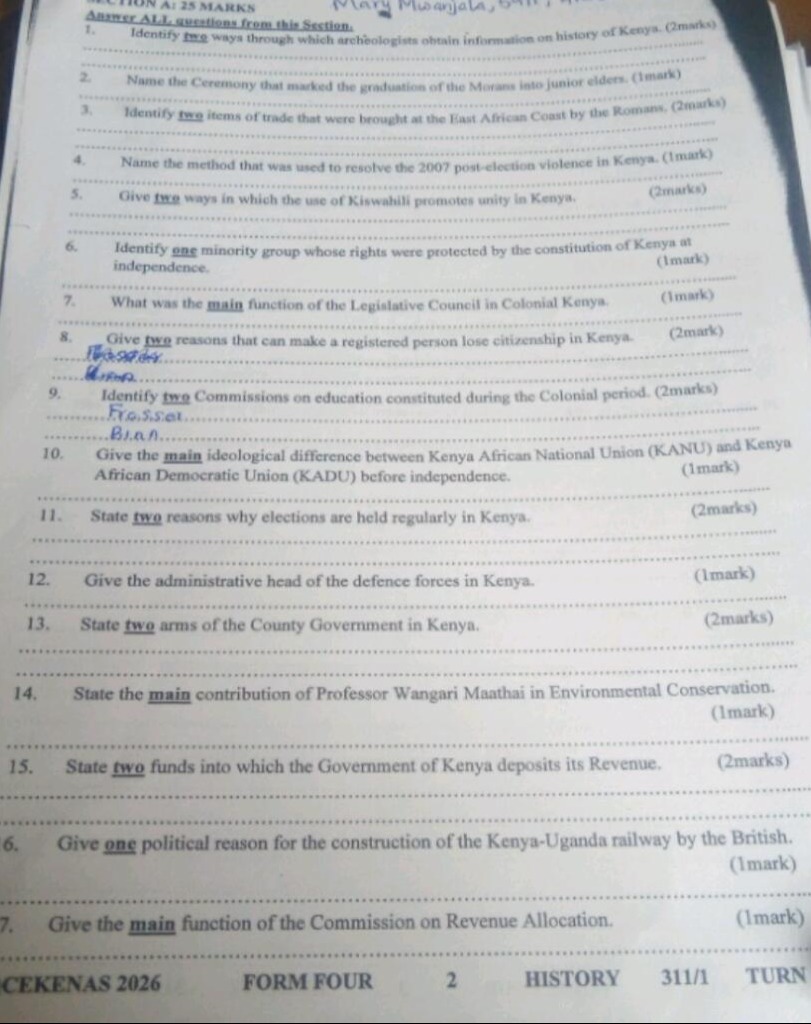
section a: 25 marks
answer all questions from this section.
- identify two ways through which archeologists obtain information on history of kenya. (2marks)
- name the ceremony that marked the graduation of the morans into junior elders. (1mark)
- identify two items of trade that were brought at the east african coast by the romans. (2marks)
- name the method that was used to resolve the 2007 post-election violence in kenya. (1mark)
- give two ways in which the use of kiswahili promotes unity in kenya. (2marks)
- identify one minority group whose rights were protected by the constitution of kenya at independence. (1mark)
- what was the main function of the legislative council in colonial kenya. (1mark)
- give two reasons that can make a registered person lose citizenship in kenya. (2marks)
- identify two commissions on education constituted during the colonial period. (2marks)
- give the main ideological difference between kenya african national union (kanu) and kenya african democratic union (kadu) before independence. (1mark)
- state two reasons why elections are held regularly in kenya. (2marks)
- give the administrative head of the defence forces in kenya. (1mark)
- state two arms of the county government in kenya. (2marks)
- state the main contribution of professor wangari maathai in environmental conservation. (1mark)
- state two funds into which the government of kenya deposits its revenue. (2marks)
- give one political reason for the construction of the kenya-uganda railway by the british. (1mark)
- give the main function of the commission on revenue allocation. (1mark)
🆕 New Concept Discovered: Kenyan History and Government
Analyzing historical events, constitutional provisions, and governance structures in Kenya.
Step 1: Archaeological Sources of Kenyan History (Question 1)
Archaeologists reconstruct the history of Kenya by physically recovering and analyzing material remains left behind by past societies. Two primary methods they use to obtain this information are:
- Excavating archaeological sites: Digging up historical sites to find physical artifacts such as tools, pottery, fossils, and weapons.
- Analyzing fossils and artifacts: Studying human and animal skeletal remains (fossils) as well as human-made objects (artifacts) to determine their age, diet, technology, and lifestyle.
Step 2: Maasai Graduation Ceremony (Question 2)
In traditional Maasai society, the transition of warriors (Morans) into junior elders is marked by a major rite of passage.
- The ceremony is called Eunoto.
Step 3: Roman Trade Items at the East African Coast (Question 3)
During the ancient Indian Ocean trade, Roman merchants visited the East African Coast. Two items of trade brought by the Romans were:
- Glassware (or glass vessels)
- Wine (or swords/weapons, metal daggers, and cloth)
Step 4: Resolution of the 2007 Post-Election Violence (Question 4)
The political crisis and violence following the 2007 general election in Kenya was resolved through a structured diplomatic process.
- The method used was Mediation (led by the African Union Panel of Eminent African Personalities, chaired by Kofi Annan, which resulted in the National Accord and Reconciliation Act).
Step 5: Kiswahili as a Tool for National Unity (Question 5)
Kiswahili serves as both a national and official language in Kenya. Two ways it promotes national unity include:
- Breaking down ethnic barriers: It serves as a common language (lingua franca) that enables Kenyans from different ethnic backgrounds to communicate easily.
- Fostering a sense of national identity: It instills a sense of belonging and patriotism as a shared national language.
Step 6: Minority Rights at Independence (Question 6)
At independence, the 1963 Constitution of Kenya (Majimbo Constitution) sought to protect various minority groups. One such group was:
- The European/White settlers (or Asian minority, or smaller African ethnic communities such as the Kalenjin, Maasai, Turkana, and Samburu represented by KADU).
Step 7: Function of the Legislative Council (LegCo) (Question 7)
The Legislative Council was the colonial predecessor to Kenya's modern parliament.
- Its main function was to make laws (legislate) for the administration of colonial Kenya.
Step 8: Loss of Registered Citizenship (Question 8)
Under Kenyan law, a person who acquired citizenship by registration can lose it under specific circumstances. Two reasons are:
- Acquisition through fraud: If the citizenship was obtained by fraud, false representation, or concealment of any material fact.
- Disloyalty to the state: If the person has shown disloyalty by speech or act towards the Republic of Kenya (such as treason or collaborating with an enemy of Kenya during a war).
Step 9: Colonial Education Commissions (Question 9)
During the colonial period, the British administration established several commissions to review and make recommendations on African education. Two of these commissions were:
- The Phelps-Stokes Commission (1924)
- The Beecher Committee/Commission (1949) (or the Fraser Committee of…

Snap & solve any problem in the app
Get step-by-step solutions on Sovi AI
Photo-based solutions with guided steps
Explore more problems and detailed explanations
- Two ways archaeologists obtain information:
- Excavating archaeological sites to unearth physical remains.
- Analyzing fossils and artifacts to determine their age and use.
- Ceremony marking Moran graduation:
- Eunoto ceremony.
- Two trade items brought by Romans:
- Glassware and Wine.
- Method used to resolve 2007 post-election violence:
- Mediation (National Accord and Reconciliation process).
- Two ways Kiswahili promotes unity:
- It acts as a common language (lingua franca) that unites different ethnic groups.
- It fosters a shared national identity and patriotism.
- One minority group protected at independence:
- European/Asian minorities (or smaller African ethnic groups represented by KADU).
- Main function of the Legislative Council (LegCo):
- To make laws (legislate) for the colonial administration.
- Two reasons a registered citizen can lose citizenship:
- If citizenship was acquired through fraud, false representation, or concealment of facts.
- If the person is found guilty of treason or showing disloyalty to the state.
- Two colonial education commissions:
- The Phelps-Stokes Commission and the Beecher Committee.
- Main ideological difference between KANU and KADU:
- KANU favored a centralized unitary system of government, whereas KADU advocated for a decentralized federal system (Majimboism).
- Two reasons for regular elections:
- To allow citizens to exercise their democratic right to elect leaders of their choice.
- To ensure political accountability and peaceful transition of power.
- Administrative head of the defence forces:
- The Chief of the Defence Forces (CDF) / Principal Secretary for Defence.
- Two arms of County Government:
- The County Executive.
- The County Assembly.
- Main contribution of Prof. Wangari Maathai:
- Founding the Green Belt Movement to promote environmental conservation through tree planting.
- Two funds for government revenue:
- The Consolidated Fund.
- The Equalisation Fund.
- One political reason for the Kenya-Uganda railway:
- To facilitate effective administrative control over the British East Africa Protectorate and Uganda.
- Main function of the Commission on Revenue Allocation (CRA):
- To recommend the basis for the equitable sharing of national revenue between the national and county governments.