QUESTION IMAGE
Question
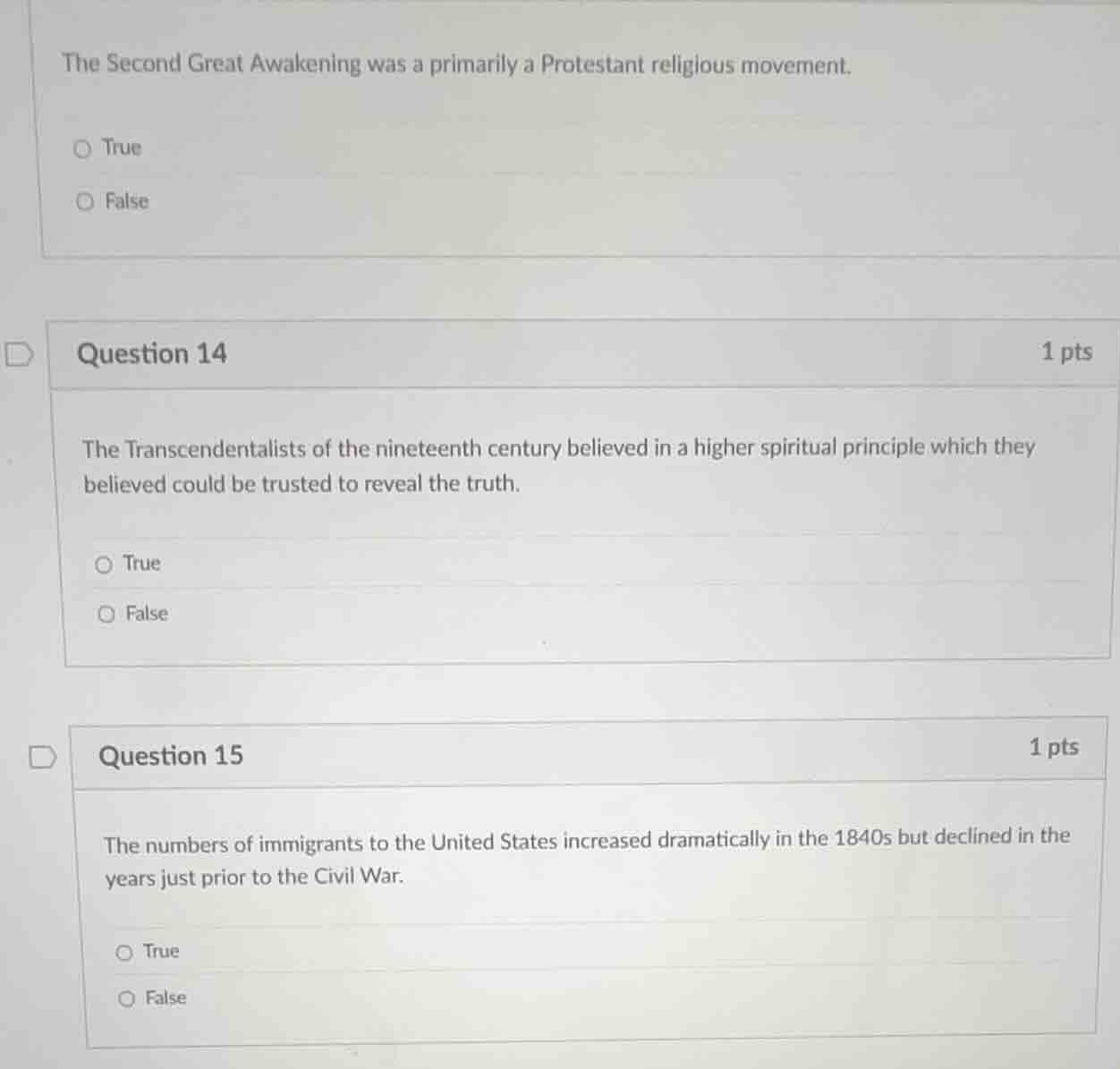
the second great awakening was a primarily a protestant religious movement.
true
false
question 14
1 pts
the transcendentalists of the nineteenth century believed in a higher spiritual principle which they believed could be trusted to reveal the truth.
true
false
question 15
1 pts
the numbers of immigrants to the united states increased dramatically in the 1840s but declined in the years just prior to the civil war.
true
false
🆕 New Concept Discovered: 19th-Century American Reform and Culture
Understanding the religious, philosophical, and demographic shifts of the 1800s.
Step 1: Analyze the first statement
- Statement: "The Second Great Awakening was a primarily a Protestant religious movement."
- Analysis: The Second Great Awakening (which peaked in the 1820s to 1840s) was a massive Protestant religious revival in the United States. It was characterized by large camp meetings and led to the rapid growth of Methodist, Baptist, and Presbyterian congregations.
- Determination: True.
Step 2: Analyze Question 14
- Statement: "The Transcendentalists of the nineteenth century believed in a higher spiritual principle which they believed could be trusted to reveal the truth."
- Analysis: Transcendentalism was a philosophical and literary movement centered in New England during the mid-19th century (led by figures like Ralph Waldo Emerson and Henry David Thoreau). A core belief of Transcendentalism was that individuals possess an inherent spiritual intuition or "inner light" (a higher spiritual principle) that transcends physical senses and rationalism, which can be trusted to find ultimate truth.
- Determination: True.
Step 3: Analyze Question 15
- Statement: "The numbers of immigrants to the United States increased dramatically in the 1840s but declined in the years just prior to the Civil War."
- Analysis: Immigration to the U.S. surged dramatically in the 1840s and early 1850s, driven largely by the Irish Potato Famine and political unrest in Germany. While there were minor annual fluctuations, overall immigration levels remained historically high throughout the 1850s right up until the outbreak of the Civil War in 1861, rather than experiencing a significant decline just prior to it. The actual sharp decline in immigration occurred during the Civil War itself due to the conflict.
- Determination: False.

Snap & solve any problem in the app
Get step-by-step solutions on Sovi AI
Photo-based solutions with guided steps
Explore more problems and detailed explanations
- First Statement: True
- Question 14: True
- Question 15: False