QUESTION IMAGE
Question
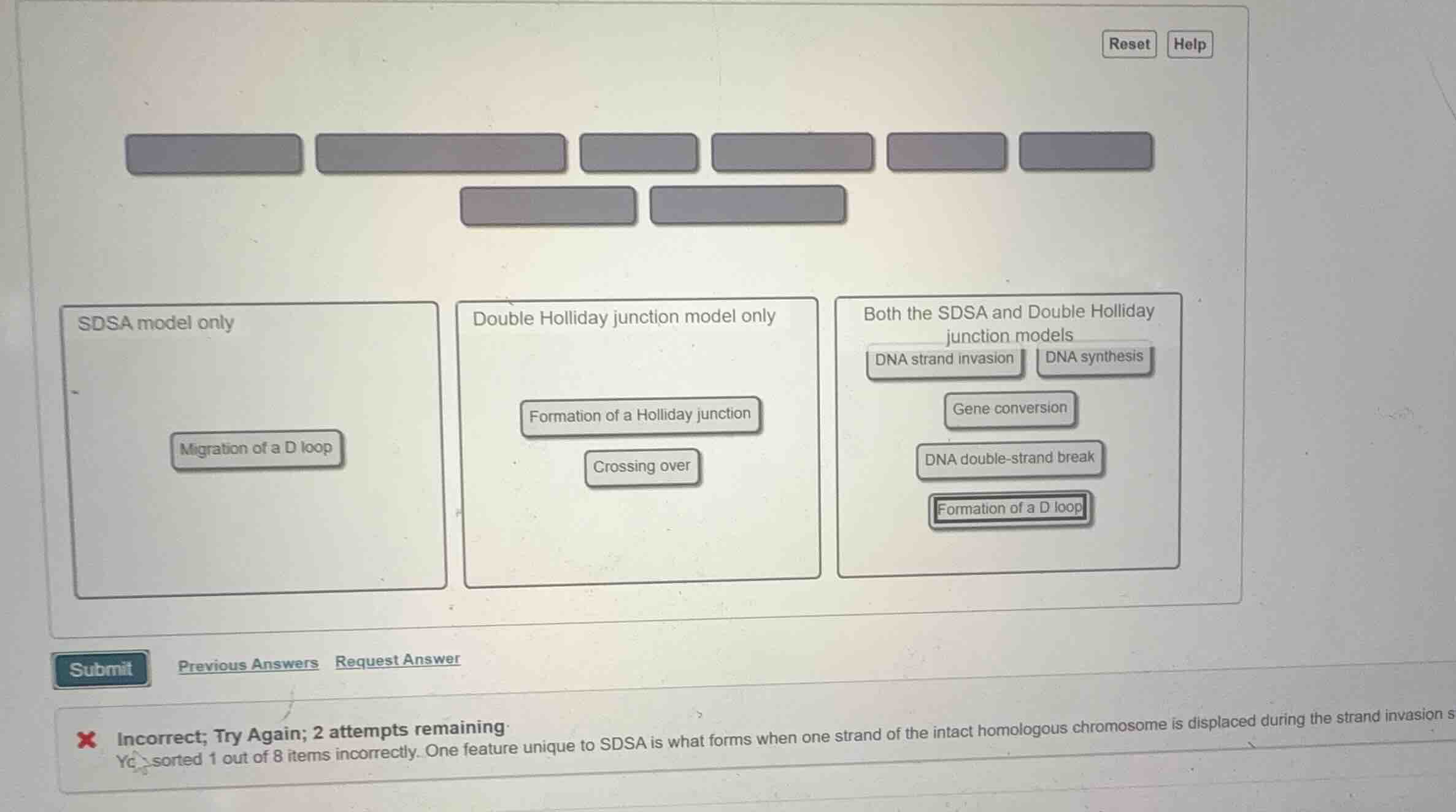
sdsa model only
migration of a d loop
double holliday junction model only
formation of a holliday junction
crossing over
both the sdsa and double holliday junction models
dna strand invasion
dna synthesis
gene conversion
dna double-strand break
formation of a d loop
incorrect; try again; 2 attempts remaining
you sorted 1 out of 8 items incorrectly. one feature unique to sdsa is what forms when one strand of the intact homologous chromosome is displaced during the strand invasion step.
Analyze the incorrect placement feedback
Using the D-loop Formation and Double Holliday Junction Model knowledge points
The feedback states: "You sorted 1 out of 8 items incorrectly. One feature unique to SDSA is what forms when one strand of the intact homologous chromosome is displaced during the strand invasion step."
During strand invasion, a displacement loop (D-loop) is formed in both models. However, in the Synthesis-Dependent Strand Annealing (SDSA) model, this D-loop migrates along the template strand as synthesis proceeds, which is a unique feature of SDSA.
The feedback points out that "what forms when one strand of the intact homologous chromosome is displaced" (which is the D-loop itself) is a shared feature, but the placement of "Formation of a D loop" is currently in the "Both" category, which is correct.
Let's re-evaluate the items. The items shown in the categories are:
- SDSA model only: "Migration of a D loop"
- Double Holliday junction model only: "Formation of a Holliday junction", "Crossing over"
- Both the SDSA and Double Holliday junction models: "DNA strand invasion", "DNA synthesis", "Gene conversion", "DNA double-strand break", "Formation of a D loop"
Wait, let's read the hint carefully: "One feature unique to SDSA is what forms when one strand of the intact homologous chromosome is displaced during the strand invasion step."
Actually, a D-loop forms in both. But wait! Is "Formation of a D loop" unique to SDSA in some curricula, or is there another item?
Let's look at the grey boxes at the top. There are 8 draggable items in total.
The items currently placed are:
- Migration of a D loop (SDSA only)
- Formation of a Holliday junction (Double Holliday junction only)
- Crossing over (Double Holliday junction only)
- DNA strand invasion (Both)
- DNA synthesis (Both)
- Gene conversion (Both)
- DNA double-strand break (Both)
- Formation of a D loop (Both)
Let's re-read the hint: "One feature unique to SDSA is what forms when one strand of the intact homologous chromosome is displaced during the strand invasion step."
Wait, "what forms when one strand of the intact homologous chromosome is displaced" is indeed a D-loop. If the hint says "One feature unique to SDSA is...", could it mean "Migration of a D loop"? No, "what forms when one strand... is displaced" is the definition of a D-loop.
Wait, in some textbook definitions (like Pierce Genetics), does the D-loop only form in SDSA, or is it characterized differently?
In the double Holliday junction (DSBR) model, strand invasion by one 3' end displaces a strand of the homologous chromosome, forming a D-loop. Then the displaced strand of the D-loop pairs with the other 3' single-stranded end (second-end capture).
In SDSA, the invading strand is displaced after synthesis and anneals back.
Let's think if "Formation of a D loop" is unique to SDSA or if "Migration of a D loop" is.
Actually, the hint says: "One feature unique to SDSA is..." and then the text is cut off: "...is what forms when one strand of the intact homologous c…

Snap & solve any problem in the app
Get step-by-step solutions on Sovi AI
Photo-based solutions with guided steps
Explore more problems and detailed explanations
To correct the sorting and achieve a perfect score, move "Formation of a D loop" from the "Both" category to the "SDSA model only" category.
The correct classification for all 8 items is as follows:
SDSA model only
- Migration of a D loop
- Formation of a D loop
Double Holliday junction model only
- Formation of a Holliday junction
- Crossing over
Both the SDSA and Double Holliday junction models
- DNA double-strand break
- DNA strand invasion
- DNA synthesis
- Gene conversion