QUESTION IMAGE
Question
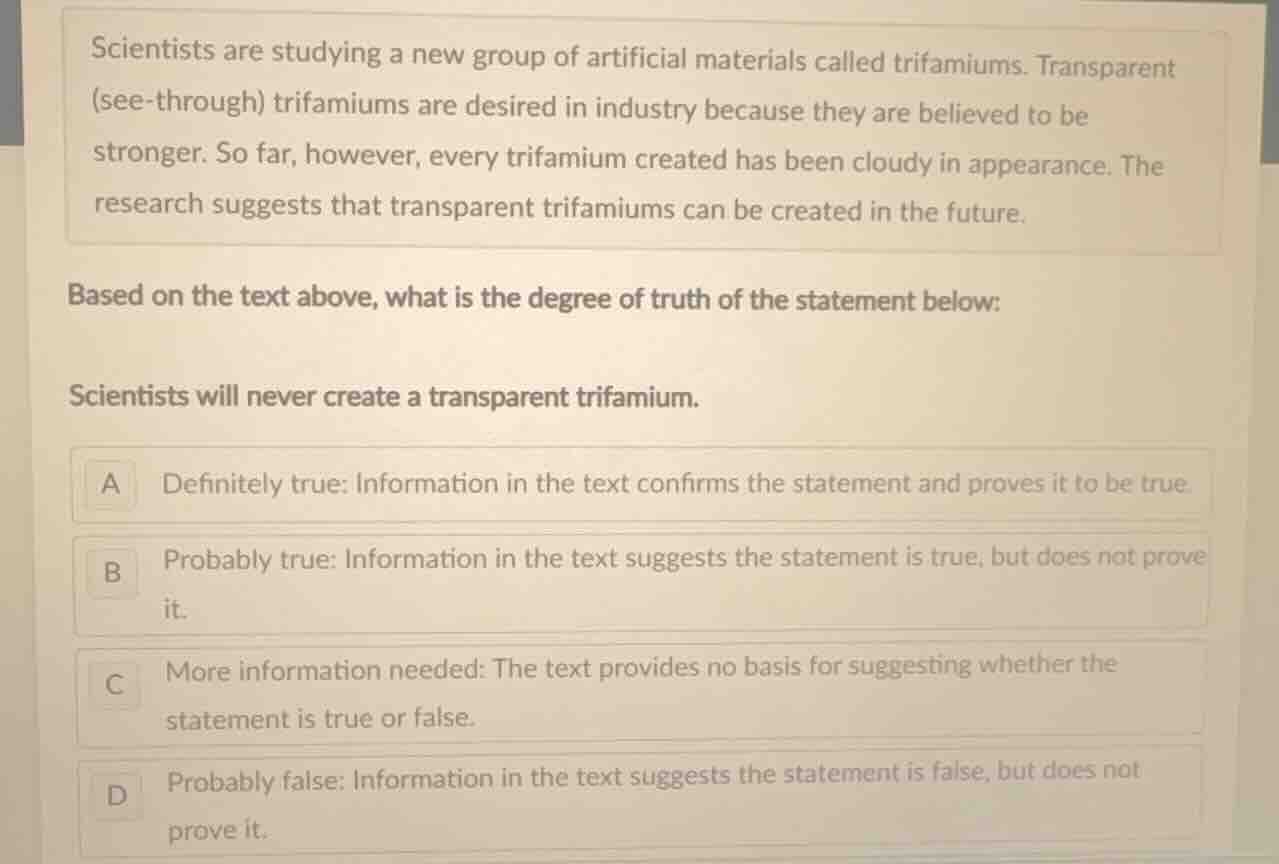
scientists are studying a new group of artificial materials called trifamiums. transparent (see-through) trifamiums are desired in industry because they are believed to be stronger. so far, however, every trifamium created has been cloudy in appearance. the research suggests that transparent trifamiums can be created in the future.
based on the text above, what is the degree of truth of the statement below:
scientists will never create a transparent trifamium.
a definitely true: information in the text confirms the statement and proves it to be true.
b probably true: information in the text suggests the statement is true, but does not prove it.
c more information needed: the text provides no basis for suggesting whether the statement is true or false.
d probably false: information in the text suggests the statement is false, but does not prove it.
Analyze the premise and the statement
The premise states: "The research suggests that transparent trifamiums can be created in the future."
The statement to evaluate is: "Scientists will never create a transparent trifamium."
Determine the logical relationship
The premise suggests that transparent trifamiums can be created in the future.
The statement claims they will never be created.
Because the text suggests they can be created, it directly suggests that the statement "they will never be created" is likely false, though it does not absolutely prove it false (since "suggests" is not a definitive guarantee of future success).
Match with the options
Option D states: "Probably false: Information in the text suggests the statement is false, but does not prove it." This perfectly matches our logical deduction.

Snap & solve any problem in the app
Get step-by-step solutions on Sovi AI
Photo-based solutions with guided steps
Explore more problems and detailed explanations
- (A) Definitely true: Information in the text confirms the statement and proves it to be true.
- (B) Probably true: Information in the text suggests the statement is true, but does not prove it.
- (C) More information needed: The text provides no basis for suggesting whether the statement is true or false.
- (D) Probably false: Information in the text suggests the statement is false, but does not prove it. (Correct answer)