QUESTION IMAGE
Question
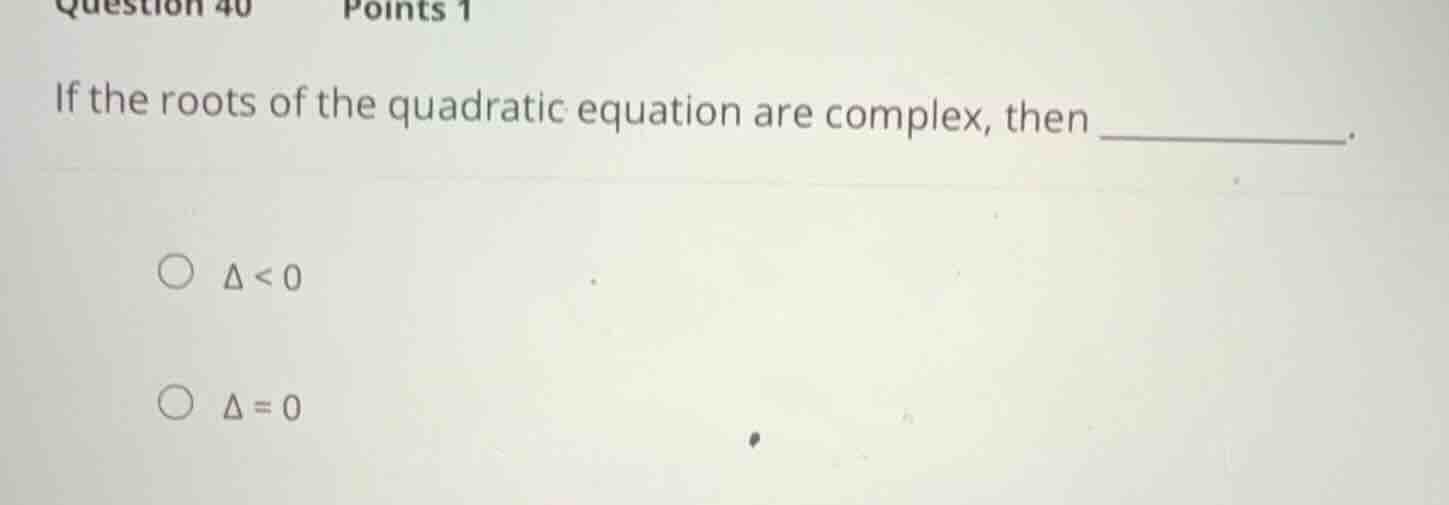
if the roots of the quadratic equation are complex, then ______.
\\(\delta < 0\\)
\\(\delta = 0\\)
<pre_analysis>
{
"quality": "clear",
"question_count": 1,
"skills_matched": [
"step_cot",
"multiple_choice_formatter",
"explain_then_answer",
"quick"
],
"needs_drawing": false,
"concepts_used": [
"Discriminant of Quadratic"
],
"new_concepts": [],
"current_concepts": [
"Discriminant of Quadratic",
"Quadratic Equations"
]
}
</pre_analysis>
<reasoning>
Define the discriminant of a quadratic equation
The discriminant of a quadratic equation \(ax^2 + bx + c = 0\) is denoted by \(\Delta\) (or \(D\)) and is given by:
\[
\Delta = b^2 - 4ac
\]
Determine the condition for complex roots
The nature of the roots depends on the sign of the discriminant \(\Delta\):
- If \(\Delta > 0\), the equation has two distinct real roots.
- If \(\Delta = 0\), the equation has one repeated real root.
- If \(\Delta < 0\), the equation has two complex (conjugate) roots.
</reasoning>
<answer>
<mcq-correct>\(\Delta < 0\)</mcq-correct>
<mcq-option>\(\Delta = 0\)</mcq-option>
</answer>
<post_analysis>
{
"subject": "Mathematics",
"question_type": "Multiple Choice",
"knowledge_point": [
"Mathematics",
"Algebra",
"Discriminant of Quadratic"
]
}
</post_analysis>
Snap & solve any problem in the app
Get step-by-step solutions on Sovi AI
Photo-based solutions with guided steps
Explore more problems and detailed explanations
<pre_analysis>
{
"quality": "clear",
"question_count": 1,
"skills_matched": [
"step_cot",
"multiple_choice_formatter",
"explain_then_answer",
"quick"
],
"needs_drawing": false,
"concepts_used": [
"Discriminant of Quadratic"
],
"new_concepts": [],
"current_concepts": [
"Discriminant of Quadratic",
"Quadratic Equations"
]
}
</pre_analysis>
<reasoning>
Define the discriminant of a quadratic equation
The discriminant of a quadratic equation \(ax^2 + bx + c = 0\) is denoted by \(\Delta\) (or \(D\)) and is given by:
\[
\Delta = b^2 - 4ac
\]
Determine the condition for complex roots
The nature of the roots depends on the sign of the discriminant \(\Delta\):
- If \(\Delta > 0\), the equation has two distinct real roots.
- If \(\Delta = 0\), the equation has one repeated real root.
- If \(\Delta < 0\), the equation has two complex (conjugate) roots.
</reasoning>
<answer>
<mcq-correct>\(\Delta < 0\)</mcq-correct>
<mcq-option>\(\Delta = 0\)</mcq-option>
</answer>
<post_analysis>
{
"subject": "Mathematics",
"question_type": "Multiple Choice",
"knowledge_point": [
"Mathematics",
"Algebra",
"Discriminant of Quadratic"
]
}
</post_analysis>