QUESTION IMAGE
Question
the roaring twenties
mike kubic • 2016
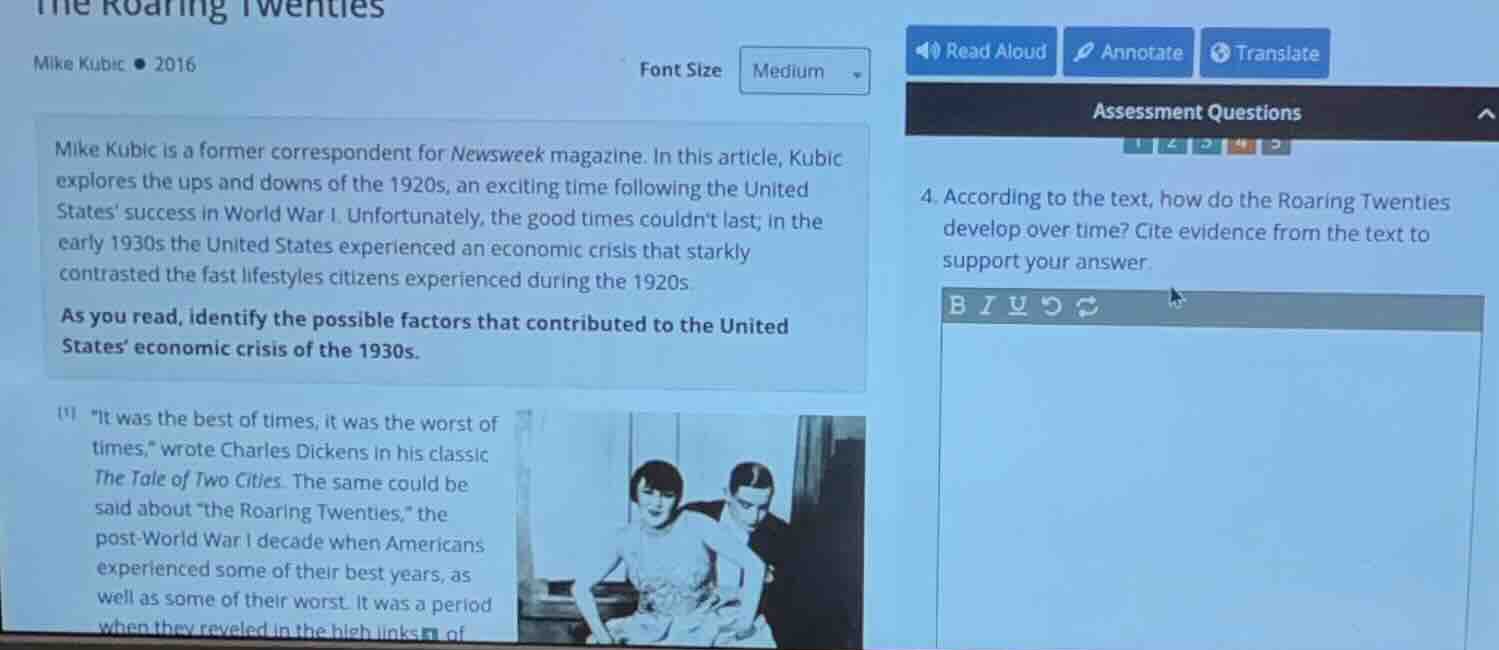
mike kubic is a former correspondent for newsweek magazine. in this article, kubic explores the ups and downs of the 1920s, an exciting time following the united states’ success in world war i. unfortunately, the good times couldn’t last; in the early 1930s the united states experienced an economic crisis that starkly contrasted the fast lifestyles citizens experienced during the 1920s
as you read, identify the possible factors that contributed to the united states’ economic crisis of the 1930s.
(1) “it was the best of times, it was the worst of times,” wrote charles dickens in his classic the tale of two cities. the same could be said about “the roaring twenties,” the post - world war i decade when americans experienced some of their best years, as well as some of their worst. it was a period when they reveled in the high jinks of
assessment questions
- according to the text, how do the roaring twenties develop over time? cite evidence from the text to support your answer
To answer this, we analyze the text's context:
- Initial Prosperity: Post - WWI, the 1920s saw economic growth, cultural dynamism (e.g., new lifestyles, consumerism). The text says it was a time of “high jinks” and “fast lifestyles,” showing a booming period.
- Downward Trend: The “good times couldn’t last” and the 1930s brought an “economic crisis” that contrasted with the 1920s’ prosperity. Evidence like the shift from the Roaring Twenties’ excess to the Great Depression’s hardship (implied by the contrast) shows the 1920s developed from a period of economic and social boom to setting the stage for the 1930s crisis (due to factors like overspeculation, uneven wealth distribution, or unsustainable growth, though the text’s contrast hints at this trajectory).
A full answer would need direct quotes from the text (e.g., “the good times couldn’t last; in the early 1930s... economic crisis that starkly contrasted the fast lifestyles... during the 1920s” to show the shift from boom to bust over time).
(Note: Since the full text isn’t fully visible, the above uses the provided snippets. For a complete answer, extract more quotes about the 1920s’ rise and the 1930s’ fall from the article.)

Snap & solve any problem in the app
Get step-by-step solutions on Sovi AI
Photo-based solutions with guided steps
Explore more problems and detailed explanations
To answer this, we analyze the text's context:
- Initial Prosperity: Post - WWI, the 1920s saw economic growth, cultural dynamism (e.g., new lifestyles, consumerism). The text says it was a time of “high jinks” and “fast lifestyles,” showing a booming period.
- Downward Trend: The “good times couldn’t last” and the 1930s brought an “economic crisis” that contrasted with the 1920s’ prosperity. Evidence like the shift from the Roaring Twenties’ excess to the Great Depression’s hardship (implied by the contrast) shows the 1920s developed from a period of economic and social boom to setting the stage for the 1930s crisis (due to factors like overspeculation, uneven wealth distribution, or unsustainable growth, though the text’s contrast hints at this trajectory).
A full answer would need direct quotes from the text (e.g., “the good times couldn’t last; in the early 1930s... economic crisis that starkly contrasted the fast lifestyles... during the 1920s” to show the shift from boom to bust over time).
(Note: Since the full text isn’t fully visible, the above uses the provided snippets. For a complete answer, extract more quotes about the 1920s’ rise and the 1930s’ fall from the article.)