QUESTION IMAGE
Question
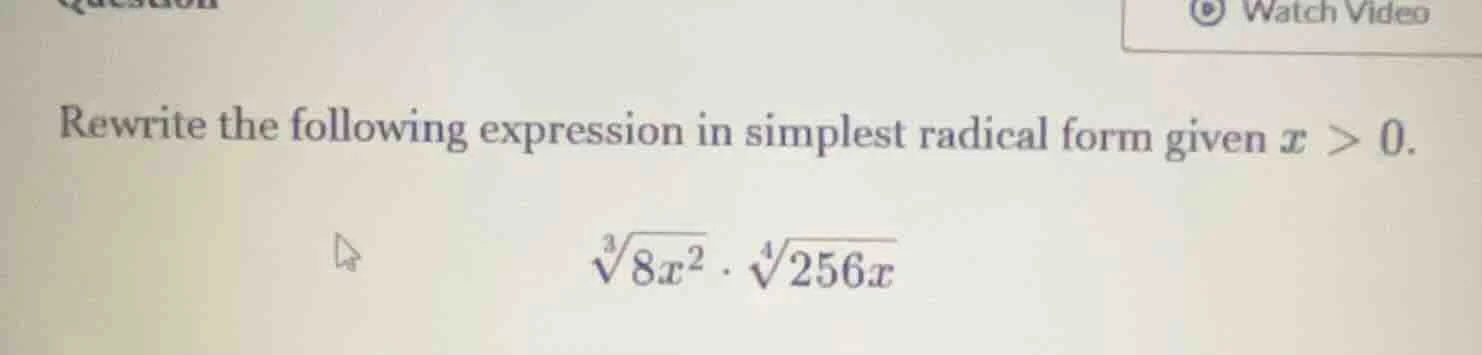
rewrite the following expression in simplest radical form given ( x > 0 ). (sqrt3{8x^{2}} cdot sqrt4{256x})
Step1: Simplify each radical separately
First, simplify \(\sqrt[3]{8x^{2}}\). We know that \(8 = 2^{3}\), so \(\sqrt[3]{8x^{2}}=\sqrt[3]{2^{3}x^{2}} = 2x^{\frac{2}{3}}\) (using the property \(\sqrt[n]{a^{n}b}=a\sqrt[n]{b}\) and \(\sqrt[n]{a^{m}}=a^{\frac{m}{n}}\)).
Next, simplify \(\sqrt[4]{256x}\). Since \(256 = 4^{4}=2^{8}\), but more simply \(256 = 4^{4}\), so \(\sqrt[4]{256x}=\sqrt[4]{4^{4}x}=4x^{\frac{1}{4}}\) (using the same properties as above).
Step2: Multiply the simplified radicals
Now we multiply \(2x^{\frac{2}{3}}\) and \(4x^{\frac{1}{4}}\). First, multiply the coefficients: \(2\times4 = 8\). Then, multiply the variable terms using the property \(a^{m}\cdot a^{n}=a^{m + n}\). So \(x^{\frac{2}{3}}\cdot x^{\frac{1}{4}}=x^{\frac{2}{3}+\frac{1}{4}}\).
To add the exponents, find a common denominator: \(\frac{2}{3}+\frac{1}{4}=\frac{8}{12}+\frac{3}{12}=\frac{11}{12}\). So the product of the variable terms is \(x^{\frac{11}{12}}\).
Now we have \(8x^{\frac{11}{12}}\), but we need to express this back in radical form. \(x^{\frac{11}{12}}=\sqrt[12]{x^{11}}\) (since \(a^{\frac{m}{n}}=\sqrt[n]{a^{m}}\)). Wait, but maybe we made a mistake in the approach. Let's try another way by converting to exponents with a common index.
The least common multiple of 3 and 4 is 12. So rewrite each radical with index 12.
\(\sqrt[3]{8x^{2}}=(8x^{2})^{\frac{1}{3}}=(2^{3}x^{2})^{\frac{1}{3}} = 2x^{\frac{2}{3}}=2x^{\frac{8}{12}}\) (multiplying numerator and denominator of \(\frac{2}{3}\) by 4 to get denominator 12).
\(\sqrt[4]{256x}=(256x)^{\frac{1}{4}}=(4^{4}x)^{\frac{1}{4}} = 4x^{\frac{1}{4}}=4x^{\frac{3}{12}}\) (multiplying numerator and denominator of \(\frac{1}{4}\) by 3 to get denominator 12).
Now multiply them: \(2x^{\frac{8}{12}}\cdot4x^{\frac{3}{12}}=(2\times4)x^{\frac{8 + 3}{12}}=8x^{\frac{11}{12}}\). But we can also write this as \(8\sqrt[12]{x^{11}}\)? Wait, no, maybe we should factor the original radicals into prime factors.
Let's try prime factorization:
\(8 = 2^{3}\), \(256=2^{8}\)
So \(\sqrt[3]{8x^{2}}=\sqrt[3]{2^{3}x^{2}} = 2\sqrt[3]{x^{2}}\)
\(\sqrt[4]{256x}=\sqrt[4]{2^{8}x}=2^{2}\sqrt[4]{x}=4\sqrt[4]{x}\) (since \(2^{8}\) under 4th root: \(2^{8\times\frac{1}{4}}=2^{2}=4\))
Now we have \(2\sqrt[3]{x^{2}}\cdot4\sqrt[4]{x}=8\sqrt[3]{x^{2}}\sqrt[4]{x}\)
To multiply these radicals, we need a common index, which is 12.
\(\sqrt[3]{x^{2}}=x^{\frac{2}{3}}=x^{\frac{8}{12}}=\sqrt[12]{x^{8}}\)
\(\sqrt[4]{x}=x^{\frac{1}{4}}=x^{\frac{3}{12}}=\sqrt[12]{x^{3}}\)
So \(\sqrt[12]{x^{8}}\cdot\sqrt[12]{x^{3}}=\sqrt[12]{x^{8 + 3}}=\sqrt[12]{x^{11}}\)
Therefore, the product is \(8\sqrt[12]{x^{11}}\)? Wait, no, that seems off. Wait, let's check the exponents again.
Wait, when we have \(\sqrt[3]{8x^{2}} = 2x^{\frac{2}{3}}\) and \(\sqrt[4]{256x}=4x^{\frac{1}{4}}\), multiplying them gives \(2\times4=8\) and \(x^{\frac{2}{3}+\frac{1}{4}}=x^{\frac{8 + 3}{12}}=x^{\frac{11}{12}}\), which is \(8\sqrt[12]{x^{11}}\). But let's verify with another approach.
Alternatively, let's compute the product inside a single radical by finding a common index. The common index of 3 and 4 is 12. So:
\(\sqrt[3]{8x^{2}}=\sqrt[12]{(8x^{2})^{4}}=\sqrt[12]{8^{4}x^{8}}\)
\(\sqrt[4]{256x}=\sqrt[12]{(256x)^{3}}=\sqrt[12]{256^{3}x^{3}}\)
Now multiply the two radicals: \(\sqrt[12]{8^{4}x^{8}\cdot256^{3}x^{3}}=\sqrt[12]{8^{4}\cdot256^{3}\cdot x^{11}}\)
Now compute \(8^{4}\cdot256^{3}\). Since \(8 = 2^{3}\) and \(256 = 2^{8}\), so \(8^{4}=(2^{3})^{4}=2^{12}\), \(256^{3}=(2^{8})^{3}=2^{24}\). Then \(2^{12}\cdot2^{24}=2^{36}\). So we have \(\sqrt[12]{2^{36}\cdot x^{11…

Snap & solve any problem in the app
Get step-by-step solutions on Sovi AI
Photo-based solutions with guided steps
Explore more problems and detailed explanations
\(8\sqrt[12]{x^{11}}\)