Sovi.AI - AI Math Tutor

Scan to solve math questions

QUESTION IMAGE

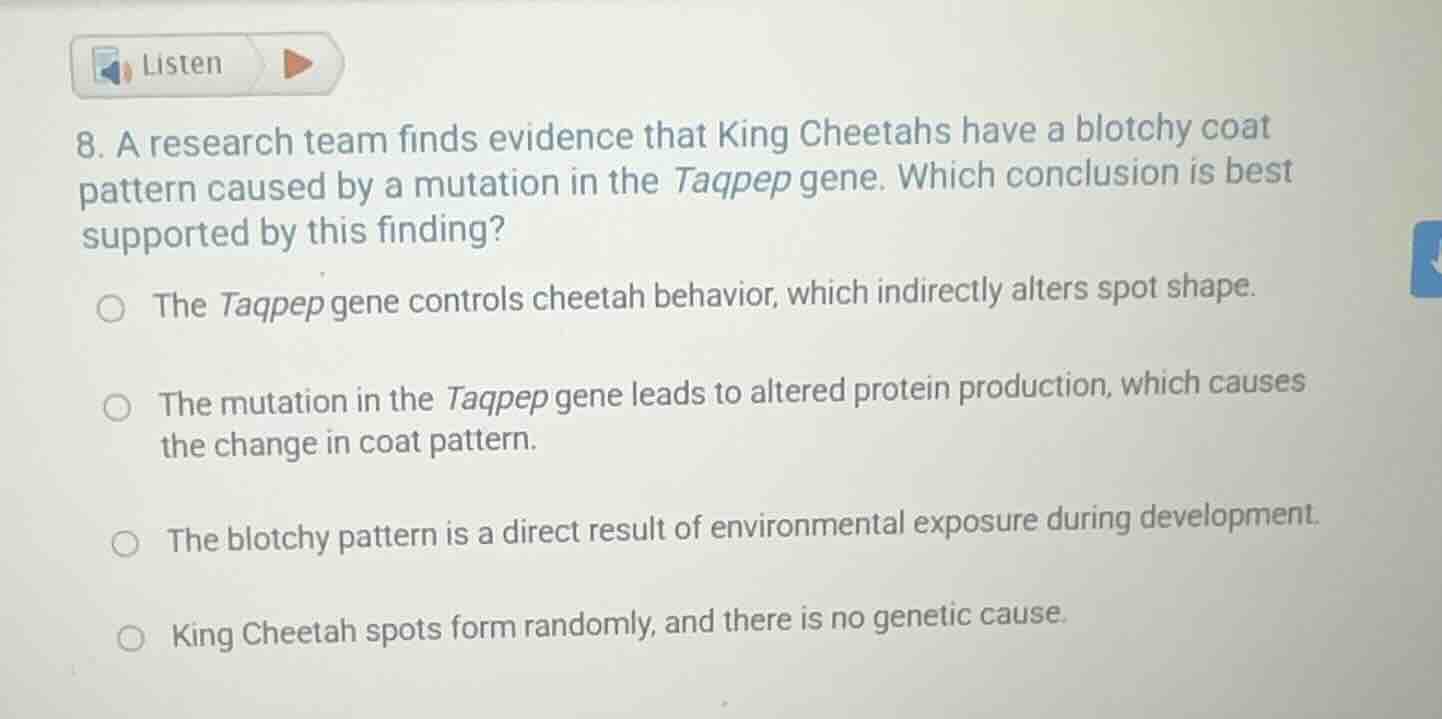
8. a research team finds evidence that king cheetahs have a blotchy coa…

Question

  1. a research team finds evidence that king cheetahs have a blotchy coat pattern caused by a mutation in the taqpep gene. which conclusion is best supported by this finding?
  • the taqpep gene controls cheetah behavior, which indirectly alters spot shape.
  • the mutation in the taqpep gene leads to altered protein production, which causes the change in coat pattern.
  • the blotchy pattern is a direct result of environmental exposure during development.
  • king cheetah spots form randomly, and there is no genetic cause.

Explanation:

Response

<pre_analysis>
{
"quality": "clear",
"question_count": 1,
"skills_matched": [
"direct_cot",
"multiple_choice_formatter",
"explain_then_answer",
"quick"
],
"needs_drawing": false,
"concepts_used": [
"Gene Expression",
"Protein Synthesis",
"Mutation Effects",
"Phenotypic Traits"
],
"new_concepts": [],
"current_concepts": [
"Gene Expression",
"Protein Synthesis",
"Mutation Effects",
"Phenotypic Traits"
]
}
</pre_analysis>

<reasoning>

Analyze the genetic mechanism

A mutation in a gene alters its DNA sequence, which changes the mRNA codon sequence during transcription.

Connect mutation to protein synthesis

The altered mRNA sequence leads to the translation of a modified amino acid sequence, producing an altered protein.

Link protein function to phenotype

The altered protein functions differently during development, resulting in the blotchy coat pattern phenotype.
</reasoning>

<answer>
<mcq-option>The Taqpep gene controls cheetah behavior, which indirectly alters spot shape.</mcq-option>
<mcq-correct>The mutation in the Taqpep gene leads to altered protein production, which causes the change in coat pattern.</mcq-correct>
<mcq-option>The blotchy pattern is a direct result of environmental exposure during development.</mcq-option>
<mcq-option>King Cheetah spots form randomly, and there is no genetic cause.</mcq-option>
</answer>

<post_analysis>
{
"subject": "Natural Science",
"question_type": "Multiple Choice",
"knowledge_point": [
"Natural Science",
"Biology",
"Gene Expression and Protein Synthesis"
]
}
</post_analysis>

Answer:

<pre_analysis>
{
"quality": "clear",
"question_count": 1,
"skills_matched": [
"direct_cot",
"multiple_choice_formatter",
"explain_then_answer",
"quick"
],
"needs_drawing": false,
"concepts_used": [
"Gene Expression",
"Protein Synthesis",
"Mutation Effects",
"Phenotypic Traits"
],
"new_concepts": [],
"current_concepts": [
"Gene Expression",
"Protein Synthesis",
"Mutation Effects",
"Phenotypic Traits"
]
}
</pre_analysis>

<reasoning>

Analyze the genetic mechanism

A mutation in a gene alters its DNA sequence, which changes the mRNA codon sequence during transcription.

Connect mutation to protein synthesis

The altered mRNA sequence leads to the translation of a modified amino acid sequence, producing an altered protein.

Link protein function to phenotype

The altered protein functions differently during development, resulting in the blotchy coat pattern phenotype.
</reasoning>

<answer>
<mcq-option>The Taqpep gene controls cheetah behavior, which indirectly alters spot shape.</mcq-option>
<mcq-correct>The mutation in the Taqpep gene leads to altered protein production, which causes the change in coat pattern.</mcq-correct>
<mcq-option>The blotchy pattern is a direct result of environmental exposure during development.</mcq-option>
<mcq-option>King Cheetah spots form randomly, and there is no genetic cause.</mcq-option>
</answer>

<post_analysis>
{
"subject": "Natural Science",
"question_type": "Multiple Choice",
"knowledge_point": [
"Natural Science",
"Biology",
"Gene Expression and Protein Synthesis"
]
}
</post_analysis>