Sovi.AI - AI Math Tutor

Scan to solve math questions

QUESTION IMAGE

research indicates that dreaming may be responsible for inspiring creat…

Question

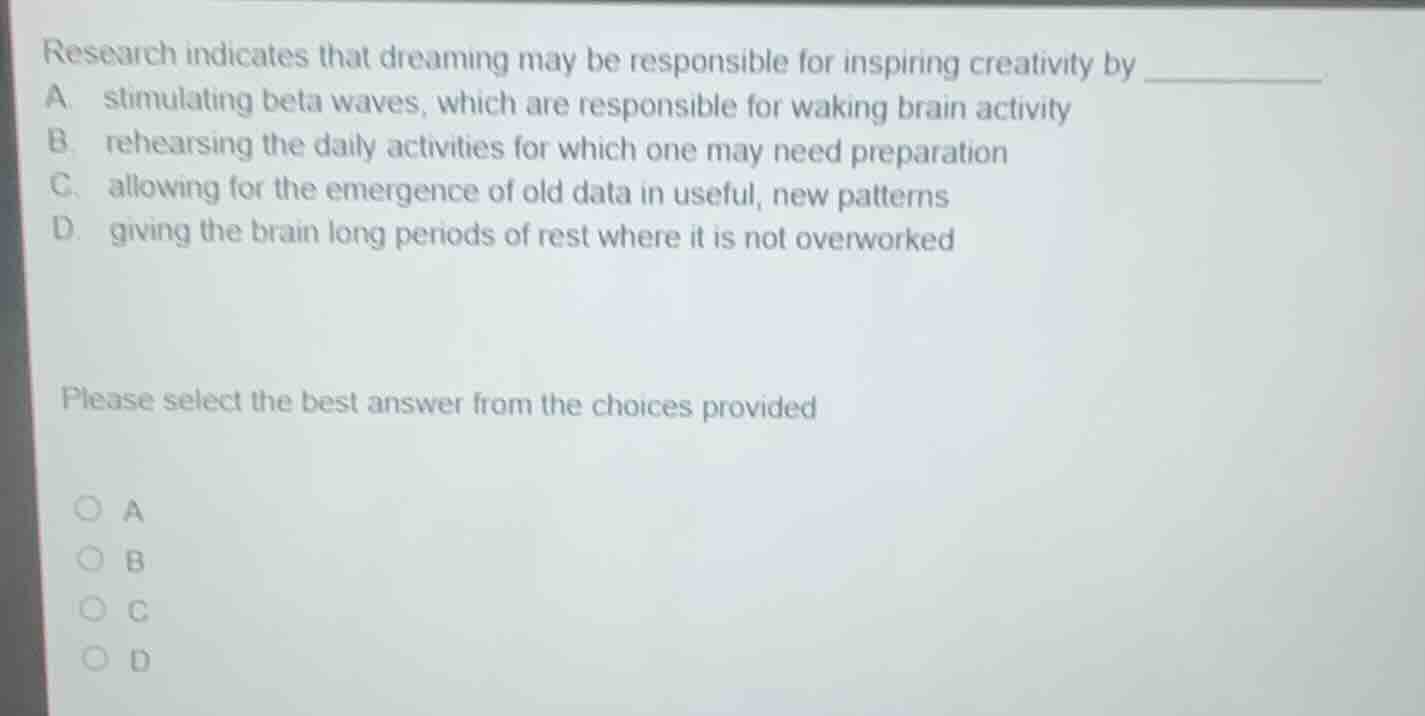
research indicates that dreaming may be responsible for inspiring creativity by _______
a. stimulating beta waves, which are responsible for waking brain activity
b. rehearsing the daily activities for which one may need preparation
c. allowing for the emergence of old data in useful, new patterns
d. giving the brain long periods of rest where it is not overworked

please select the best answer from the choices provided

a
b
c
d

Explanation:

Response

<pre_analysis>
{
"quality": "clear",
"question_count": 1,
"skills_matched": [
"direct_cot",
"multiple_choice_formatter",
"explain_then_answer",
"quick"
],
"needs_drawing": false,
"concepts_used": [
"Theories of Dreaming"
],
"new_concepts": [],
"current_concepts": [
"Theories of Dreaming"
]
}
</pre_analysis>

<reasoning>

Analyze the relationship between dreaming and creativity

Dreaming, particularly during REM sleep, is thought to facilitate creative problem-solving and integration of memory by allowing the brain to reorganize and recombine existing information (old data) into novel, useful associations and patterns.

Evaluate the given options

  • Option A is incorrect because beta waves are associated with alert, active waking states, not the dreaming state.
  • Option B describes the threat-simulation or rehearsal theory of dreaming, which is focused on survival preparation rather than creative inspiration.
  • Option C directly describes the cognitive/information-processing view of dreaming, where the brain synthesizes and integrates memories ("old data") into novel, creative configurations ("useful, new patterns").
  • Option D is incorrect because the dreaming brain (especially during REM) is highly active metabolically and electrically, not resting.

</reasoning>

<answer>
<mcq-option>A. stimulating beta waves, which are responsible for waking brain activity</mcq-option>
<mcq-option>B. rehearsing the daily activities for which one may need preparation</mcq-option>
<mcq-correct>C. allowing for the emergence of old data in useful, new patterns</mcq-correct>
<mcq-option>D. giving the brain long periods of rest where it is not overworked</mcq-option>
</answer>

<post_analysis>
{
"subject": "Natural Science",
"question_type": "Multiple Choice",
"knowledge_point": [
"Natural Science",
"Psychology",
"Theories of Dreaming"
]
}
</post_analysis>

Answer:

<pre_analysis>
{
"quality": "clear",
"question_count": 1,
"skills_matched": [
"direct_cot",
"multiple_choice_formatter",
"explain_then_answer",
"quick"
],
"needs_drawing": false,
"concepts_used": [
"Theories of Dreaming"
],
"new_concepts": [],
"current_concepts": [
"Theories of Dreaming"
]
}
</pre_analysis>

<reasoning>

Analyze the relationship between dreaming and creativity

Dreaming, particularly during REM sleep, is thought to facilitate creative problem-solving and integration of memory by allowing the brain to reorganize and recombine existing information (old data) into novel, useful associations and patterns.

Evaluate the given options

  • Option A is incorrect because beta waves are associated with alert, active waking states, not the dreaming state.
  • Option B describes the threat-simulation or rehearsal theory of dreaming, which is focused on survival preparation rather than creative inspiration.
  • Option C directly describes the cognitive/information-processing view of dreaming, where the brain synthesizes and integrates memories ("old data") into novel, creative configurations ("useful, new patterns").
  • Option D is incorrect because the dreaming brain (especially during REM) is highly active metabolically and electrically, not resting.

</reasoning>

<answer>
<mcq-option>A. stimulating beta waves, which are responsible for waking brain activity</mcq-option>
<mcq-option>B. rehearsing the daily activities for which one may need preparation</mcq-option>
<mcq-correct>C. allowing for the emergence of old data in useful, new patterns</mcq-correct>
<mcq-option>D. giving the brain long periods of rest where it is not overworked</mcq-option>
</answer>

<post_analysis>
{
"subject": "Natural Science",
"question_type": "Multiple Choice",
"knowledge_point": [
"Natural Science",
"Psychology",
"Theories of Dreaming"
]
}
</post_analysis>