QUESTION IMAGE
Question
republic of cameroon
peace - work - fatherland
the university of bamenda
higher technical teachers training college bamenda
directorate of studies
p.o. box 39 bambili
republique du cameroun
paix - travail - patrie
universite de bamenda
ecole normale superieure denseignement technique
direction des etudes
tel 33 05 10 69
school: h.t.t.t.c
department: ceft
lecture(s): dr. kouamou nguessia.
course code: ceft2222
course title: material and fluid mechanics
option: bpw, 200
date:
hall:
time: 1hr 30min
nature: 2^{nd} semester exam
instructions: ...answer all the questions...
exercise 1 (8marks)
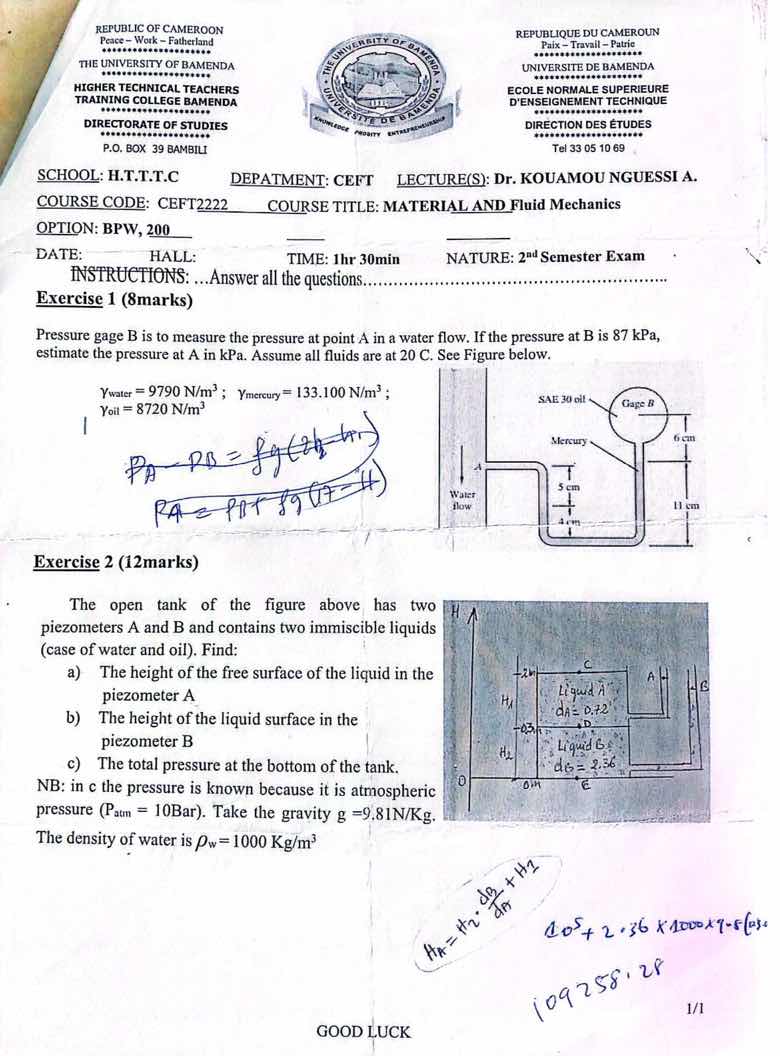
pressure gage b is to measure the pressure at point a in a water flow. if the pressure at b is \\(87\text{ kpa}\\), estimate the pressure at a in \\(\text{ kpa}\\). assume all fluids are at \\(20^{\circ}\text{c}\\). see figure below.
\\(\gamma_{\text{water}} = 9790\text{ n/m}^3\\); \\(\gamma_{\text{mercury}} = 133,100\text{ n/m}^3\\);
\\(\gamma_{\text{oil}} = 8720\text{ n/m}^3\\)
exercise 2 (12marks)
the open tank of the figure above has two piezometers a and b and contains two immiscible liquids (case of water and oil). find:
a) the height of the free surface of the liquid in the piezometer a
b) the height of the liquid surface in the piezometer b
c) the total pressure at the bottom of the tank.
nb: in c the pressure is known because it is atmospheric pressure (\\(p_{\text{atm}} = 10\text{bar}\\)). take the gravity \\(g = 9.81\text{ n/kg}\\).
the density of water is \\(\
ho_{\text{w}} = 1000\text{ kg/m}^3\\)
good luck
🆕 New Concept Discovered: Manometry
Using hydrostatic pressure changes across fluid interfaces to find unknown pressures.
Step 1: Identify given values and convert units
Identify the specific weights (\(\gamma\)) of the fluids and the geometric heights from the diagram, converting all dimensions from centimeters to meters:
- \(\gamma_{\text{water}} = 9790\text{ N/m}^3\)
- \(\gamma_{\text{mercury}} = 133,100\text{ N/m}^3\) (noting the French notation \(133.100\) on the paper represents \(133,100\))
- \(\gamma_{\text{oil}} = 8720\text{ N/m}^3\)
- Pressure at gage B: \(p_B = 87\text{ kPa} = 87,000\text{ Pa}\)
Heights of the fluid columns:
- Height difference from point A to the water-mercury interface:
- Height of the mercury column (from the bottom bend to the mercury-oil interface):
- Height of the oil column (from the mercury-oil interface up to the center of gage B):
Step 2: Set up the hydrostatic manometer equation
Start at point A and write the pressure balance equation by moving through the tube to gage B:
- As we go down in a fluid, pressure increases: \(+ \gamma \cdot h\)
- As we go up in a fluid, pressure decreases: \(- \gamma \cdot h\)
Starting at \(p_A\):
- Move down through the water column of height \(h_1 = 0.09\text{ m}\) to the bottom of the U-tube:
- Move up through the mercury column of height \(h_2 = 0.07\text{ m}\) to the mercury-oil interface:
- Move up through the oil column of height \(h_3 = 0.06\text{ m}\) to the center of gage B:
Step 3: Solve for the pressure at point A (\(p_A\))
Rearrange the equation to isolate \(p_A\):
Substitute the numerical values:
Calculate each term:
- Water term: \(9790 \cdot 0.09 = 881.1\text{ Pa}\)
- Mercury term: \(133,100 \cdot 0.07 = 9317\text{ Pa}\)
- Oil term: \(8720 \cdot 0.06 = 523.2\text{ Pa}\)
Combine the values:
Convert the final pressure back to kilopascals (kPa):

Snap & solve any problem in the app
Get step-by-step solutions on Sovi AI
Photo-based solutions with guided steps
Explore more problems and detailed explanations
The estimated pressure at point A is 95.96 kPa (or 96.0 kPa).