QUESTION IMAGE
Question
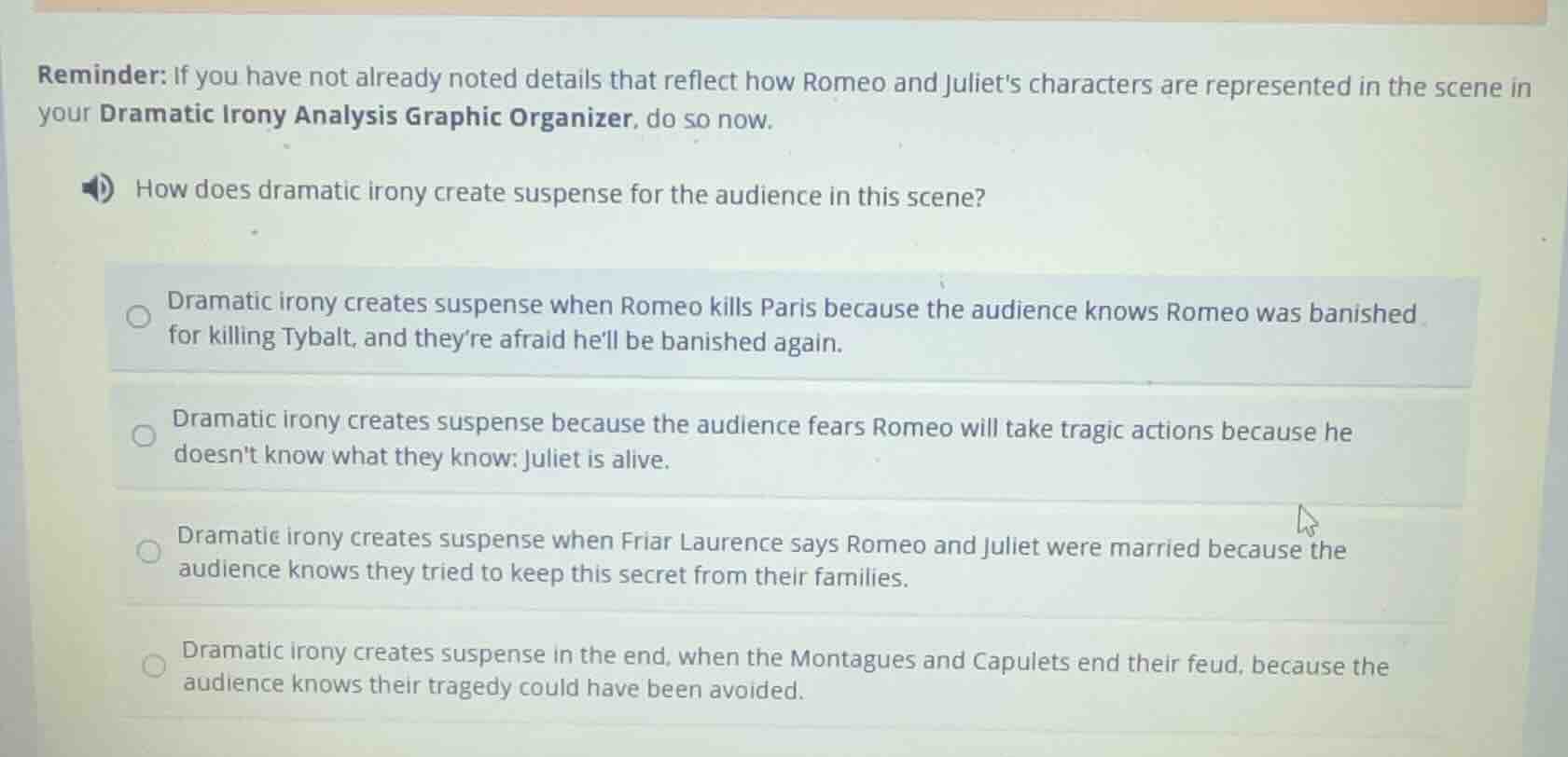
reminder: if you have not already noted details that reflect how romeo and juliets characters are represented in the scene in your dramatic irony analysis graphic organizer, do so now.
how does dramatic irony create suspense for the audience in this scene?
dramatic irony creates suspense when romeo kills paris because the audience knows romeo was banished for killing tybalt, and theyre afraid hell be banished again.
dramatic irony creates suspense because the audience fears romeo will take tragic actions because he doesnt know what they know: juliet is alive.
dramatic irony creates suspense when friar laurence says romeo and juliet were married because the audience knows they tried to keep this secret from their families.
dramatic irony creates suspense in the end, when the montagues and capulets end their feud, because the audience knows their tragedy could have been avoided.
Define dramatic irony in the context of the scene
Dramatic irony occurs when the audience knows key information that a character on stage does not know. In Act 5, Scene 3 of Romeo and Juliet, the audience knows Juliet is merely asleep under the influence of Friar Laurence's potion, but Romeo believes she is truly dead.
Analyze the source of suspense
The suspense arises because the audience is aware of Juliet's actual state (alive) while watching Romeo prepare to take his own life out of grief. This gap in knowledge makes the audience fear the tragic, irreversible actions Romeo is about to commit.
Evaluate the given options
- Option 1 is incorrect because Romeo cannot be banished again if he is dead, and the primary suspense is about his survival, not banishment.
- Option 2 correctly identifies that the audience knows Juliet is alive while Romeo does not, which creates the tragic suspense.
- Option 3 describes a past secret rather than the immediate, high-stakes suspense of the final scene.
- Option 4 describes the resolution of the play, which occurs after the tragic climax, rather than the building of suspense during the scene.

Snap & solve any problem in the app
Get step-by-step solutions on Sovi AI
Photo-based solutions with guided steps
Explore more problems and detailed explanations
- Dramatic irony creates suspense when Romeo kills Paris because the audience knows Romeo was banished for killing Tybalt, and they're afraid he'll be banished again.
- Dramatic irony creates suspense because the audience fears Romeo will take tragic actions because he doesn't know what they know: Juliet is alive. (Correct answer)
- Dramatic irony creates suspense when Friar Laurence says Romeo and Juliet were married because the audience knows they tried to keep this secret from their families.
- Dramatic irony creates suspense in the end, when the Montagues and Capulets end their feud, because the audience knows their tragedy could have been avoided.