QUESTION IMAGE
Question
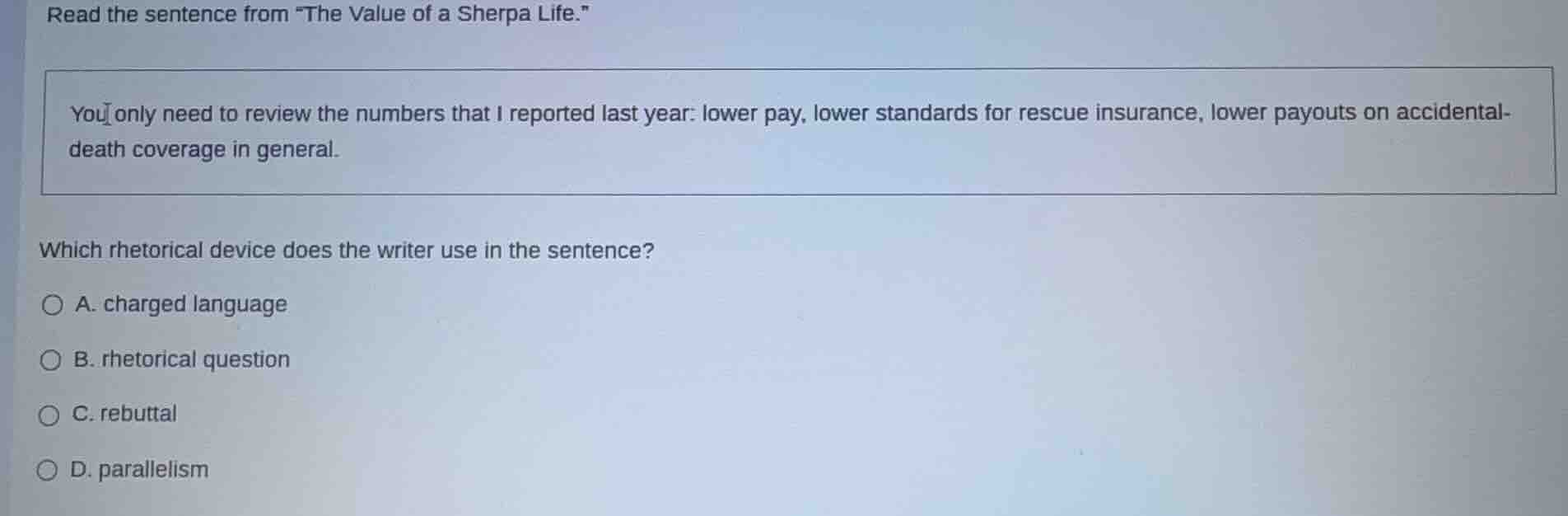
read the sentence from \the value of a sherpa life.\
you only need to review the numbers that i reported last year: lower pay, lower standards for rescue insurance, lower payouts on accidental-death coverage in general.
which rhetorical device does the writer use in the sentence?
a. charged language
b. rhetorical question
c. rebuttal
d. parallelism
<pre_analysis>
{
"quality": "clear",
"question_count": 1,
"skills_matched": [
"direct_cot",
"multiple_choice_formatter",
"explain_then_answer",
"tutor",
"mastery_adaptive_brevity"
],
"needs_drawing": false,
"concepts_used": [
"Rhetorical Devices",
"Parallelism"
],
"new_concepts": [],
"current_concepts": [
"Rhetorical Devices",
"Parallelism",
"Sherpa Life Analysis"
]
}
</pre_analysis>
<reasoning>
Analyze the sentence structure
Using the Parallelism and Rhetorical Devices knowledge points
The sentence contains a list of three items following a colon:
- "lower pay"
- "lower standards for rescue insurance"
- "lower payouts on accidental-death coverage in general"
Each item in this list begins with the comparative adjective "lower" followed by a noun phrase. This repetition of a grammatical structure is a classic example of parallelism.
Evaluate the answer choices
Using the Rhetorical Devices knowledge point
- A. charged language: While the sentence discusses disparities, the phrasing itself is factual and structured rather than relying on highly emotional or loaded words.
- B. rhetorical question: The sentence is a statement, not a question.
- C. rebuttal: The sentence presents evidence/numbers rather than directly refuting a specific counterargument in this line.
- D. parallelism: The grammatical repetition of "lower [noun phrase]" directly defines parallelism.
</reasoning>
<answer>
<mcq-option>(A) charged language</mcq-option>
<mcq-option>(B) rhetorical question</mcq-option>
<mcq-option>(C) rebuttal</mcq-option>
<mcq-correct>(D) parallelism</mcq-correct>
</answer>
<post_analysis>
{
"subject": "Others",
"question_type": "Multiple Choice",
"knowledge_point": [
"Others",
"English Language Arts",
"Rhetorical Devices"
]
}
</post_analysis>
Snap & solve any problem in the app
Get step-by-step solutions on Sovi AI
Photo-based solutions with guided steps
Explore more problems and detailed explanations
<pre_analysis>
{
"quality": "clear",
"question_count": 1,
"skills_matched": [
"direct_cot",
"multiple_choice_formatter",
"explain_then_answer",
"tutor",
"mastery_adaptive_brevity"
],
"needs_drawing": false,
"concepts_used": [
"Rhetorical Devices",
"Parallelism"
],
"new_concepts": [],
"current_concepts": [
"Rhetorical Devices",
"Parallelism",
"Sherpa Life Analysis"
]
}
</pre_analysis>
<reasoning>
Analyze the sentence structure
Using the Parallelism and Rhetorical Devices knowledge points
The sentence contains a list of three items following a colon:
- "lower pay"
- "lower standards for rescue insurance"
- "lower payouts on accidental-death coverage in general"
Each item in this list begins with the comparative adjective "lower" followed by a noun phrase. This repetition of a grammatical structure is a classic example of parallelism.
Evaluate the answer choices
Using the Rhetorical Devices knowledge point
- A. charged language: While the sentence discusses disparities, the phrasing itself is factual and structured rather than relying on highly emotional or loaded words.
- B. rhetorical question: The sentence is a statement, not a question.
- C. rebuttal: The sentence presents evidence/numbers rather than directly refuting a specific counterargument in this line.
- D. parallelism: The grammatical repetition of "lower [noun phrase]" directly defines parallelism.
</reasoning>
<answer>
<mcq-option>(A) charged language</mcq-option>
<mcq-option>(B) rhetorical question</mcq-option>
<mcq-option>(C) rebuttal</mcq-option>
<mcq-correct>(D) parallelism</mcq-correct>
</answer>
<post_analysis>
{
"subject": "Others",
"question_type": "Multiple Choice",
"knowledge_point": [
"Others",
"English Language Arts",
"Rhetorical Devices"
]
}
</post_analysis>