QUESTION IMAGE
Question
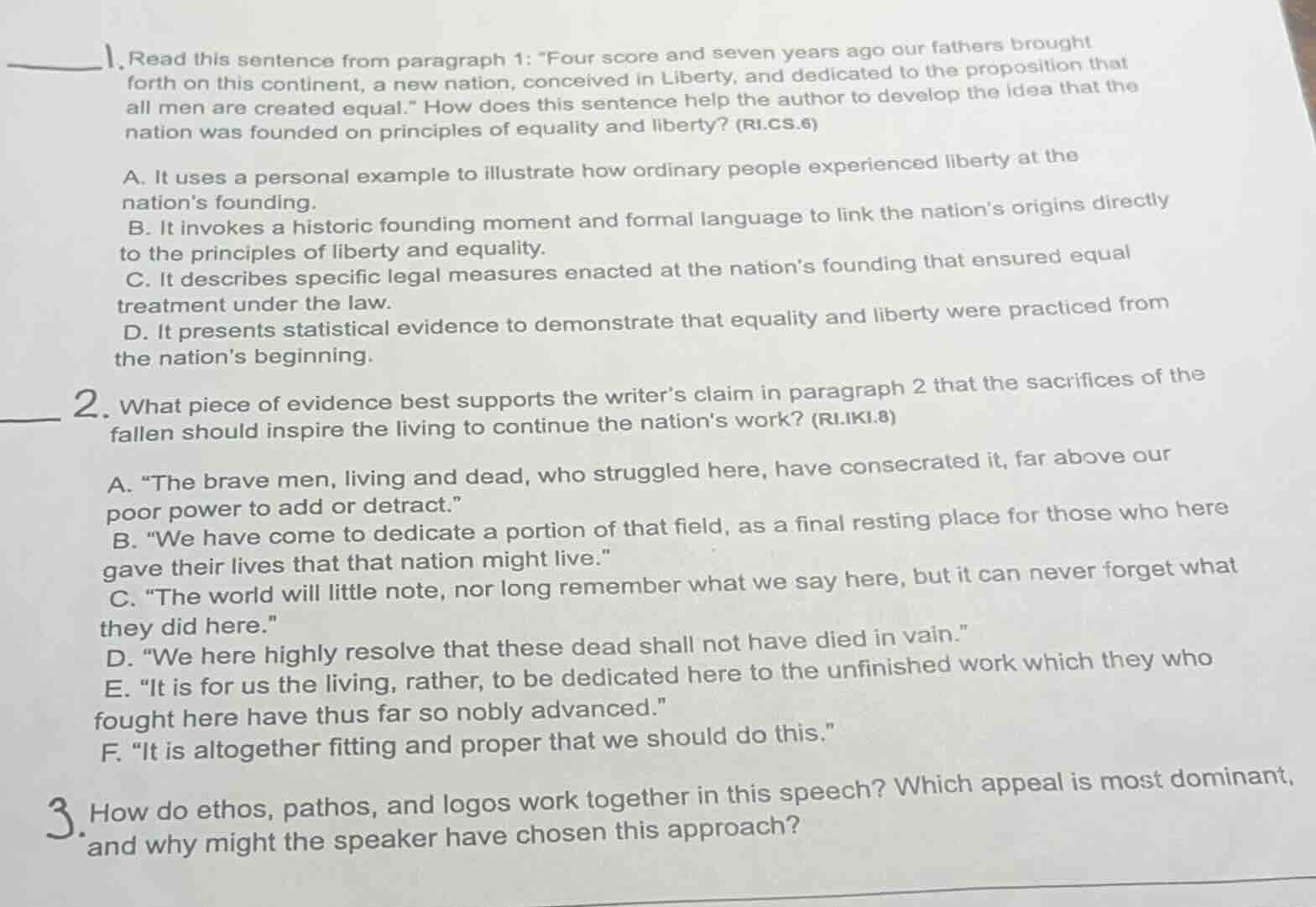
- read this sentence from paragraph 1: \four score and seven years ago our fathers brought forth on this continent, a new nation, conceived in liberty, and dedicated to the proposition that all men are created equal.\ how does this sentence help the author to develop the idea that the nation was founded on principles of equality and liberty? (ri.cs.6)
a. it uses a personal example to illustrate how ordinary people experienced liberty at the nation’s founding.
b. it invokes a historic founding moment and formal language to link the nation’s origins directly to the principles of liberty and equality.
c. it describes specific legal measures enacted at the nation’s founding that ensured equal treatment under the law.
d. it presents statistical evidence to demonstrate that equality and liberty were practiced from the nation’s beginning.
- what piece of evidence best supports the writer’s claim in paragraph 2 that the sacrifices of the fallen should inspire the living to continue the nation’s work? (ri.iki.8)
a. \the brave men, living and dead, who struggled here, have consecrated it, far above our poor power to add or detract.\
b. \we have come to dedicate a portion of that field, as a final resting place for those who here gave their lives that that nation might live.\
c. \the world will little note, nor long remember what we say here, but it can never forget what they did here.\
d. \we here highly resolve that these dead shall not have died in vain.\
e. \it is for us the living, rather, to be dedicated here to the unfinished work which they who fought here have thus far so nobly advanced.\
f. \it is altogether fitting and proper that we should do this.\
- how do ethos, pathos, and logos work together in this speech? which appeal is most dominant, and why might the speaker have chosen this approach?
Question 1
- Option A: The sentence doesn't use a personal example of ordinary people, so A is wrong.
- Option B: "Four score and seven years ago" invokes the nation's founding moment, and "conceived in Liberty... all men are created equal" uses formal language to link origins to liberty and equality. This matches.
- Option C: The sentence doesn't describe legal measures, so C is wrong.
- Option D: There's no statistical evidence, so D is wrong.
- Option A: Talks about consecration, not inspiring the living, so A is wrong.
- Option B: Is about dedicating a field, not inspiring, so B is wrong.
- Option C: Compares what's said and done, not inspiring the living, so C is wrong.
- Option D: Says the dead won't have died in vain, but doesn't directly link to the living continuing work, so D is wrong.
- Option E: States the living should be dedicated to the unfinished work the fallen advanced, which supports the claim.
- Option F: Is about the appropriateness of dedication, not inspiring the living, so F is wrong.
- Ethos: The speaker (Lincoln) establishes credibility by referencing the nation’s founding principles and the sacrifices of the fallen, aligning with the nation’s values.
- Pathos: Appeals to emotion by highlighting the sacrifices of soldiers (“the brave men, living and dead”) and the idea of not letting their deaths be in vain, evoking feelings of patriotism and duty.
- Logos: Uses logical connections, like linking the nation’s founding principles (equality, liberty) to the current task of preserving the nation, and the idea that the living must continue the work the fallen started (if the fallen’s sacrifice was for the nation, the living should fulfill that purpose).
- Dominant Appeal: Pathos is most dominant. The focus on the soldiers’ sacrifices, the emotional call to honor them by continuing their work, and the vivid imagery of their struggle and consecration of the battlefield rely heavily on evoking emotion to persuade the audience. The speaker likely chose this to rally the audience’s hearts, as the Civil War context needed emotional connection to inspire unity and dedication.

Snap & solve any problem in the app
Get step-by-step solutions on Sovi AI
Photo-based solutions with guided steps
Explore more problems and detailed explanations
B. It invokes a historic founding moment and formal language to link the nation’s origins directly to the principles of liberty and equality.