QUESTION IMAGE
Question
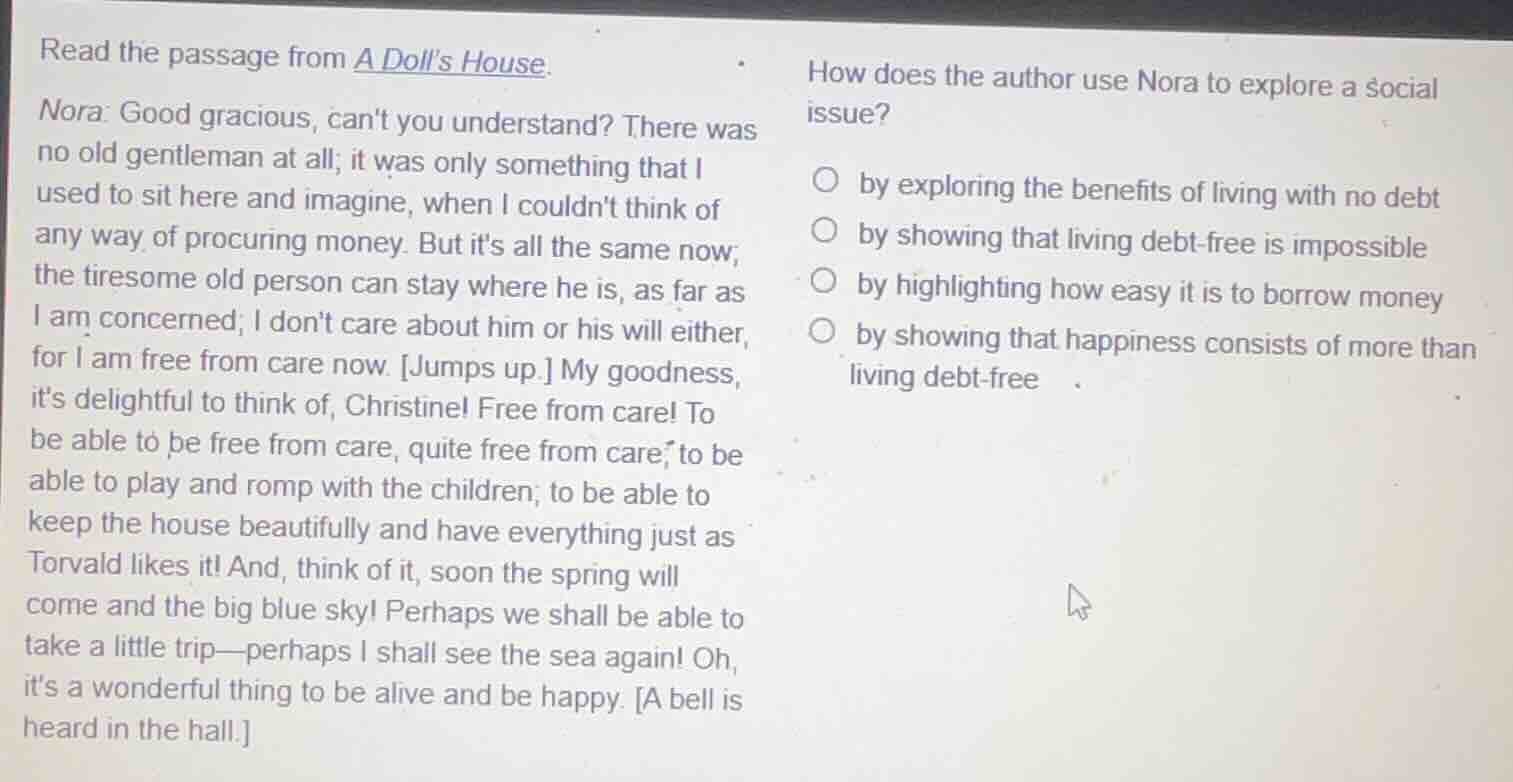
read the passage from a dolls house.
nora: good gracious, cant you understand? there was no old gentleman at all; it was only something that i used to sit here and imagine, when i couldnt think of any way of procuring money. but its all the same now; the tiresome old person can stay where he is, as far as i am concerned; i dont care about him or his will either, for i am free from care now. jumps up. my goodness, its delightful to think of, christinel free from care! to be able to be free from care, quite free from care; to be able to play and romp with the children; to be able to keep the house beautifully and have everything just as torvald likes it! and, think of it, soon the spring will come and the big blue sky! perhaps we shall be able to take a little trip—perhaps i shall see the sea again! oh, its a wonderful thing to be alive and be happy. a bell is heard in the hall.
how does the author use nora to explore a social issue?
○ by exploring the benefits of living with no debt
○ by showing that living debt - free is impossible
○ by highlighting how easy it is to borrow money
○ by showing that happiness consists of more than living debt - free
In this passage from A Doll's House, Nora expresses profound joy after being free from debt-related worries. Her happiness comes not just from being debt-free, but from the ability to engage in meaningful, joyful activities: playing with her children, caring for her home as her husband likes, and looking forward to future trips and simple pleasures. This shows that her contentment extends beyond just being out of debt, highlighting that true happiness includes emotional and personal fulfillment beyond financial freedom. The other options are incorrect: she does not focus on benefits of no debt in isolation, does not claim debt-free living is impossible, nor does she emphasize ease of borrowing.

Snap & solve any problem in the app
Get step-by-step solutions on Sovi AI
Photo-based solutions with guided steps
Explore more problems and detailed explanations
by showing that happiness consists of more than living debt-free