QUESTION IMAGE
Question
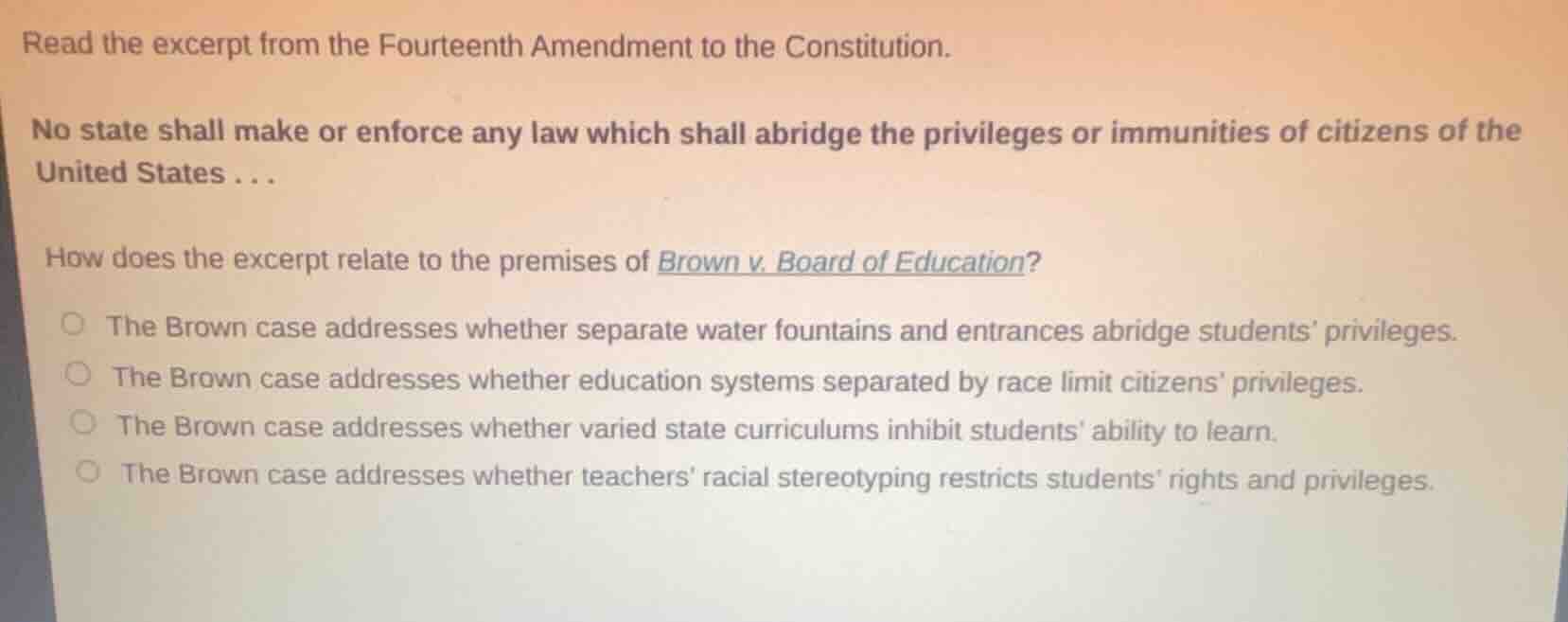
read the excerpt from the fourteenth amendment to the constitution.
no state shall make or enforce any law which shall abridge the privileges or immunities of citizens of the united states...
how does the excerpt relate to the premises of brown v. board of education?
- the brown case addresses whether separate water fountains and entrances abridge students privileges.
- the brown case addresses whether education systems separated by race limit citizens privileges.
- the brown case addresses whether varied state curriculums inhibit students ability to learn.
- the brown case addresses whether teachers racial stereotyping restricts students rights and privileges.
Analyze the constitutional excerpt
Using the Constitutional Law knowledge point
The excerpt is from Section 1 of the Fourteenth Amendment: "No state shall make or enforce any law which shall abridge the privileges or immunities of citizens of the United States..." This clause restricts states from denying citizens their fundamental rights and privileges.
Connect the excerpt to the Brown case
Using the Brown v. Board of Education knowledge point
Brown v. Board of Education challenged state-mandated racial segregation in public schools. The core legal question was whether state-enforced segregation in education abridged the rights and privileges of Black students, violating the Fourteenth Amendment.
Evaluate the answer choices
- Option 1 focuses on water fountains and entrances, which is too narrow and does not represent the primary premise of the school-focused Brown case.
- Option 2 directly links state-segregated education systems to the limitation of citizens' privileges, matching the excerpt's focus on state laws abridging privileges.
- Option 3 focuses on varied state curriculums, which was not the central issue of racial segregation in Brown.
- Option 4 focuses on individual teachers' racial stereotyping rather than state-enforced laws and systems.

Snap & solve any problem in the app
Get step-by-step solutions on Sovi AI
Photo-based solutions with guided steps
Explore more problems and detailed explanations
- (A) The Brown case addresses whether separate water fountains and entrances abridge students' privileges.
- (B) The Brown case addresses whether education systems separated by race limit citizens' privileges. (Correct answer)
- (C) The Brown case addresses whether varied state curriculums inhibit students' ability to learn.
- (D) The Brown case addresses whether teachers' racial stereotyping restricts students' rights and privileges.