QUESTION IMAGE
Question
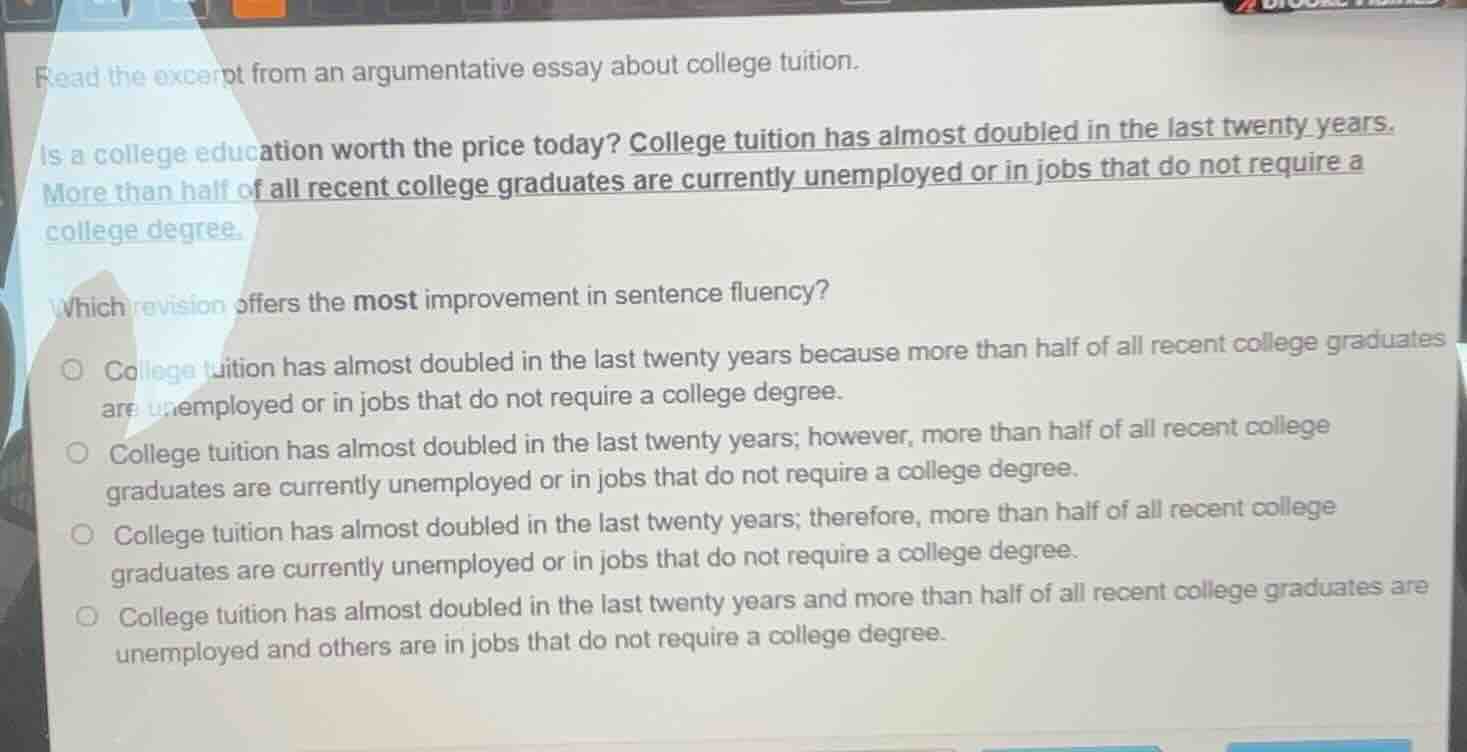
read the excerpt from an argumentative essay about college tuition.
is a college education worth the price today? college tuition has almost doubled in the last twenty years. more than half of all recent college graduates are currently unemployed or in jobs that do not require a college degree.
which revision offers the most improvement in sentence fluency?
- college tuition has almost doubled in the last twenty years because more than half of all recent college graduates are unemployed or in jobs that do not require a college degree.
- college tuition has almost doubled in the last twenty years; however, more than half of all recent college graduates are currently unemployed or in jobs that do not require a college degree.
- college tuition has almost doubled in the last twenty years; therefore, more than half of all recent college graduates are currently unemployed or in jobs that do not require a college degree.
- college tuition has almost doubled in the last twenty years and more than half of all recent college graduates are unemployed and others are in jobs that do not require a college degree.
<pre_analysis>
{
"quality": "clear",
"question_count": 1,
"skills_matched": [
"direct_cot",
"multiple_choice_formatter",
"explain_then_answer",
"tutor"
],
"needs_drawing": false,
"concepts_used": [
"Argumentative Writing"
],
"new_concepts": [
"Sentence Fluency",
"Conjunctive Adverbs"
],
"current_concepts": [
"Argumentative Writing",
"Sentence Fluency",
"Conjunctive Adverbs"
]
}
</pre_analysis>
<reasoning>
Analyze the original sentences
The original text contains two independent clauses:
- "College tuition has almost doubled in the last twenty years."
- "More than half of all recent college graduates are currently unemployed or in jobs that do not require a college degree."
Both sentences present facts that support the introductory question: "Is a college education worth the price today?"
Evaluate the relationship between the clauses
The first clause discusses the rising cost of college (tuition doubling). The second clause discusses the poor job outcomes for graduates. These two points are complementary pieces of evidence showing why a college education might not be worth the price. They do not have a direct cause-and-effect relationship, but rather present parallel, compounding arguments.
Assess the revision options
- Option 1 (because): Suggests a cause-and-effect relationship (tuition doubled because graduates are unemployed). This is logically incorrect.
- Option 2 (however): Suggests a contrast. However, rising tuition and high unemployment are both negative aspects of the college value proposition; they do not contrast each other.
- Option 3 (therefore): Suggests a cause-and-effect relationship (tuition doubled; therefore, graduates are unemployed). This is logically incorrect.
- Option 4 (and): Connects the two parallel facts smoothly using a coordinating conjunction, which improves Argumentative Writing flow and sentence fluency without creating an incorrect logical relationship.
Select the best revision
Option 4 correctly uses "and" to join these two related, supporting facts, creating a balanced and fluent compound sentence.
</reasoning>
<answer>
<mcq-option>(A) College tuition has almost doubled in the last twenty years because more than half of all recent college graduates are unemployed or in jobs that do not require a college degree.</mcq-option>
<mcq-option>(B) College tuition has almost doubled in the last twenty years; however, more than half of all recent college graduates are currently unemployed or in jobs that do not require a college degree.</mcq-option>
<mcq-option>(C) College tuition has almost doubled in the last twenty years; therefore, more than half of all recent college graduates are currently unemployed or in jobs that do not require a college degree.</mcq-option>
<mcq-correct>(D) College tuition has almost doubled in the last twenty years and more than half of all recent college graduates are unemployed and others are in jobs that do not require a college degree.</mcq-correct>
</answer>
<post_analysis>
{
"subject": "Others",
"question_type": "Multiple Choice",
"knowledge_point": [
"Others",
"English Language Arts",
"Sentence Fluency and Cohesion"
]
}
</post_analysis>
Snap & solve any problem in the app
Get step-by-step solutions on Sovi AI
Photo-based solutions with guided steps
Explore more problems and detailed explanations
<pre_analysis>
{
"quality": "clear",
"question_count": 1,
"skills_matched": [
"direct_cot",
"multiple_choice_formatter",
"explain_then_answer",
"tutor"
],
"needs_drawing": false,
"concepts_used": [
"Argumentative Writing"
],
"new_concepts": [
"Sentence Fluency",
"Conjunctive Adverbs"
],
"current_concepts": [
"Argumentative Writing",
"Sentence Fluency",
"Conjunctive Adverbs"
]
}
</pre_analysis>
<reasoning>
Analyze the original sentences
The original text contains two independent clauses:
- "College tuition has almost doubled in the last twenty years."
- "More than half of all recent college graduates are currently unemployed or in jobs that do not require a college degree."
Both sentences present facts that support the introductory question: "Is a college education worth the price today?"
Evaluate the relationship between the clauses
The first clause discusses the rising cost of college (tuition doubling). The second clause discusses the poor job outcomes for graduates. These two points are complementary pieces of evidence showing why a college education might not be worth the price. They do not have a direct cause-and-effect relationship, but rather present parallel, compounding arguments.
Assess the revision options
- Option 1 (because): Suggests a cause-and-effect relationship (tuition doubled because graduates are unemployed). This is logically incorrect.
- Option 2 (however): Suggests a contrast. However, rising tuition and high unemployment are both negative aspects of the college value proposition; they do not contrast each other.
- Option 3 (therefore): Suggests a cause-and-effect relationship (tuition doubled; therefore, graduates are unemployed). This is logically incorrect.
- Option 4 (and): Connects the two parallel facts smoothly using a coordinating conjunction, which improves Argumentative Writing flow and sentence fluency without creating an incorrect logical relationship.
Select the best revision
Option 4 correctly uses "and" to join these two related, supporting facts, creating a balanced and fluent compound sentence.
</reasoning>
<answer>
<mcq-option>(A) College tuition has almost doubled in the last twenty years because more than half of all recent college graduates are unemployed or in jobs that do not require a college degree.</mcq-option>
<mcq-option>(B) College tuition has almost doubled in the last twenty years; however, more than half of all recent college graduates are currently unemployed or in jobs that do not require a college degree.</mcq-option>
<mcq-option>(C) College tuition has almost doubled in the last twenty years; therefore, more than half of all recent college graduates are currently unemployed or in jobs that do not require a college degree.</mcq-option>
<mcq-correct>(D) College tuition has almost doubled in the last twenty years and more than half of all recent college graduates are unemployed and others are in jobs that do not require a college degree.</mcq-correct>
</answer>
<post_analysis>
{
"subject": "Others",
"question_type": "Multiple Choice",
"knowledge_point": [
"Others",
"English Language Arts",
"Sentence Fluency and Cohesion"
]
}
</post_analysis>