QUESTION IMAGE
Question
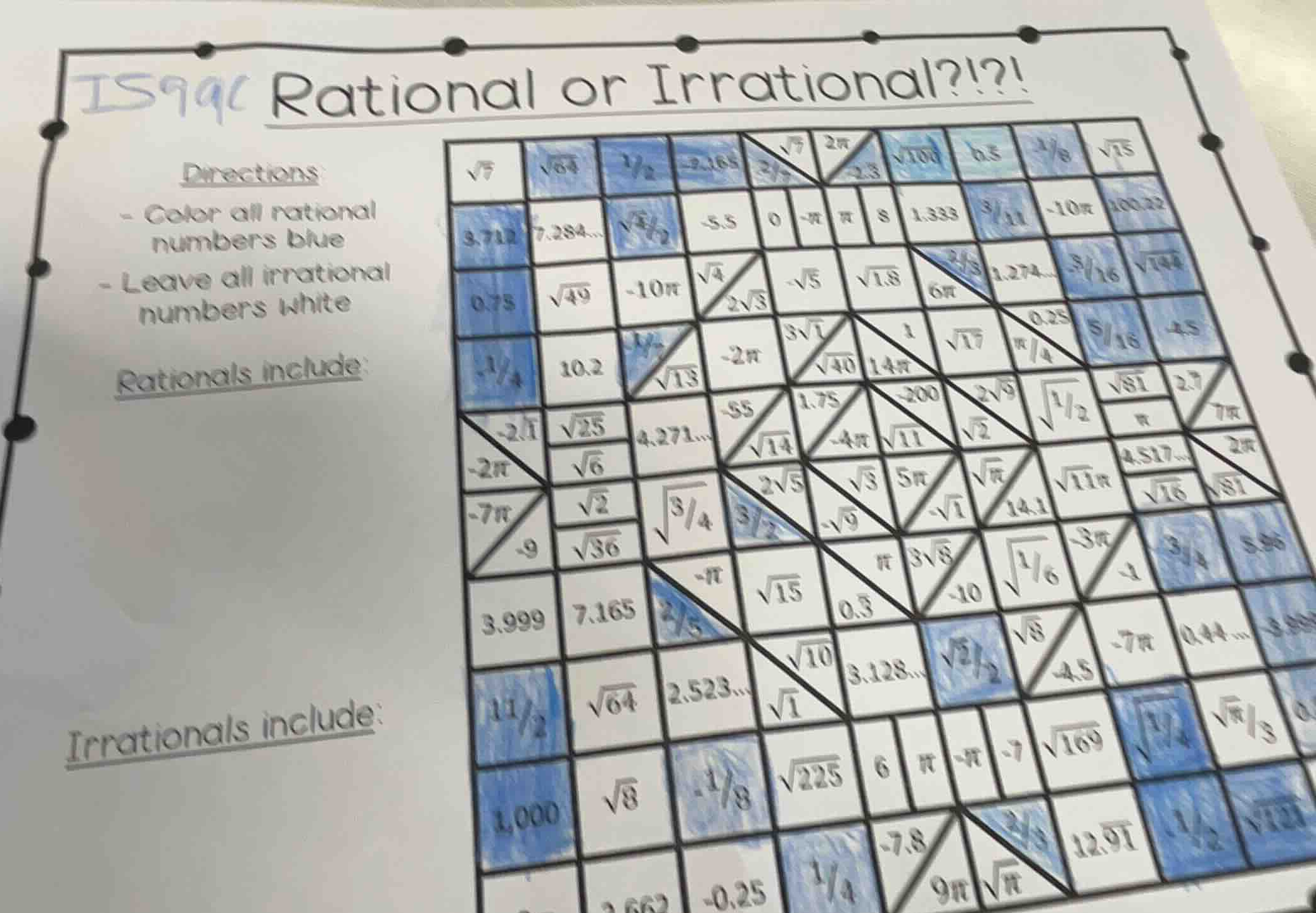
rational or irrational?!?!
directions:
- color all rational numbers blue
- leave all irrational numbers white
rationals include:
irrationals include:
🆕 New Concept Discovered: Rational vs. Irrational Numbers
Rational numbers can be written as fractions; irrational numbers cannot.
Step 1: Understand the Definitions
- Rational Numbers: Any number that can be written as a simple fraction \( \frac{a}{b} \) where \( a \) and \( b \) are integers, and \( b
eq 0 \). This includes:
- Integers (e.g., \( -10, 0, 6 \))
- Fractions (e.g., \( \frac{1}{2}, \frac{3}{11} \))
- Terminating decimals (e.g., \( 0.75, -5.5 \))
- Repeating decimals (e.g., \( 1.333..., 12.\overline{91} \))
- Perfect square roots (e.g., \( \sqrt{64} = 8, \sqrt{49} = 7 \))
- Irrational Numbers: Numbers that cannot be written as simple fractions. Their decimal representations go on forever without repeating. This includes:
- Non-perfect square roots (e.g., \( \sqrt{7}, \sqrt{8}, \sqrt{15} \))
- Numbers containing \( \pi \) (e.g., \( \pi, -10\pi, 2\pi \))
- Non-terminating, non-repeating decimals (e.g., \( 7.284... \))
---
Step 2: Analyze the Colored (Blue) Squares
Let's check if the colored squares in the image are correctly identified as Rational (should be blue) or if there are any mistakes:
- \( \sqrt{64} \): Since \( \sqrt{64} = 8 \) (an integer), it is Rational. (Correctly colored blue)
- \( \frac{1}{2} \): A simple fraction, so it is Rational. (Correctly colored blue)
- \( 0.75 \): A terminating decimal, so it is Rational. (Correctly colored blue)
- \( \frac{1}{4} \): A simple fraction, so it is Rational. (Correctly colored blue)
- \( \frac{3}{11} \): A simple fraction, so it is Rational. (Correctly colored blue)
- \( 1,000 \): An integer, so it is Rational. (Correctly colored blue)
---
Step 3: Analyze the Uncolored (White) Squares
Let's check if the uncolored squares are correctly identified as Irrational (should be white):
- \( \sqrt{7} \): \( 7 \) is not a perfect square, so its root is Irrational. (Correctly left white)
- \( 7.284... \): The ellipsis (\( ... \)) without a bar indicates a non-terminating, non-repeating decimal, which is Irrational. (Correctly left white)
- \( -10\pi \): Any non-zero multiple of \( \pi \) is Irrational. (Correctly left white)
- \( \sqrt{8} \): \( 8 \) is not a perfect square, so its root is Irrational. (Correctly left white)
---

Snap & solve any problem in the app
Get step-by-step solutions on Sovi AI
Photo-based solutions with guided steps
Explore more problems and detailed explanations
The coloring on the worksheet is correct:
- Blue squares represent Rational numbers (such as integers, terminating decimals, fractions, and perfect square roots like \( \sqrt{64} \)).
- White squares represent Irrational numbers (such as non-perfect square roots like \( \sqrt{7} \), non-repeating infinite decimals like \( 7.284... \), and terms containing \( \pi \)).