QUESTION IMAGE
Question
question 5
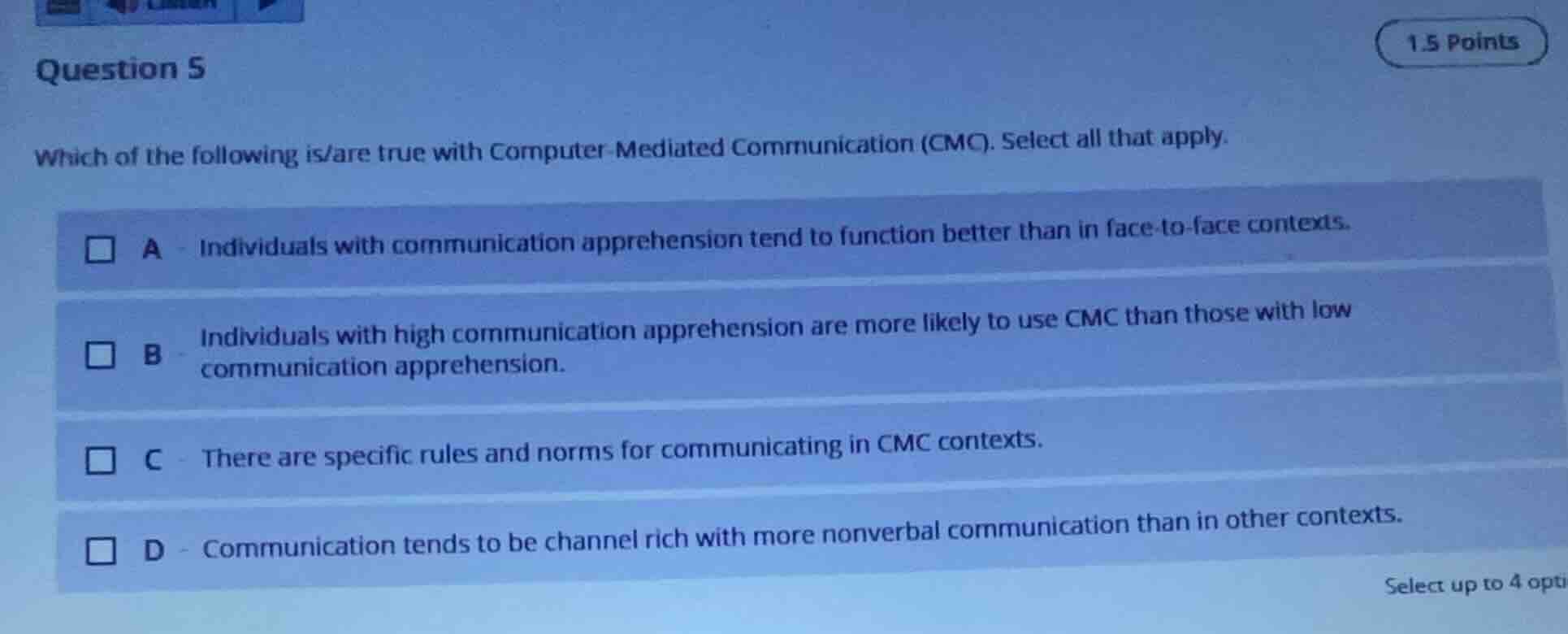
which of the following is/are true with computer-mediated communication (cmc). select all that apply.
a - individuals with communication apprehension tend to function better than in face-to-face contexts.
b - individuals with high communication apprehension are more likely to use cmc than those with low communication apprehension.
c - there are specific rules and norms for communicating in cmc contexts.
d - communication tends to be channel rich with more nonverbal communication than in other contexts.
<pre_analysis>
{
"quality": "clear",
"question_count": 1,
"skills_matched": [
"direct_cot",
"multiple_choice_formatter",
"explain_then_answer",
"tutor"
],
"needs_drawing": false,
"concepts_used": [
"Interpersonal Communication",
"Communication Technology"
],
"new_concepts": [
"Computer-Mediated Communication",
"Communication Apprehension"
],
"current_concepts": [
"Interpersonal Communication",
"Communication Technology",
"Computer-Mediated Communication",
"Communication Apprehension"
]
}
</pre_analysis>
<reasoning>
Analyze the characteristics of Computer-Mediated Communication (CMC)
Computer-Mediated Communication (CMC) refers to human communication that occurs through the use of two or more electronic devices. We need to evaluate each option based on established communication theories regarding CMC and Communication Technology.
- Option A: Individuals with communication apprehension (fear or anxiety associated with real or anticipated communication) often find CMC less threatening than face-to-face interactions. The asynchronous nature, reduced nonverbal cues, and ability to edit messages before sending allow highly apprehensive individuals to function better and feel more comfortable. This is a recognized benefit of CMC.
- Option B: Research indicates that individuals with high communication apprehension are indeed more likely to choose and use CMC channels over face-to-face channels because it helps them manage their anxiety.
- Option C: CMC has its own set of unique rules, norms, and etiquette (often referred to as "netiquette"), such as guidelines regarding response times, use of emojis, capitalization (which can denote shouting), and platform-specific behaviors.
- Option D: CMC is generally considered "channel lean" rather than "channel rich" because it lacks many of the physical, vocal, and nonverbal cues (such as eye contact, body language, and tone of voice) present in face-to-face communication. Therefore, Option D is incorrect.
Determine the correct options
Based on the analysis of Interpersonal Communication dynamics in digital spaces:
- Option A is true.
- Option B is true.
- Option C is true.
- Option D is false.
</reasoning>
<answer>
<mcq-correct>(A) Individuals with communication apprehension tend to function better than in face-to-face contexts.</mcq-correct>
<mcq-correct>(B) Individuals with high communication apprehension are more likely to use CMC than those with low communication apprehension.</mcq-correct>
<mcq-correct>(C) There are specific rules and norms for communicating in CMC contexts.</mcq-correct>
<mcq-option>(D) Communication tends to be channel rich with more nonverbal communication than in other contexts.</mcq-option>
</answer>
<post_analysis>
{
"subject": "Social Science",
"question_type": "Multiple Choice",
"knowledge_point": [
"Social Science",
"Communication Studies",
"Computer-Mediated Communication"
]
}
</post_analysis>
Snap & solve any problem in the app
Get step-by-step solutions on Sovi AI
Photo-based solutions with guided steps
Explore more problems and detailed explanations
<pre_analysis>
{
"quality": "clear",
"question_count": 1,
"skills_matched": [
"direct_cot",
"multiple_choice_formatter",
"explain_then_answer",
"tutor"
],
"needs_drawing": false,
"concepts_used": [
"Interpersonal Communication",
"Communication Technology"
],
"new_concepts": [
"Computer-Mediated Communication",
"Communication Apprehension"
],
"current_concepts": [
"Interpersonal Communication",
"Communication Technology",
"Computer-Mediated Communication",
"Communication Apprehension"
]
}
</pre_analysis>
<reasoning>
Analyze the characteristics of Computer-Mediated Communication (CMC)
Computer-Mediated Communication (CMC) refers to human communication that occurs through the use of two or more electronic devices. We need to evaluate each option based on established communication theories regarding CMC and Communication Technology.
- Option A: Individuals with communication apprehension (fear or anxiety associated with real or anticipated communication) often find CMC less threatening than face-to-face interactions. The asynchronous nature, reduced nonverbal cues, and ability to edit messages before sending allow highly apprehensive individuals to function better and feel more comfortable. This is a recognized benefit of CMC.
- Option B: Research indicates that individuals with high communication apprehension are indeed more likely to choose and use CMC channels over face-to-face channels because it helps them manage their anxiety.
- Option C: CMC has its own set of unique rules, norms, and etiquette (often referred to as "netiquette"), such as guidelines regarding response times, use of emojis, capitalization (which can denote shouting), and platform-specific behaviors.
- Option D: CMC is generally considered "channel lean" rather than "channel rich" because it lacks many of the physical, vocal, and nonverbal cues (such as eye contact, body language, and tone of voice) present in face-to-face communication. Therefore, Option D is incorrect.
Determine the correct options
Based on the analysis of Interpersonal Communication dynamics in digital spaces:
- Option A is true.
- Option B is true.
- Option C is true.
- Option D is false.
</reasoning>
<answer>
<mcq-correct>(A) Individuals with communication apprehension tend to function better than in face-to-face contexts.</mcq-correct>
<mcq-correct>(B) Individuals with high communication apprehension are more likely to use CMC than those with low communication apprehension.</mcq-correct>
<mcq-correct>(C) There are specific rules and norms for communicating in CMC contexts.</mcq-correct>
<mcq-option>(D) Communication tends to be channel rich with more nonverbal communication than in other contexts.</mcq-option>
</answer>
<post_analysis>
{
"subject": "Social Science",
"question_type": "Multiple Choice",
"knowledge_point": [
"Social Science",
"Communication Studies",
"Computer-Mediated Communication"
]
}
</post_analysis>