QUESTION IMAGE
Question
question 3
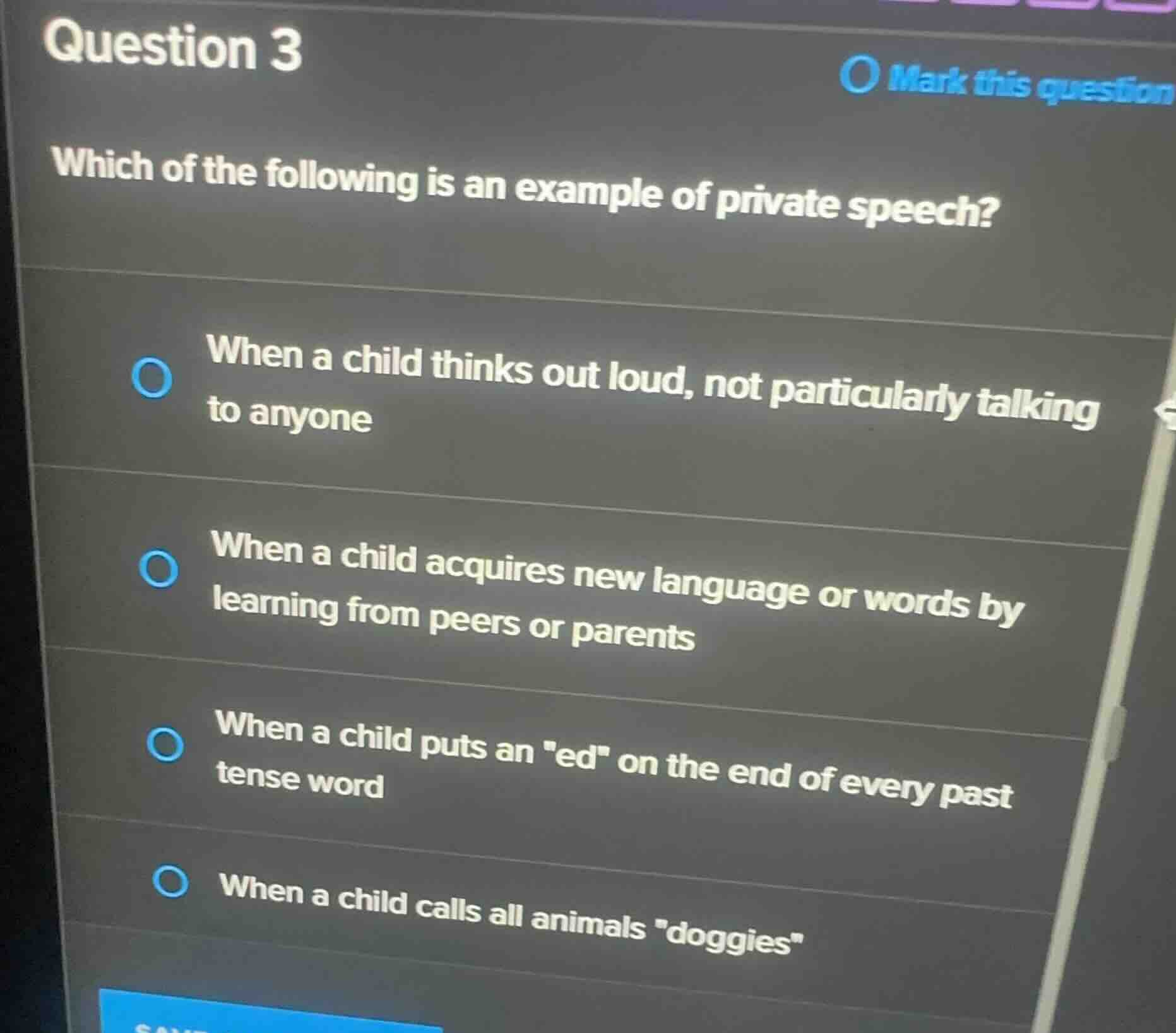
which of the following is an example of private speech?
- when a child thinks out loud, not particularly talking to anyone
- when a child acquires new language or words by learning from peers or parents
- when a child puts an \ed\ on the end of every past tense word
- when a child calls all animals \doggies\
The user is a university student, and the auto detail routing selects tutor mode to provide a clear conceptual explanation of the developmental psychology concepts involved.
Define private speech
In developmental psychology, particularly in Lev Vygotsky's sociocultural theory of cognitive development, private speech refers to speech spoken aloud by children that is addressed to themselves. It serves a self-regulatory function, helping children plan, guide, and monitor their behavior and thinking processes. It is not intended for communication with others.
Analyze the given options
- Option 1: "When a child thinks out loud, not particularly talking to anyone"
This directly matches the definition of private speech, where audible speech is used for self-direction and cognitive regulation rather than social communication.
- Option 2: "When a child acquires new language or words by learning from peers or parents"
This describes social learning or general Language Acquisition through social interaction, rather than private speech.
- Option 3: "When a child puts an 'ed' on the end of every past tense word"
This is an example of overregularization (or overgeneralization) of grammatical rules, a common phenomenon in language development.
- Option 4: "When a child calls all animals 'doggies'"
This is an example of overextension, where a child uses a single word to label a broader category of objects than is appropriate.
Determine the correct answer
Based on the analysis, the first option is the correct example of private speech.

Snap & solve any problem in the app
Get step-by-step solutions on Sovi AI
Photo-based solutions with guided steps
Explore more problems and detailed explanations
- When a child thinks out loud, not particularly talking to anyone (Correct answer)
- When a child acquires new language or words by learning from peers or parents
- When a child puts an "ed" on the end of every past tense word
- When a child calls all animals "doggies"