QUESTION IMAGE
Question
question
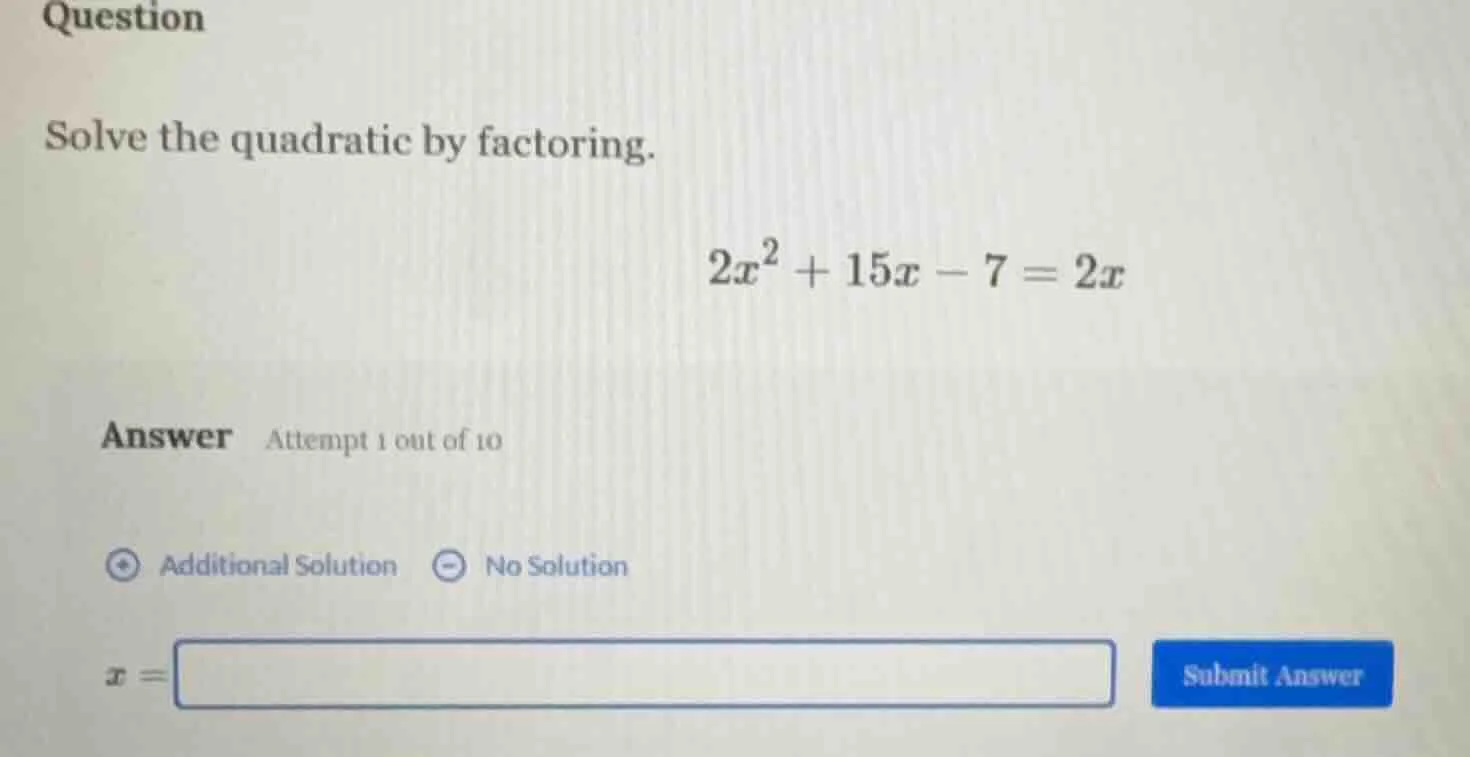
solve the quadratic by factoring.
$2x^2 + 15x - 7 = 2x$
answer attempt 1 out of 10
additional solution no solution
$x = $ submit answer
Step1: Rearrange the equation
First, we need to get all terms on one side of the equation to set it equal to zero. Subtract \(2x\) from both sides:
\(2x^{2}+15x - 7-2x=2x - 2x\)
Simplify the left - hand side and the right - hand side:
\(2x^{2}+13x - 7 = 0\)
Step2: Factor the quadratic
We need to factor the quadratic expression \(2x^{2}+13x - 7\). For a quadratic of the form \(ax^{2}+bx + c\) (here \(a = 2\), \(b = 13\), \(c=-7\)), we need to find two numbers that multiply to \(a\times c=2\times(-7)=-14\) and add up to \(b = 13\). The numbers are \(14\) and \(- 1\) since \(14\times(-1)=-14\) and \(14+( - 1)=13\).
We rewrite the middle term using these two numbers:
\(2x^{2}+14x - x - 7 = 0\)
Now, factor by grouping. Group the first two terms and the last two terms:
\((2x^{2}+14x)-(x + 7)=0\)
Factor out the greatest common factor from each group. From the first group, the GCF of \(2x^{2}\) and \(14x\) is \(2x\), and from the second group, the GCF of \(x\) and \(7\) is \(1\) (we factor out \(-1\) to make the binomials inside the parentheses the same):
\(2x(x + 7)-1(x + 7)=0\)
Now, we can factor out the common binomial factor \((x + 7)\):
\((2x - 1)(x + 7)=0\)
Step3: Solve for x
Using the zero - product property, if \(ab = 0\), then either \(a = 0\) or \(b = 0\). So we set each factor equal to zero:
- Case 1: \(2x-1 = 0\)
Add \(1\) to both sides: \(2x=1\)
Divide both sides by \(2\): \(x=\frac{1}{2}\)
- Case 2: \(x + 7=0\)
Subtract \(7\) from both sides: \(x=-7\)

Snap & solve any problem in the app
Get step-by-step solutions on Sovi AI
Photo-based solutions with guided steps
Explore more problems and detailed explanations
\(x=\frac{1}{2}\) or \(x = - 7\) (If we consider one solution at a time, for the first solution \(x=\frac{1}{2}\), for the second \(x=-7\))