QUESTION IMAGE
Question
question 7
3 pts
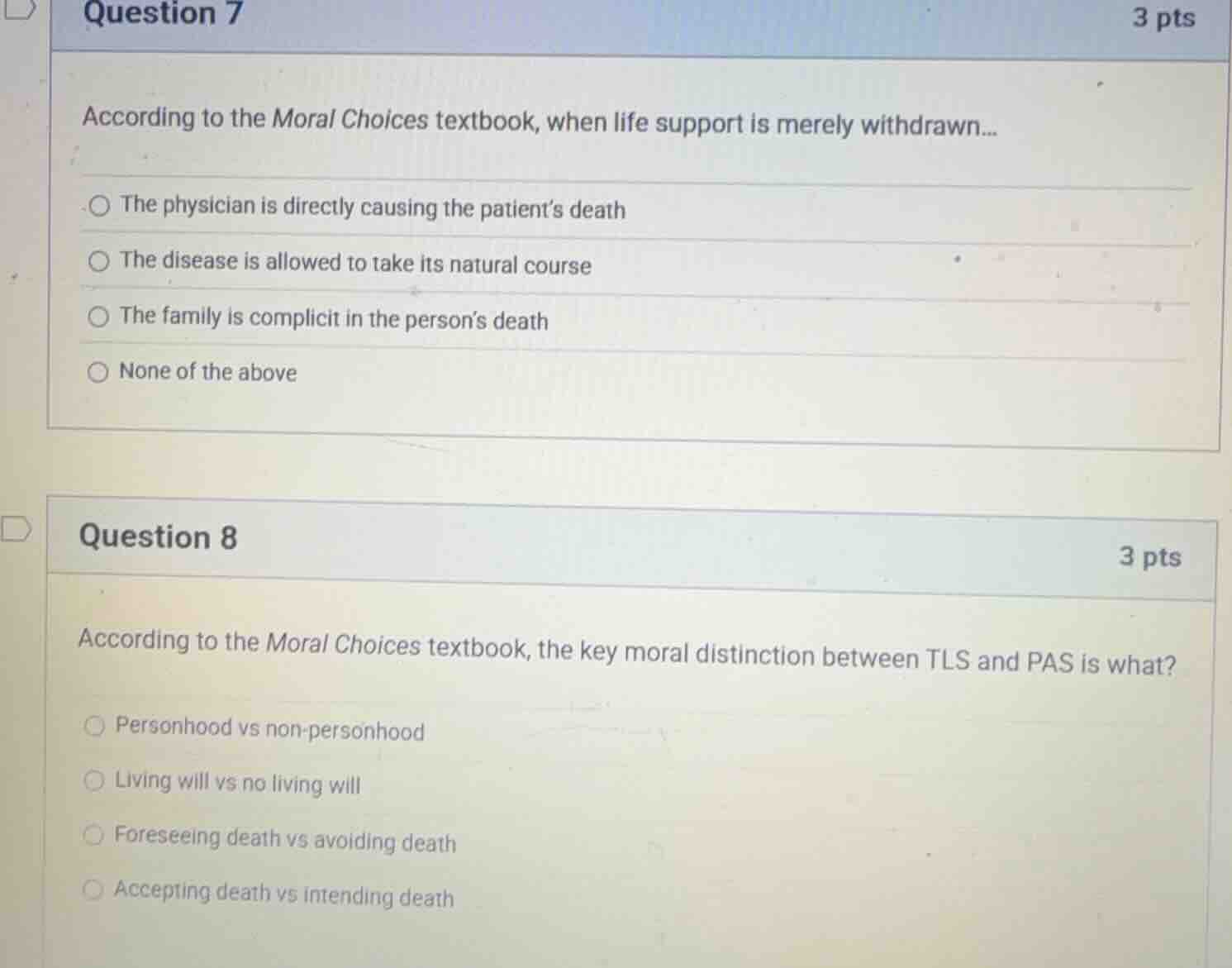
according to the moral choices textbook, when life support is merely withdrawn...
the physician is directly causing the patients death
the disease is allowed to take its natural course
the family is complicit in the persons death
none of the above
question 8
3 pts
according to the moral choices textbook, the key moral distinction between tls and pas is what?
personhood vs non-personhood
living will vs no living will
foreseeing death vs avoiding death
accepting death vs intending death
🆕 New Concept Discovered: Active vs. Passive Euthanasia
Distinguishing between letting die and causing death.
Step 1: Analyze Question 7
In bioethics and specifically within Scott Rae's Moral Choices textbook, a distinction is made between active termination of life and passive letting die (withdrawing or withholding life-sustaining treatment).
When life support is withdrawn (often referred to as passive euthanasia or termination of life support):
- The underlying pathology or disease is what ultimately causes the patient's death.
- The physician is not introducing a new lethal agent to cause death; rather, they are stopping an artificial intervention, allowing the disease to take its natural course.
Therefore, the correct option is: The disease is allowed to take its natural course.
Step 2: Analyze Question 8
Question 8 asks for the key moral distinction between TLS (Termination of Life Support) and PAS (Physician-Assisted Suicide) according to the Moral Choices textbook.
- Termination of Life Support (TLS): The moral intent is to accept the reality of biological death and stop artificial interventions that merely prolong the dying process. The patient accepts death as a natural end.
- Physician-Assisted Suicide (PAS): The moral intent is to actively bring about death as a means to escape suffering. The action is driven by the intention to end life.
Thus, the fundamental moral distinction lies in the intention and attitude toward death: Accepting death vs intending death.

Snap & solve any problem in the app
Get step-by-step solutions on Sovi AI
Photo-based solutions with guided steps
Explore more problems and detailed explanations
Question 7:
The disease is allowed to take its natural course
Question 8:
Accepting death vs intending death