QUESTION IMAGE
Question
question 7 (2.5 points)
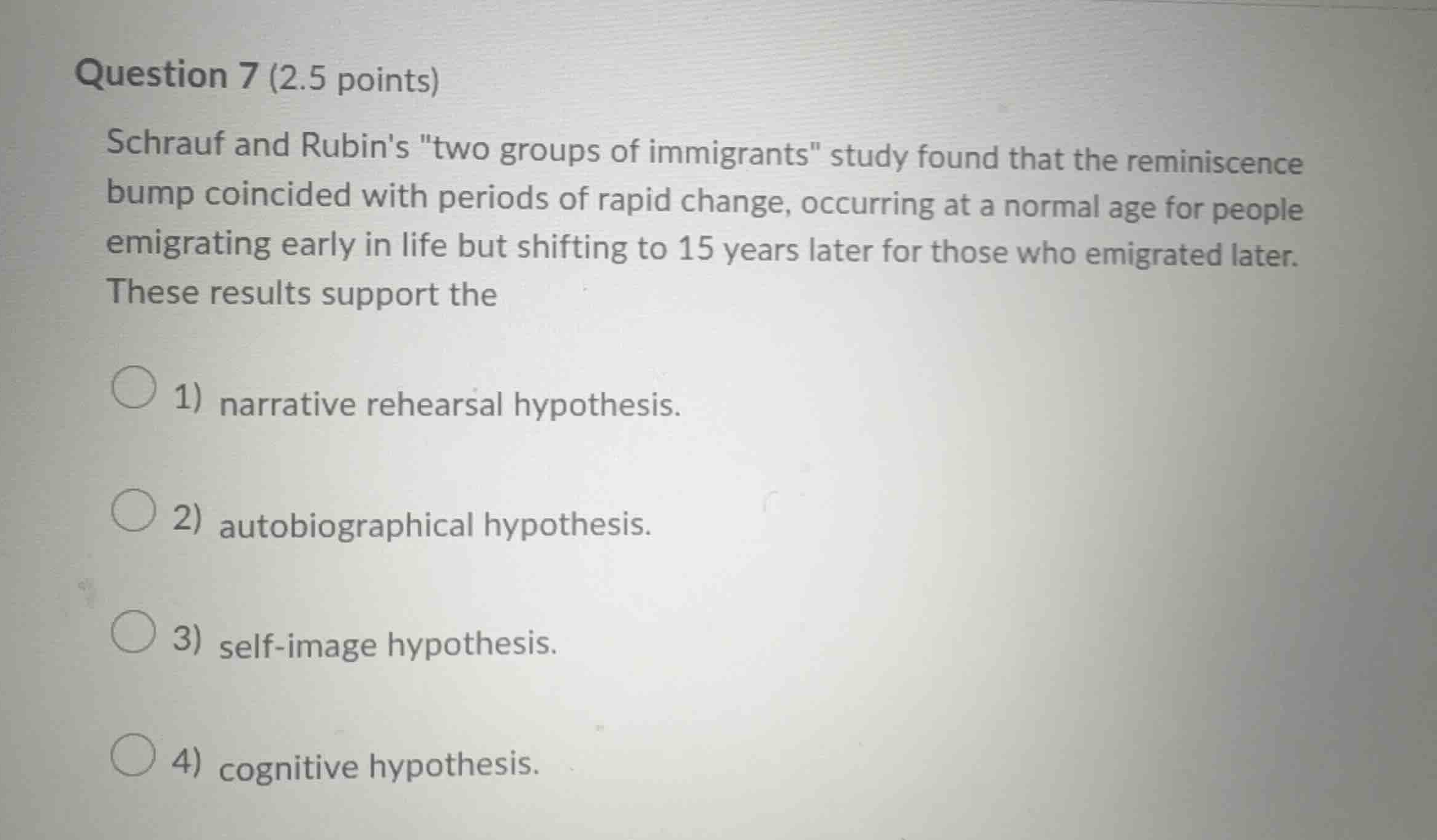
schrauf and rubins \two groups of immigrants\ study found that the reminiscence bump coincided with periods of rapid change, occurring at a normal age for people emigrating early in life but shifting to 15 years later for those who emigrated later. these results support the
- narrative rehearsal hypothesis.
- autobiographical hypothesis.
- self-image hypothesis.
- cognitive hypothesis.
🆕 New Concept Discovered: Reminiscence Bump Hypotheses
How memory encoding shifts during periods of rapid change.
Step 1: Understand the Reminiscence Bump
The reminiscence bump refers to the tendency for older adults to have increased recollection for personal events that occurred during their adolescence and early adulthood (typically between ages 10 and 30). Several hypotheses attempt to explain this phenomenon:
- Self-image hypothesis: Memory is enhanced for events that occur while a person's self-image or life identity is being formed.
- Cognitive hypothesis: Encoding is stronger during periods of rapid change that are followed by stability.
- Cultural life script hypothesis: Events are easier to recall when they fit the standard life expectations of a person's culture.
Step 2: Analyze the Study's Findings
Schrauf and Rubin (1998) studied two groups of immigrants:
- Those who emigrated early in life (around age 20 to 22) showed a reminiscence bump at the normal age (during young adulthood).
- Those who emigrated later in life (around age 34 to 35) experienced a shift in their reminiscence bump to about 15 years later, coinciding with the period of massive change and subsequent stabilization associated with adjusting to a new country.
Step 3: Match the Findings to the Correct Hypothesis
Because the bump shifted to coincide directly with a period of rapid change (emigration) followed by stability, these results provide strong empirical support for the cognitive hypothesis. The cognitive hypothesis predicts that the transition period of emigration triggers high levels of memory encoding, shifting the bump regardless of the biological age at which it occurs.

Snap & solve any problem in the app
Get step-by-step solutions on Sovi AI
Photo-based solutions with guided steps
Explore more problems and detailed explanations
- cognitive hypothesis.