QUESTION IMAGE
Question
question 8
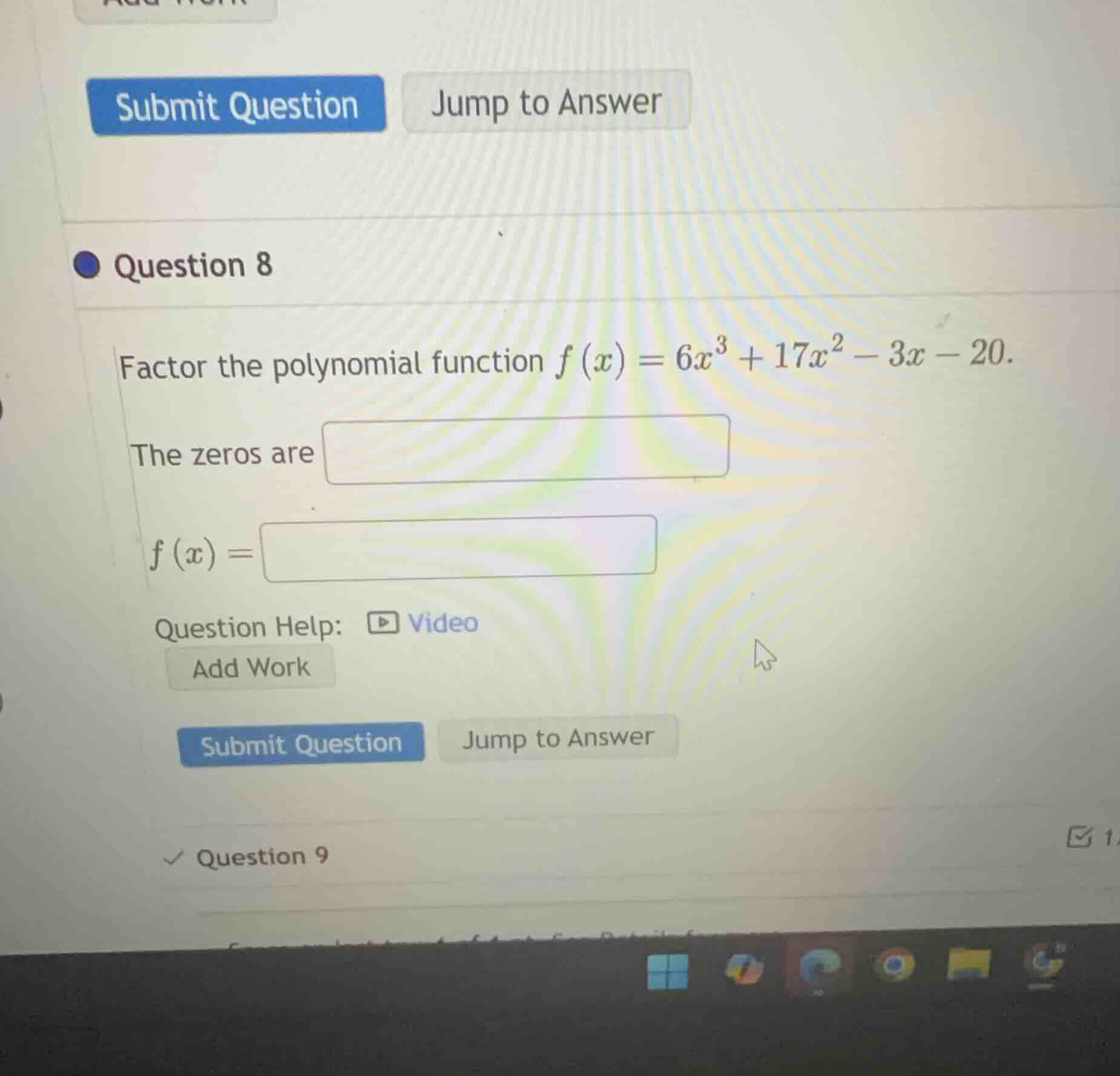
factor the polynomial function (f(x) = 6x^3 + 17x^2 - 3x - 20).
the zeros are
(f(x) = )
⚡ Using: dividing polynomials · 🆕 New: Factoring Higher-Degree Polynomials
Finding rational roots to break down polynomials
Step 1: Find a rational zero
To find the first zero, we use the Rational Root Theorem. The possible rational roots are factors of the constant term \(-20\) divided by factors of the leading coefficient \(6\).
Let's test small integer values in \(f(x) = 6x^3 + 17x^2 - 3x - 20\):
- Test \(x = 1\):
Since \(f(1) = 0\), \(x = 1\) is a zero, which means \((x - 1)\) is a factor.
Step 2: Divide the polynomial
We divide \(f(x)\) by \((x - 1)\) using synthetic division to find the remaining quadratic factor:
The quotient is the quadratic polynomial:
Step 3: Factor the quadratic quotient
Now we factor \(6x^2 + 23x + 20\) by grouping. We look for two numbers that multiply to \(6 \times 20 = 120\) and add to \(23\). These numbers are \(8\) and \(15\):
Group the terms:
Step 4: Identify all zeros
Set each factor to zero to find the remaining roots:
- \(x - 1 = 0 \implies x = 1\)
- \(2x + 5 = 0 \implies x = -\frac{5}{2}\)
- \(3x + 4 = 0 \implies x = -\frac{4}{3}\)

Snap & solve any problem in the app
Get step-by-step solutions on Sovi AI
Photo-based solutions with guided steps
Explore more problems and detailed explanations
- The zeros are: \(1, -\frac{5}{2}, -\frac{4}{3}\)
- \(f(x) =\) \((x - 1)(2x + 5)(3x + 4)\)