QUESTION IMAGE
Question
question 1
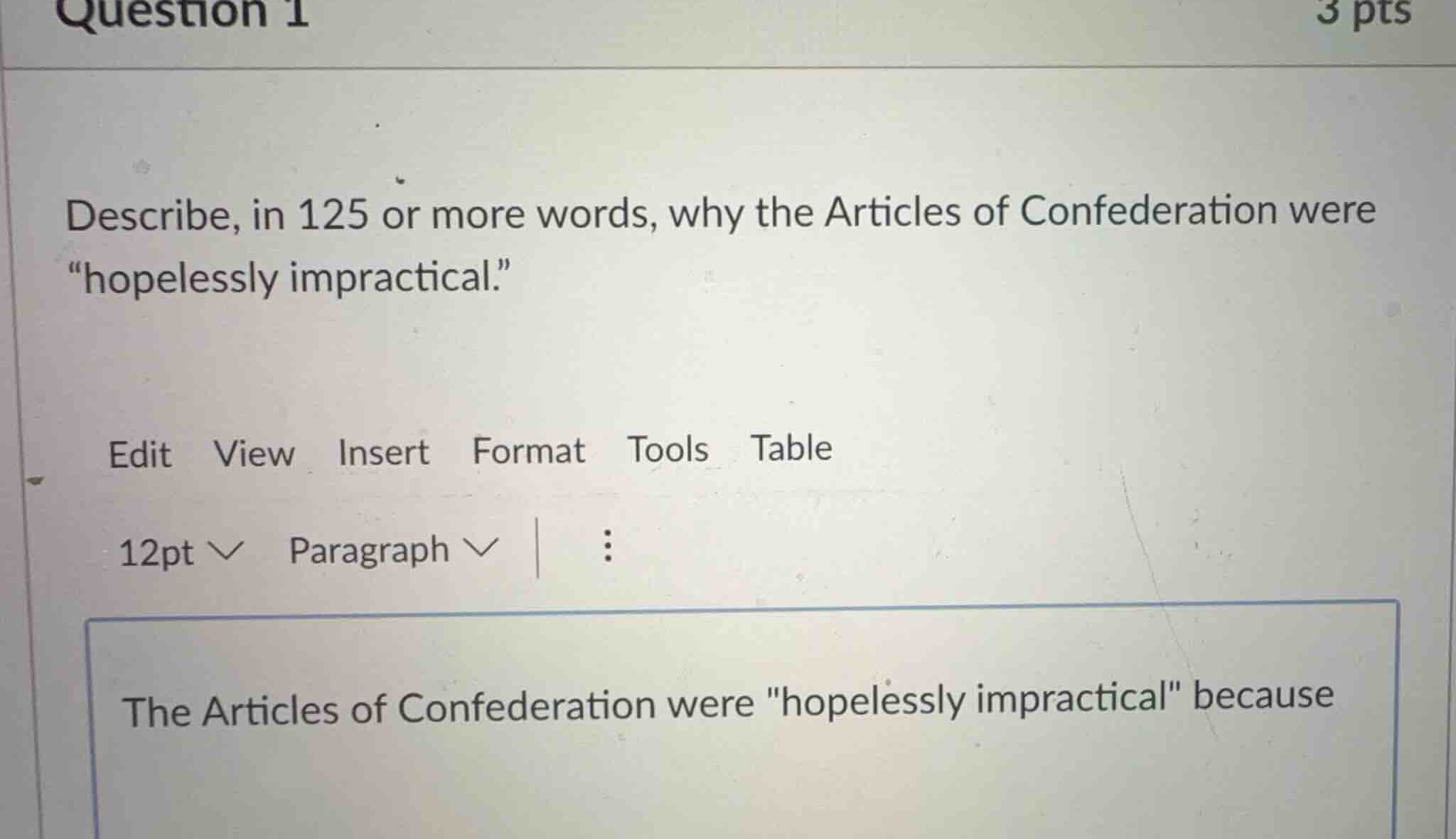
describe, in 125 or more words, why the articles of confederation were \hopelessly impractical.\
Identify structural weaknesses of the national government
- No power to levy taxes directly, leading to national debt and financial instability.
- No executive branch to enforce laws and no national court system to resolve interstate disputes.
- Inability to regulate interstate or foreign commerce, causing economic conflict between states.
Analyze legislative and amendment barriers
- Passing laws required a supermajority of 9 out of 13 states, making legislative progress extremely slow.
- Amending the Articles required a unanimous vote of all 13 states, making structural reform virtually impossible.
- Shays' Rebellion exposed the federal government's inability to maintain domestic order or raise an army quickly.
Synthesize into a cohesive response meeting the word count requirement
- Draft a response of 125 or more words explaining these points clearly and directly.
- Ensure the final response begins with the provided sentence starter: "The Articles of Confederation were "hopelessly impractical" because..."

Snap & solve any problem in the app
Get step-by-step solutions on Sovi AI
Photo-based solutions with guided steps
Explore more problems and detailed explanations
The Articles of Confederation were "hopelessly impractical" because they created a national government that was far too weak to function effectively. Under the Articles, Congress lacked the power to levy taxes directly, leaving the national government entirely dependent on voluntary state contributions to pay off war debts. Additionally, there was no executive branch to enforce laws and no national court system to resolve legal disputes between states. Congress also lacked the authority to regulate interstate or foreign commerce, which led to economic conflict and competing tariffs among the states. Furthermore, passing any major legislation required a supermajority of nine out of thirteen states, while amending the Articles required a unanimous vote, making structural reform virtually impossible. Events like Shays' Rebellion ultimately proved that this decentralized system could not maintain domestic order or protect the nation.