QUESTION IMAGE
Question
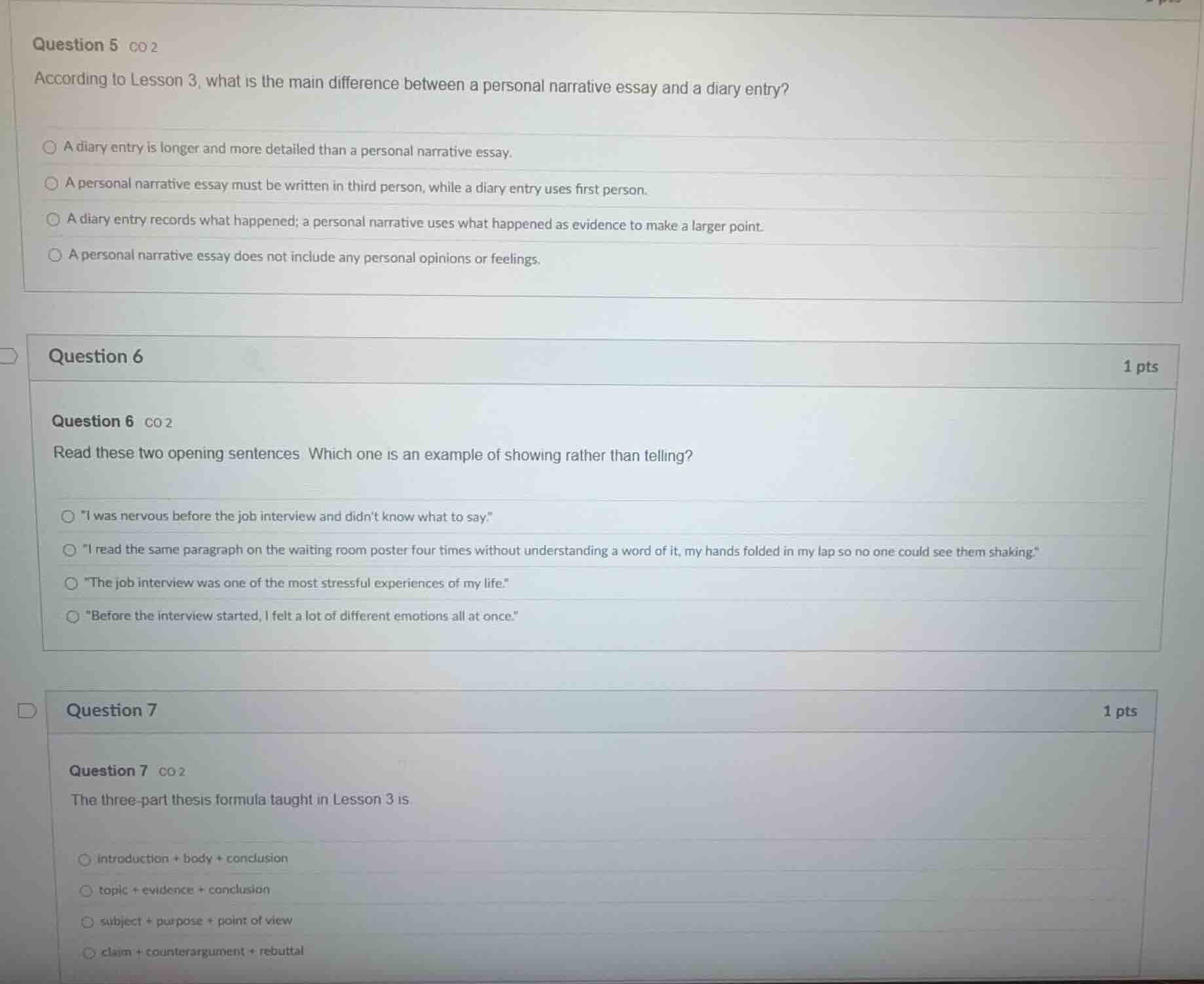
question 5 co 2
according to lesson 3, what is the main difference between a personal narrative essay and a diary entry?
a diary entry is longer and more detailed than a personal narrative essay.
a personal narrative essay must be written in third person, while a diary entry uses first person.
a diary entry records what happened; a personal narrative uses what happened as evidence to make a larger point.
a personal narrative essay does not include any personal opinions or feelings.
question 6
question 6 co 2
read these two opening sentences which one is an example of showing rather than telling?
\i was nervous before the job interview and didnt know what to say.\
\i read the same paragraph on the waiting room poster four times without understanding a word of it, my hands folded in my lap so no one could see them shaking.\
\the job interview was one of the most stressful experiences of my life.\
\before the interview started, i felt a lot of different emotions all at once.\
question 7
question 7 co 2
the three-part thesis formula taught in lesson 3 is
introduction + body + conclusion
topic + evidence + conclusion
subject + purpose + point of view
claim + counterargument + rebuttal
Analyze Question 5
The question asks for the main difference between a personal narrative essay and a diary entry.
- Option 1: Incorrect. A personal narrative essay is typically more structured and detailed.
- Option 2: Incorrect. Both are written in the first person.
- Option 3: Correct. A diary entry simply records events, whereas a personal narrative uses those events as evidence to support a larger thematic point.
- Option 4: Incorrect. Personal narratives heavily rely on personal feelings and opinions.
Analyze Question 6
The question asks to identify which sentence is an example of "showing rather than telling."
- "Telling" directly states an emotion (e.g., "I was nervous", "stressful", "felt a lot of different emotions").
- "Showing" uses sensory details and physical actions to imply the emotion.
- Option 2 describes reading the same paragraph four times without understanding and hiding shaking hands. This physically demonstrates nervousness without explicitly naming it.
Analyze Question 7
The question asks for the three-part thesis formula taught in Lesson 3.
- A standard academic thesis formula for essays (especially personal or narrative-based ones) often connects what you are writing about, why you are writing it, and your perspective.
- The option "subject + purpose + point of view" represents a comprehensive three-part thesis formula that defines the scope, the goal, and the stance of the essay.

Snap & solve any problem in the app
Get step-by-step solutions on Sovi AI
Photo-based solutions with guided steps
Explore more problems and detailed explanations
Question 5
- (A) A diary entry is longer and more detailed than a personal narrative essay.
- (B) A personal narrative essay must be written in third person, while a diary entry uses first person.
- (C) A diary entry records what happened; a personal narrative uses what happened as evidence to make a larger point. (Correct answer)
- (D) A personal narrative essay does not include any personal opinions or feelings.
Question 6
- (A) "I was nervous before the job interview and didn't know what to say."
- (B) "I read the same paragraph on the waiting room poster four times without understanding a word of it, my hands folded in my lap so no one could see them shaking." (Correct answer)
- (C) "The job interview was one of the most stressful experiences of my life."
- (D) "Before the interview started, I felt a lot of different emotions all at once."
Question 7
- (A) introduction + body + conclusion
- (B) topic + evidence + conclusion
- (C) subject + purpose + point of view (Correct answer)
- (D) claim + counterargument + rebuttal