QUESTION IMAGE
Question
this question is based on the following passage.
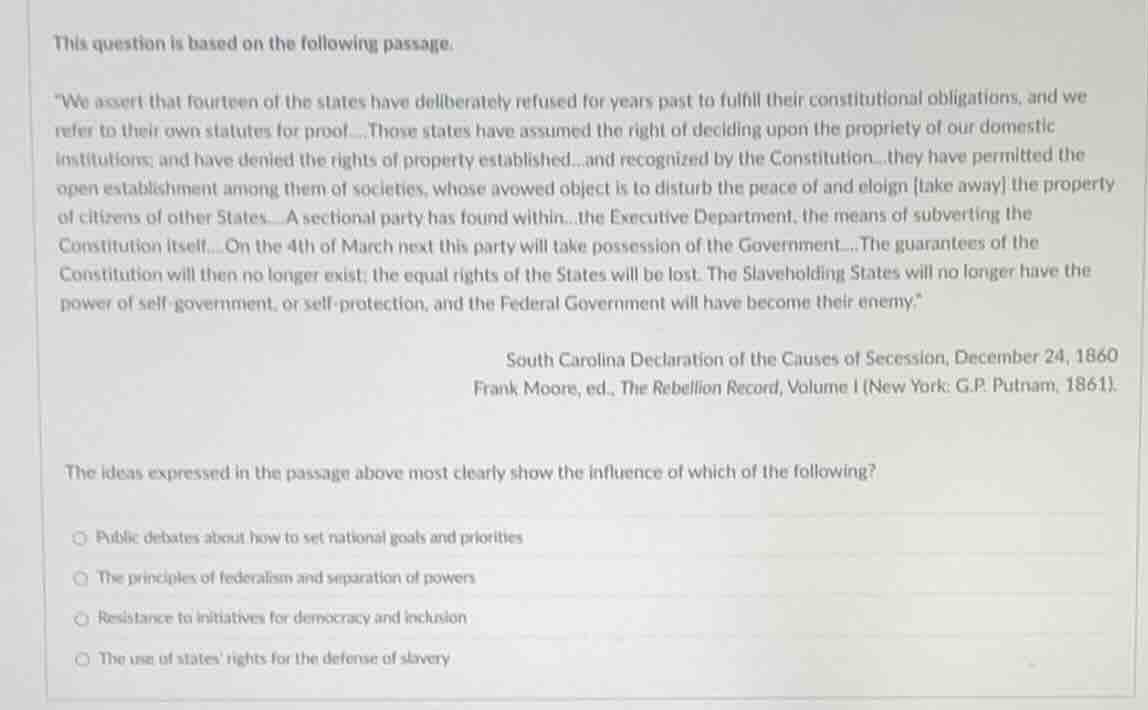
\we assert that fourteen of the states have deliberately refused for years past to fulfill their constitutional obligations, and we refer to their own statutes for proof... those states have assumed the right of deciding upon the propriety of our domestic institutions; and have denied the rights of property established... and recognized by the constitution... they have permitted the open establishment among them of societies, whose avowed object is to disturb the peace and eloign take away the property of citizens of other states... a sectional party has found within... the executive department, the means of subverting the constitution itself... on the 4th of march next this party will take possession of the government... the guarantees of the constitution will then no longer exist; the equal rights of the states will be lost. the slaveholding states will no longer have the power of self-government, or self-protection, and the federal government will have become their enemy.\
south carolina declaration of the causes of secession, december 24, 1860
frank moore, ed., the rebellion record, volume i (new york: g.p. putnam, 1861).
the ideas expressed in the passage above most clearly show the influence of which of the following?
public debates about how to set national goals and priorities
the principles of federalism and separation of powers
resistance to initiatives for democracy and inclusion
the use of states rights for the defense of slavery
Analyze the source document
Using the Secession Documents knowledge point, we examine South Carolina's Declaration of Causes (December 24, 1860). The text complains that fourteen Northern states "deliberately refused... to fulfill their constitutional obligations" regarding the return of fugitive slaves ("denied the rights of property established... by the Constitution").
Connect to sectional tensions
Using the Slavery Expansion and Sectionalism knowledge points, the document highlights how Southern states utilized the constitutional argument of states' rights and compact theory to justify secession, specifically to protect their "domestic institutions" (slavery) from a newly elected "sectional party" (the Republican Party under Abraham Lincoln).
Evaluate the multiple-choice options
- Option 1: "Public debates about how to set national goals and priorities" is too broad and does not capture the specific constitutional and sectional conflict over slavery.
- Option 2: "The principles of federalism and separation of powers" does not address the core motivation of defending the institution of slavery.
- Option 3: "Resistance to initiatives for democracy and inclusion" is incorrect in this context.
- Option 4: "The use of states' rights for the defense of slavery" directly aligns with the text's emphasis on Northern states violating constitutional compacts regarding slave property, justifying secession to protect slavery.

Snap & solve any problem in the app
Get step-by-step solutions on Sovi AI
Photo-based solutions with guided steps
Explore more problems and detailed explanations
- Public debates about how to set national goals and priorities
- The principles of federalism and separation of powers
- Resistance to initiatives for democracy and inclusion
- The use of states' rights for the defense of slavery (Correct answer)