QUESTION IMAGE
Question
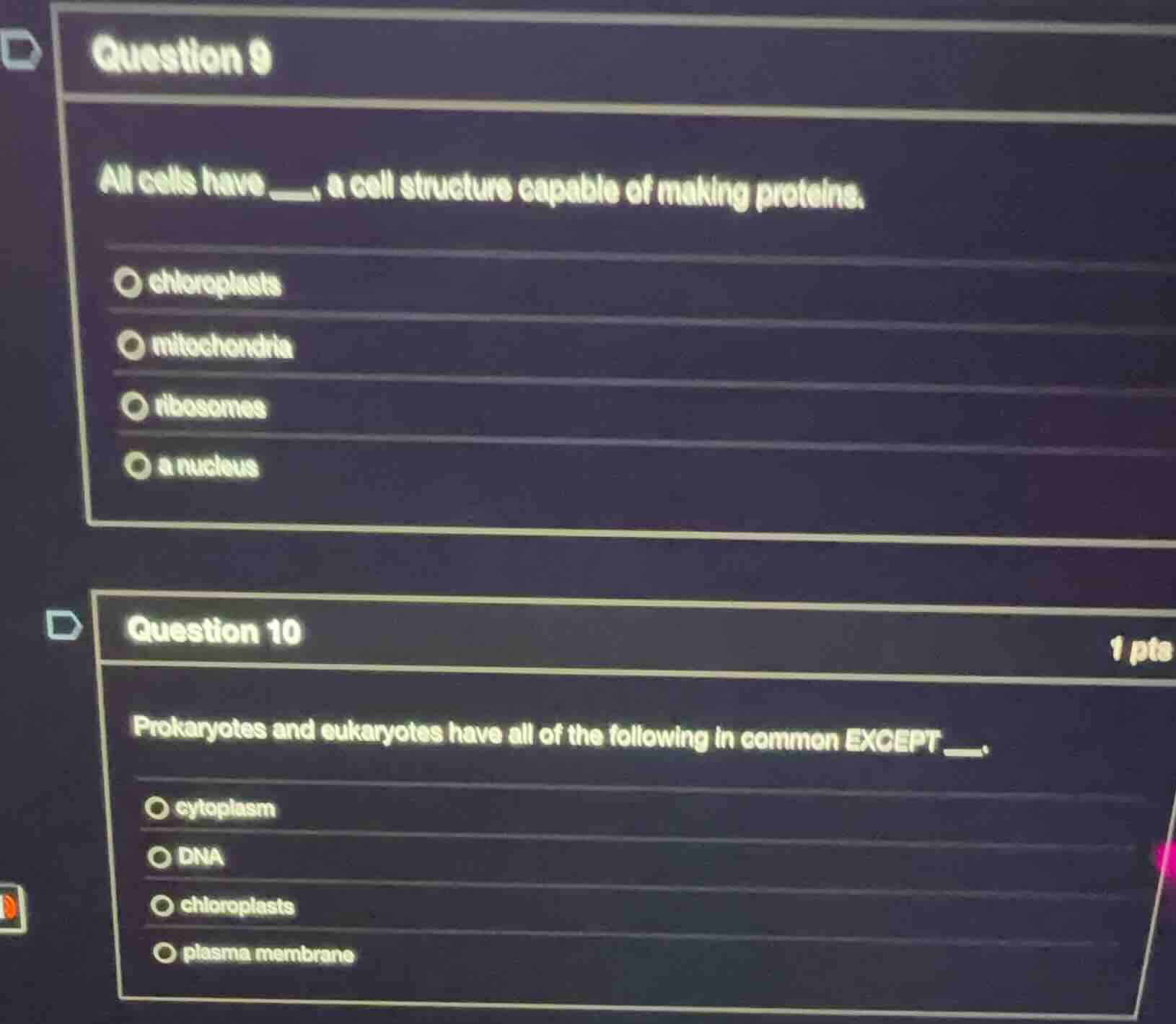
question 9
all cells have ___, a cell structure capable of making proteins.
- chloroplasts
- mitochondria
- ribosomes
- a nucleus
question 10
prokaryotes and eukaryotes have all of the following in common except ___.
- cytoplasm
- dna
- chloroplasts
- plasma membrane
Analyze Question 9
The question asks for a structure found in all cells that is capable of making proteins. Ribosomes are the universal cellular structures responsible for protein synthesis (translation) and are present in both prokaryotic and eukaryotic cells. Chloroplasts, mitochondria, and nuclei are membrane-bound organelles absent in prokaryotes.
Analyze Question 10
The question asks for a feature that prokaryotes and eukaryotes do NOT have in common. Both cell types share cytoplasm, DNA, and a plasma membrane (along with ribosomes). Chloroplasts are specialized membrane-bound organelles found only in photosynthetic eukaryotes (like plants and algae) and are absent in prokaryotes.

Snap & solve any problem in the app
Get step-by-step solutions on Sovi AI
Photo-based solutions with guided steps
Explore more problems and detailed explanations
Question 9
- (A) chloroplasts
- (B) mitochondria</mcq-correct>
- (C) ribosomes (Correct answer)
<mcq-option>(D) a nucleus
Question 10
- (A) cytoplasm
- (B) DNA
- (C) chloroplasts (Correct answer)
- (D) plasma membrane