QUESTION IMAGE
Question
question 80
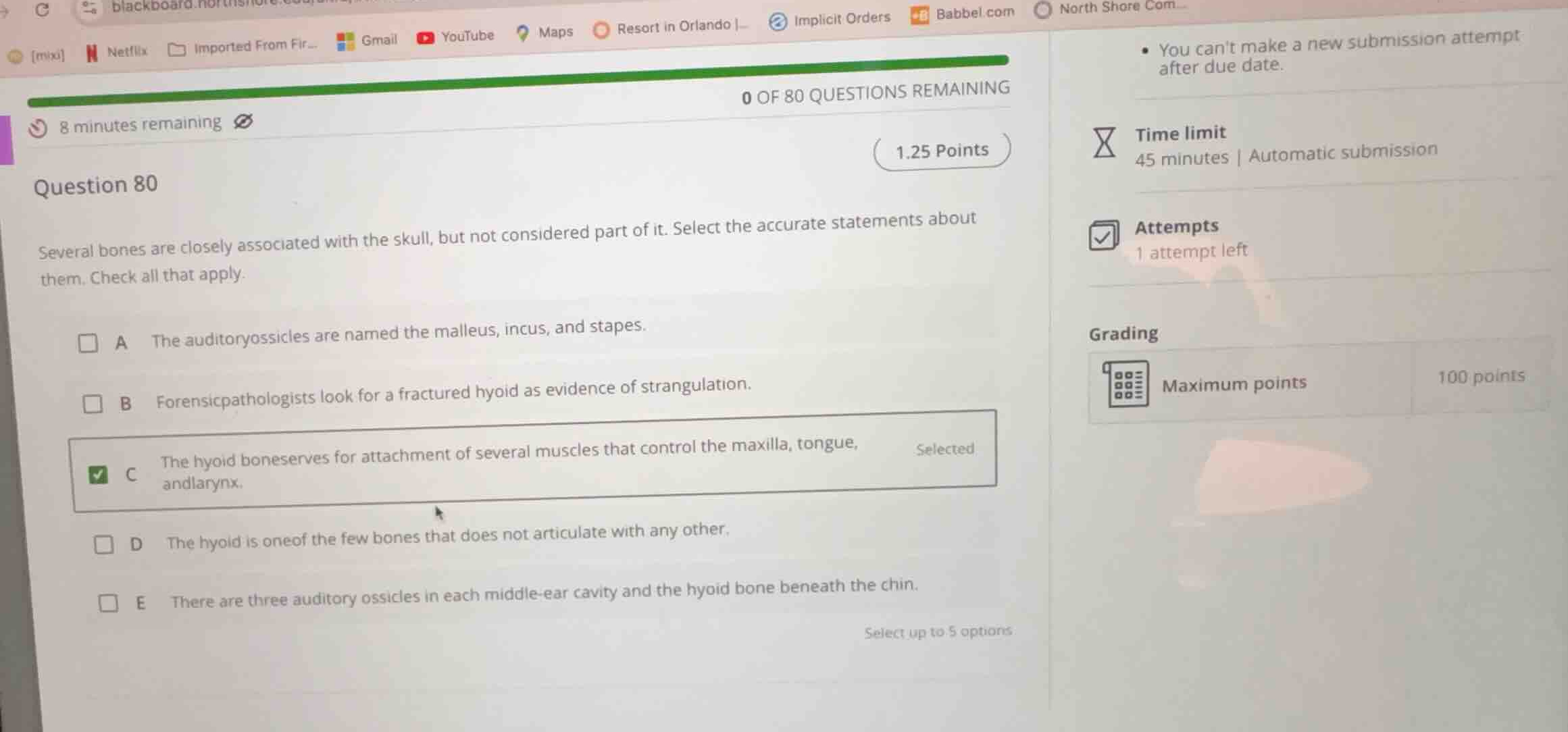
several bones are closely associated with the skull, but not considered part of it. select the accurate statements about them. check all that apply.
a the auditoryossicles are named the malleus, incus, and stapes.
b forensicpathologists look for a fractured hyoid as evidence of strangulation.
c the hyoid boneserves for attachment of several muscles that control the maxilla, tongue, andlarynx.
d the hyoid is oneof the few bones that does not articulate with any other.
e there are three auditory ossicles in each middle-ear cavity and the hyoid bone beneath the chin.
Evaluate statement A
Using the Auditory Ossicles and Middle Ear Anatomy knowledge points
The auditory ossicles are indeed named the malleus, incus, and stapes. Thus, statement A is correct.
Evaluate statement B
The hyoid bone is suspended by ligaments and muscles in the neck. In cases of manual strangulation, the compression of the neck frequently results in a fractured hyoid bone, making it a key diagnostic marker for forensic pathologists. Thus, statement B is correct.
Evaluate statement C
The hyoid bone serves as an attachment site for muscles of the tongue, larynx, and mandible. However, it does not provide attachment for muscles controlling the maxilla (upper jaw). Thus, statement C is incorrect.
Evaluate statement D
The hyoid bone is unique because it is the only bone in the human body that does not articulate directly with any other bone; it is suspended entirely by muscles and ligaments. Thus, statement D is correct.
Evaluate statement E
There are three auditory ossicles (malleus, incus, stapes) located within each middle-ear cavity, and the single hyoid bone is situated in the anterior neck region beneath the chin. Thus, statement E is correct.

Snap & solve any problem in the app
Get step-by-step solutions on Sovi AI
Photo-based solutions with guided steps
Explore more problems and detailed explanations
- (A) The auditoryossicles are named the malleus, incus, and stapes. (Correct answer)
- (B) Forensicpathologists look for a fractured hyoid as evidence of strangulation. (Correct answer)
- (C) The hyoid boneserves for attachment of several muscles that control the maxilla, tongue, andlarynx.
- (D) The hyoid is oneof the few bones that does not articulate with any other. (Correct answer)
- (E) There are three auditory ossicles in each middle-ear cavity and the hyoid bone beneath the chin. (Correct answer)