QUESTION IMAGE
Question
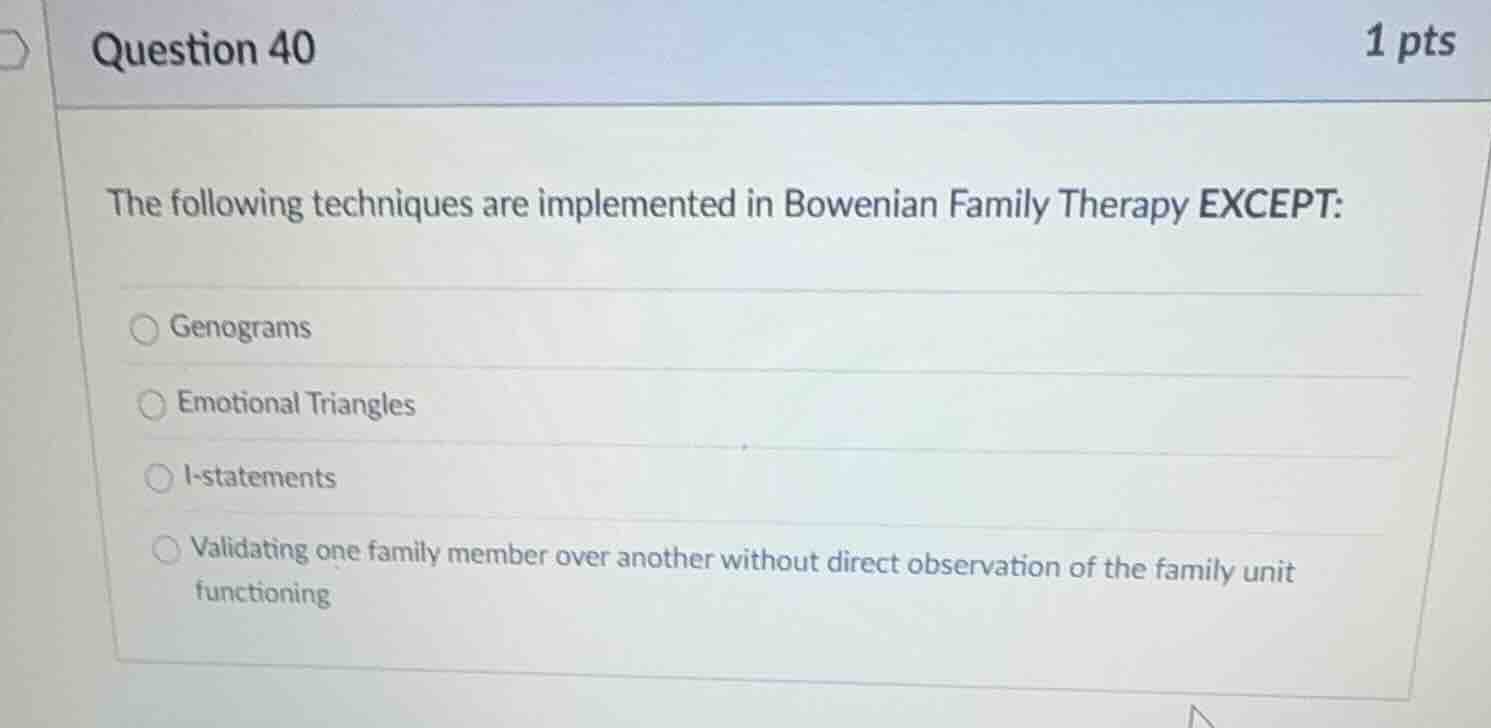
question 40 1 pts
the following techniques are implemented in bowenian family therapy except:
genograms
emotional triangles
i-statements
validating one family member over another without direct observation of the family unit functioning
🆕 New Concept Discovered: Bowenian Family Therapy
Understanding intergenerational family systems and differentiation of self.
Step 1: Analyze Bowenian Family Therapy Techniques
Bowenian Family Therapy, developed by Murray Bowen, focuses on the balance of two forces: togetherness and individuality. Key techniques and concepts include:
- Genograms: A multi-generational family tree diagram used to map out relationship patterns and medical/psychological history.
- Emotional Triangles: The smallest stable relationship system, where a two-person system under stress draws in a third party to reduce anxiety.
- I-statements: Encouraging family members to speak from their own perspective (e.g., "I feel..." rather than "You make me...") to foster differentiation of self and reduce emotional reactivity.
Step 2: Evaluate the Options
- Genograms: This is a core assessment tool in Bowenian therapy.
- Emotional Triangles: Identifying and detriangulating these dynamics is a primary goal of Bowenian therapy.
- I-statements: This is a standard communication technique used to promote differentiation in Bowenian therapy.
- Validating one family member over another without direct observation of the family unit functioning: Bowenian therapists strive to remain neutral (detriangulated) and avoid taking sides or validating one member over another, as doing so would pull the therapist into an emotional triangle. Furthermore, understanding the functioning of the family unit as a whole system is essential.
Therefore, validating one member over another is not a technique implemented in Bowenian Family Therapy.

Snap & solve any problem in the app
Get step-by-step solutions on Sovi AI
Photo-based solutions with guided steps
Explore more problems and detailed explanations
Validating one family member over another without direct observation of the family unit functioning