QUESTION IMAGE
Question
question 24
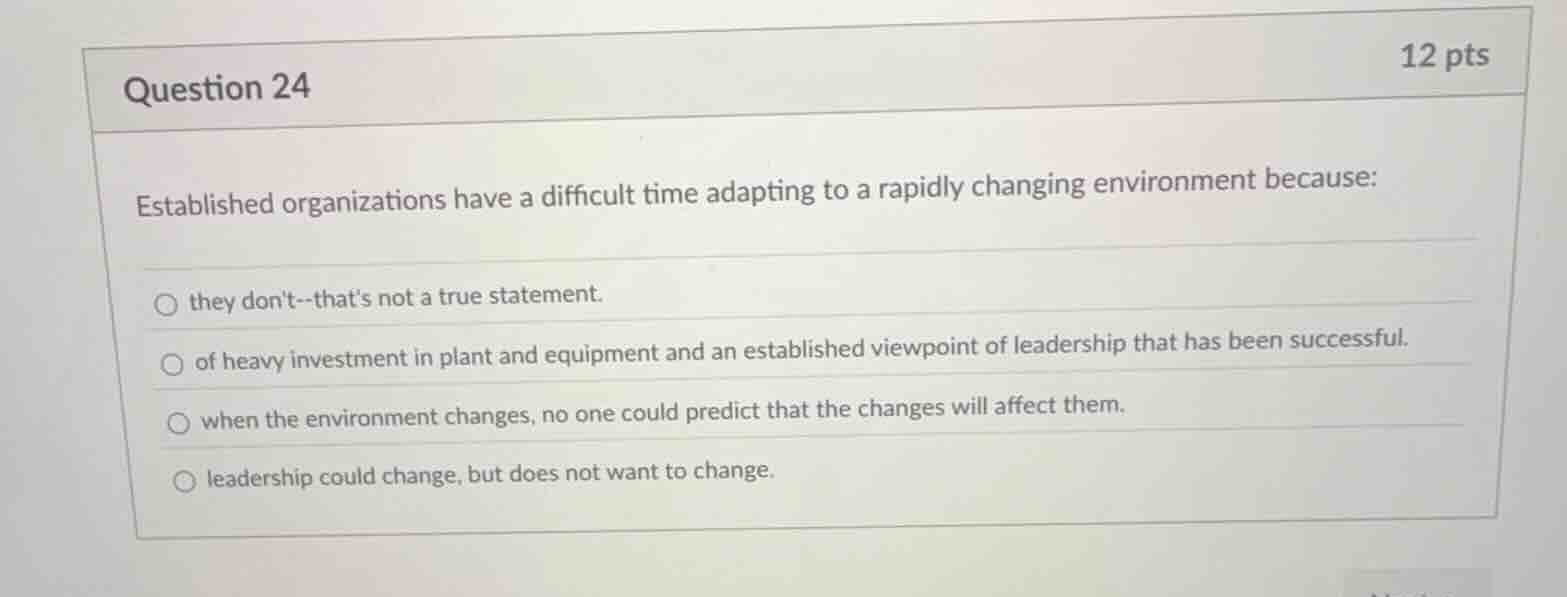
established organizations have a difficult time adapting to a rapidly changing environment because:
they dont--thats not a true statement.
of heavy investment in plant and equipment and an established viewpoint of leadership that has been successful.
when the environment changes, no one could predict that the changes will affect them.
leadership could change, but does not want to change.
Analyze the core question
The question asks why established organizations have a difficult time adapting to a rapidly changing environment. This relates to Organizational Decline Factors and structural inertia.
Evaluate the options
- Option 1: "they don't--that's not a true statement." This is incorrect because organizational inertia is a well-documented phenomenon.
- Option 2: "of heavy investment in plant and equipment and an established viewpoint of leadership that has been successful." This is correct. Sunk costs (heavy investment) and cognitive rigidity (established successful viewpoints) are primary drivers of structural inertia.
- Option 3: "when the environment changes, no one could predict that the changes will affect them." This is incorrect because environmental changes can often be predicted, but organizations still fail to adapt.
- Option 4: "leadership could change, but does not want to change." This is too narrow and oversimplifies the structural and financial barriers to change.

Snap & solve any problem in the app
Get step-by-step solutions on Sovi AI
Photo-based solutions with guided steps
Explore more problems and detailed explanations
- they don't--that's not a true statement.
- of heavy investment in plant and equipment and an established viewpoint of leadership that has been successful. (Correct answer)
- when the environment changes, no one could predict that the changes will affect them.
- leadership could change, but does not want to change.