QUESTION IMAGE
Question
question 23
2 pts
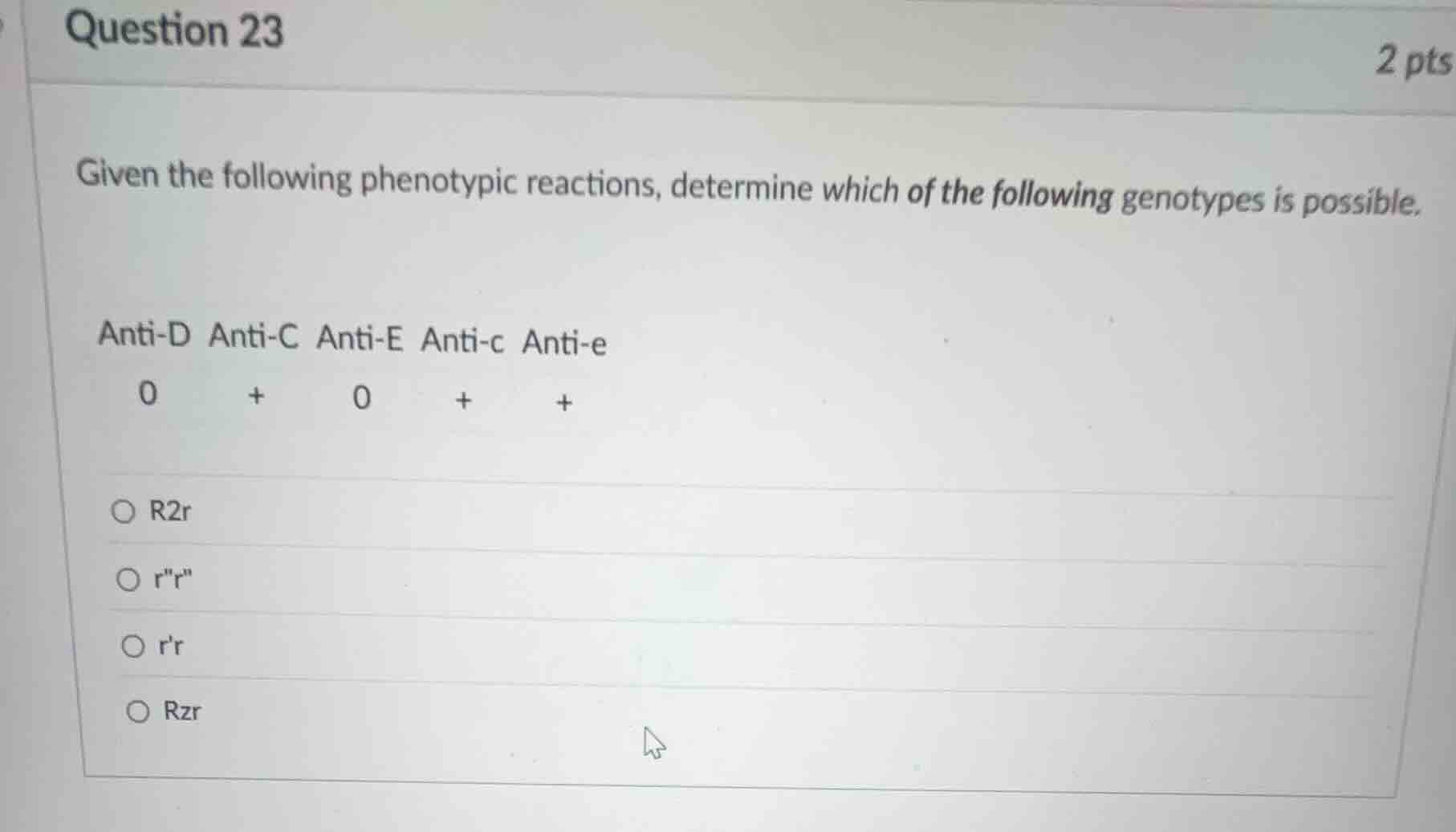
given the following phenotypic reactions, determine which of the following genotypes is possible.
anti-d anti-c anti-e anti-c anti-e
0 + 0 + +
- r2r
- r
\
- rr
- rzr
Determine the antigen phenotype
Using the Rh Blood Group System knowledge point
- Anti-D: \(0\) (D-negative)
- Anti-C: \(+\) (C-positive)
- Anti-E: \(0\) (E-negative)
- Anti-c: \(+\) (c-positive)
- Anti-e: \(+\) (e-positive)
- The phenotype is: D-, C+, E-, c+, e+
Translate Wiener nomenclature to Fisher-Race
Using the Wiener Nomenclature knowledge point
- \(R_2r\): \(DcE/dce\) (D-positive, contains E)
- \(r''r''\): \(dcE/dcE\) (C-negative, contains E)
- \(r'r\): \(dCe/dce\) (D-negative, contains C, c, e)
- \(R_zr\): \(DCE/dce\) (D-positive, contains E)
Match genotypes to the observed phenotype
Using the Rh Blood Group System and Wiener Nomenclature knowledge points
- Target phenotype: D-negative, C-positive, E-negative, c-positive, e-positive.
- \(R_2r\) and \(R_zr\) are D-positive (\(0\) reaction with Anti-D is expected for D-negative).
- \(r''r''\) is C-negative and E-positive (expected Anti-C: \(0\), Anti-E: \(+\)).
- \(r'r\) (\(dCe/dce\)) produces antigens C, c, and e, while lacking D and E. This perfectly matches the reactions: Anti-D (\(0\)), Anti-C (\(+\)), Anti-E (\(0\)), Anti-c (\(+\)), Anti-e (\(+\)).

Snap & solve any problem in the app
Get step-by-step solutions on Sovi AI
Photo-based solutions with guided steps
Explore more problems and detailed explanations
- (A) R2r
- (B) r"r"
- (C) r'r (Correct answer)
- (D) Rzr