QUESTION IMAGE
Question
question 19
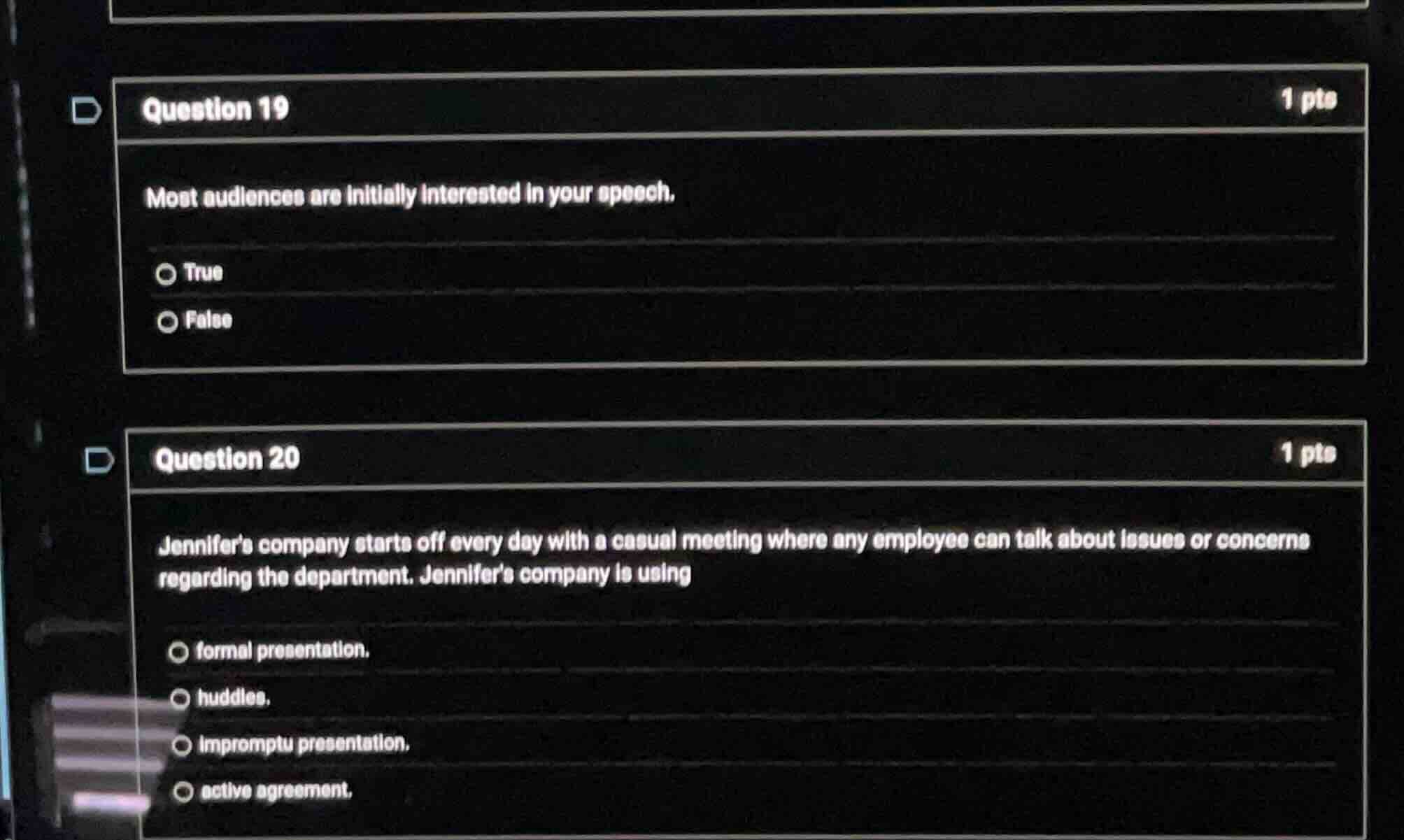
most audiences are initially interested in your speech.
true
false
question 20
jennifers company starts off every day with a casual meeting where any employee can talk about issues or concerns regarding the department. jennifers company is using
formal presentation.
huddles.
impromptu presentation.
active agreement.
<pre_analysis>
{
"quality": "clear",
"question_count": 2,
"skills_matched": [
"direct_cot",
"multiple_choice_formatter",
"explain_then_answer",
"tutor"
],
"needs_drawing": false,
"concepts_used": [
"Meeting Effectiveness"
],
"new_concepts": [
"Audience Psychology",
"Workplace Communication Channels"
],
"current_concepts": [
"Audience Psychology",
"Meeting Effectiveness",
"Workplace Communication Channels"
]
}
</pre_analysis>
<reasoning>
Analyze audience interest in public speaking
In public speaking and communication studies, a foundational principle of audience psychology is that audiences are generally polite and initially receptive. When a speaker takes the stage, the audience is typically curious and interested in what will be said, giving the speaker an initial window of attention. Therefore, the statement "Most audiences are initially interested in your speech" is considered true.
Analyze the daily casual meeting scenario
Jennifer's company starts each day with a brief, casual meeting where employees can raise issues or concerns. In organizational communication and Meeting Effectiveness, this type of quick, daily, and informal team meeting is specifically referred to as a "huddle" (or daily stand-up). It is designed for rapid alignment and identifying blockers rather than formal or impromptu presentations.
</reasoning>
<answer>
Question 19
<mcq-correct>True</mcq-correct>
<mcq-option>False</mcq-option>
Question 20
<mcq-option>formal presentation.</mcq-option>
<mcq-correct>huddles.</mcq-correct>
<mcq-option>impromptu presentation.</mcq-option>
<mcq-option>active agreement.</mcq-option>
</answer>
<post_analysis>
{
"subject": "Social Science",
"question_type": "Multiple Choice",
"knowledge_point": [
"Social Science",
"Communication Studies",
"Organizational Communication"
]
}
</post_analysis>
Snap & solve any problem in the app
Get step-by-step solutions on Sovi AI
Photo-based solutions with guided steps
Explore more problems and detailed explanations
<pre_analysis>
{
"quality": "clear",
"question_count": 2,
"skills_matched": [
"direct_cot",
"multiple_choice_formatter",
"explain_then_answer",
"tutor"
],
"needs_drawing": false,
"concepts_used": [
"Meeting Effectiveness"
],
"new_concepts": [
"Audience Psychology",
"Workplace Communication Channels"
],
"current_concepts": [
"Audience Psychology",
"Meeting Effectiveness",
"Workplace Communication Channels"
]
}
</pre_analysis>
<reasoning>
Analyze audience interest in public speaking
In public speaking and communication studies, a foundational principle of audience psychology is that audiences are generally polite and initially receptive. When a speaker takes the stage, the audience is typically curious and interested in what will be said, giving the speaker an initial window of attention. Therefore, the statement "Most audiences are initially interested in your speech" is considered true.
Analyze the daily casual meeting scenario
Jennifer's company starts each day with a brief, casual meeting where employees can raise issues or concerns. In organizational communication and Meeting Effectiveness, this type of quick, daily, and informal team meeting is specifically referred to as a "huddle" (or daily stand-up). It is designed for rapid alignment and identifying blockers rather than formal or impromptu presentations.
</reasoning>
<answer>
Question 19
<mcq-correct>True</mcq-correct>
<mcq-option>False</mcq-option>
Question 20
<mcq-option>formal presentation.</mcq-option>
<mcq-correct>huddles.</mcq-correct>
<mcq-option>impromptu presentation.</mcq-option>
<mcq-option>active agreement.</mcq-option>
</answer>
<post_analysis>
{
"subject": "Social Science",
"question_type": "Multiple Choice",
"knowledge_point": [
"Social Science",
"Communication Studies",
"Organizational Communication"
]
}
</post_analysis>