QUESTION IMAGE
Question
question 18 of 25
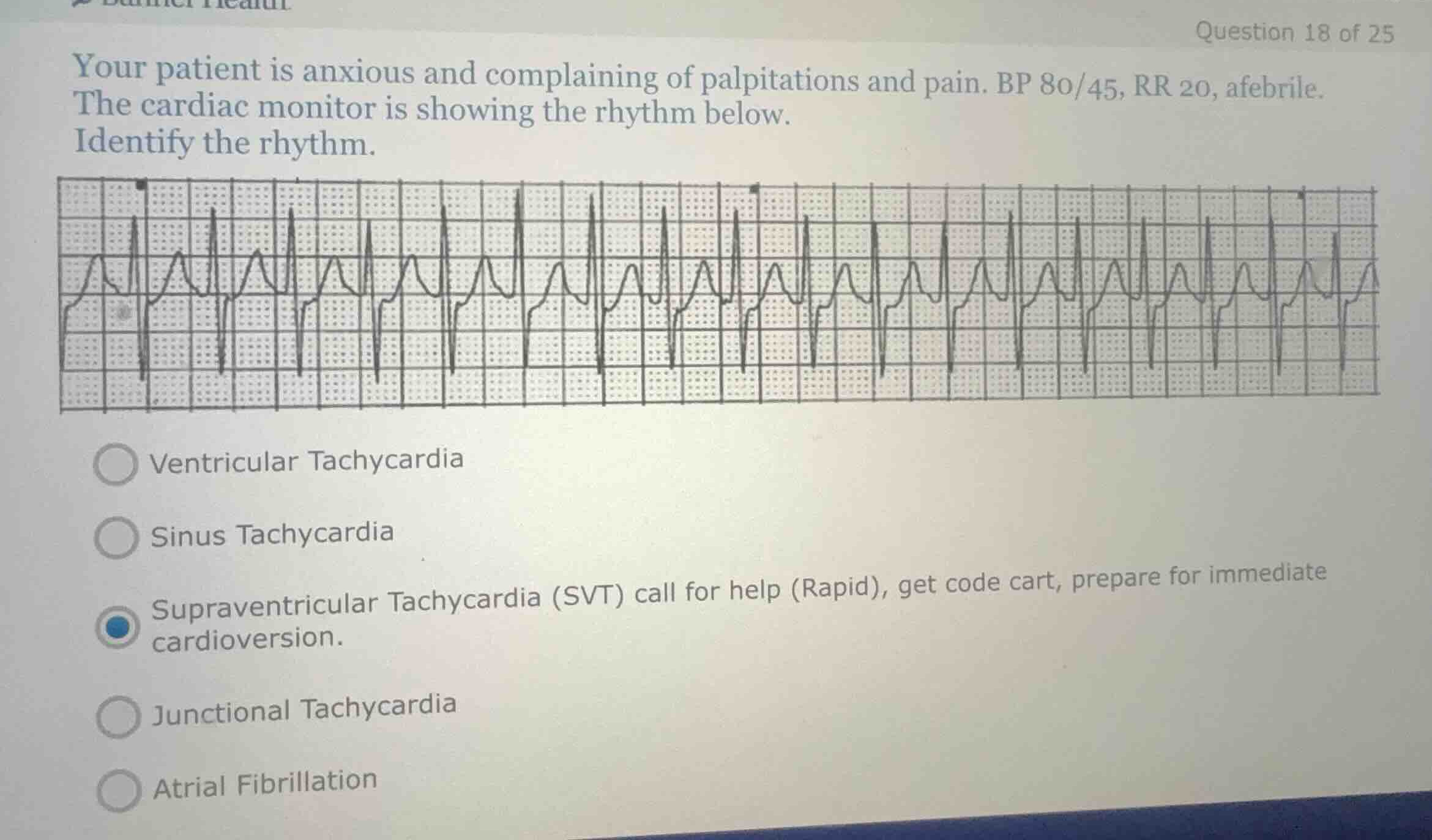
your patient is anxious and complaining of palpitations and pain. bp 80/45, rr 20, afebrile.
the cardiac monitor is showing the rhythm below.
identify the rhythm.
ventricular tachycardia
sinus tachycardia
supraventricular tachycardia (svt) call for help (rapid), get code cart, prepare for immediate cardioversion.
junctional tachycardia
atrial fibrillation
Analyze the ECG strip characteristics
- Rate: Extremely rapid, approximately \(180\text{ to }200\text{ bpm}\) (R-R interval is roughly 1.5 large boxes).
- Rhythm: Regular.
- QRS Complex: Narrow (less than 3 small boxes, or \(<0.12\text{ s}\)), indicating a supraventricular origin.
- P waves: Not clearly discernible, likely buried in the preceding T waves due to the rapid rate.
Evaluate clinical status and management
- The patient is symptomatic and unstable, presenting with hypotension (\(\text{BP } 80/45\)), anxiety, palpitations, and pain.
- According to Advanced Cardiac Life Support (ACLS) guidelines, an unstable patient with a regular narrow-complex tachycardia (Supraventricular Tachycardia) requires immediate synchronized cardioversion.

Snap & solve any problem in the app
Get step-by-step solutions on Sovi AI
Photo-based solutions with guided steps
Explore more problems and detailed explanations
- (A) Ventricular Tachycardia
- (B) Sinus Tachycardia
- (C) Supraventricular Tachycardia (SVT) call for help (Rapid), get code cart, prepare for immediate cardioversion. (Correct answer)
- (D) Junctional Tachycardia
- (E) Atrial Fibrillation