QUESTION IMAGE
Question
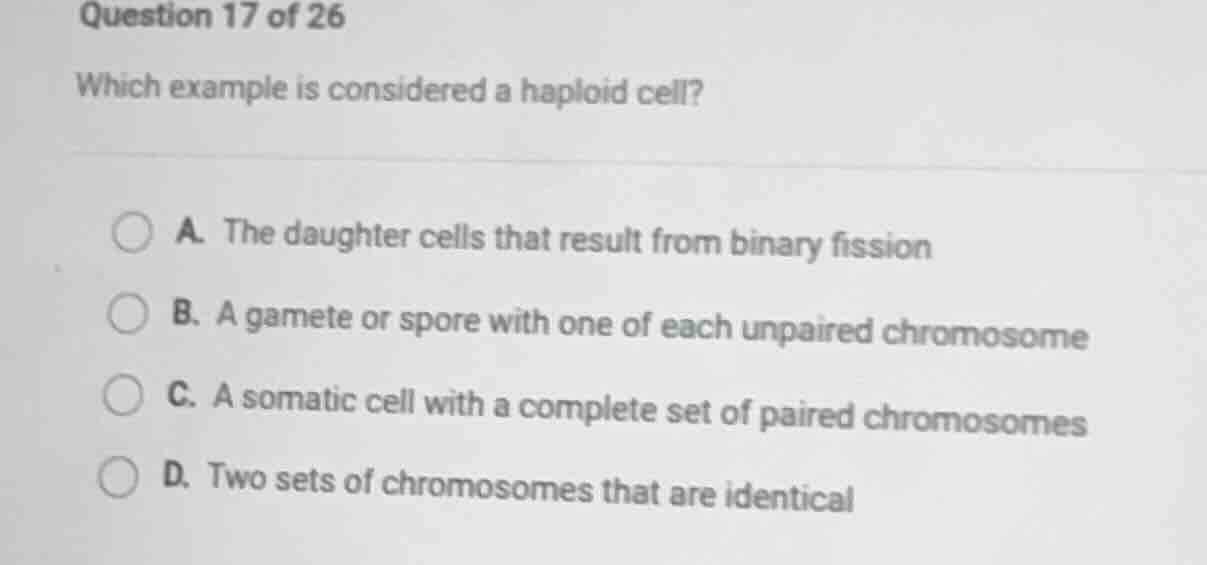
question 17 of 26
which example is considered a haploid cell?
a. the daughter cells that result from binary fission
b. a gamete or spore with one of each unpaired chromosome
c. a somatic cell with a complete set of paired chromosomes
d. two sets of chromosomes that are identical
Define haploid cells
A haploid cell contains a single set of unpaired chromosomes, represented as \(n\). This is in contrast to diploid cells (\(2n\)), which contain paired homologous chromosomes.
Analyze the given options
- Option A: Daughter cells from binary fission are typically genetically identical to the parent prokaryotic cell, which does not represent the standard eukaryotic haploid/diploid alternation.
- Option B: A gamete (like sperm or egg) or a spore is the classic biological example of a haploid cell, containing exactly one of each unpaired chromosome.
- Option C: A somatic cell with paired chromosomes is diploid (\(2n\)).
- Option D: Two identical sets of chromosomes describe a diploid state.
Connect to cell division concepts
During Mitosis vs Meiosis, meiosis reduces the chromosome number by half to produce haploid gametes, ensuring that sexual reproduction restores the diploid number. Thus, Option B is the correct definition.

Snap & solve any problem in the app
Get step-by-step solutions on Sovi AI
Photo-based solutions with guided steps
Explore more problems and detailed explanations
- (A) The daughter cells that result from binary fission
- (B) A gamete or spore with one of each unpaired chromosome (Correct answer)
- (C) A somatic cell with a complete set of paired chromosomes
- (D) Two sets of chromosomes that are identical