QUESTION IMAGE
Question
question 15
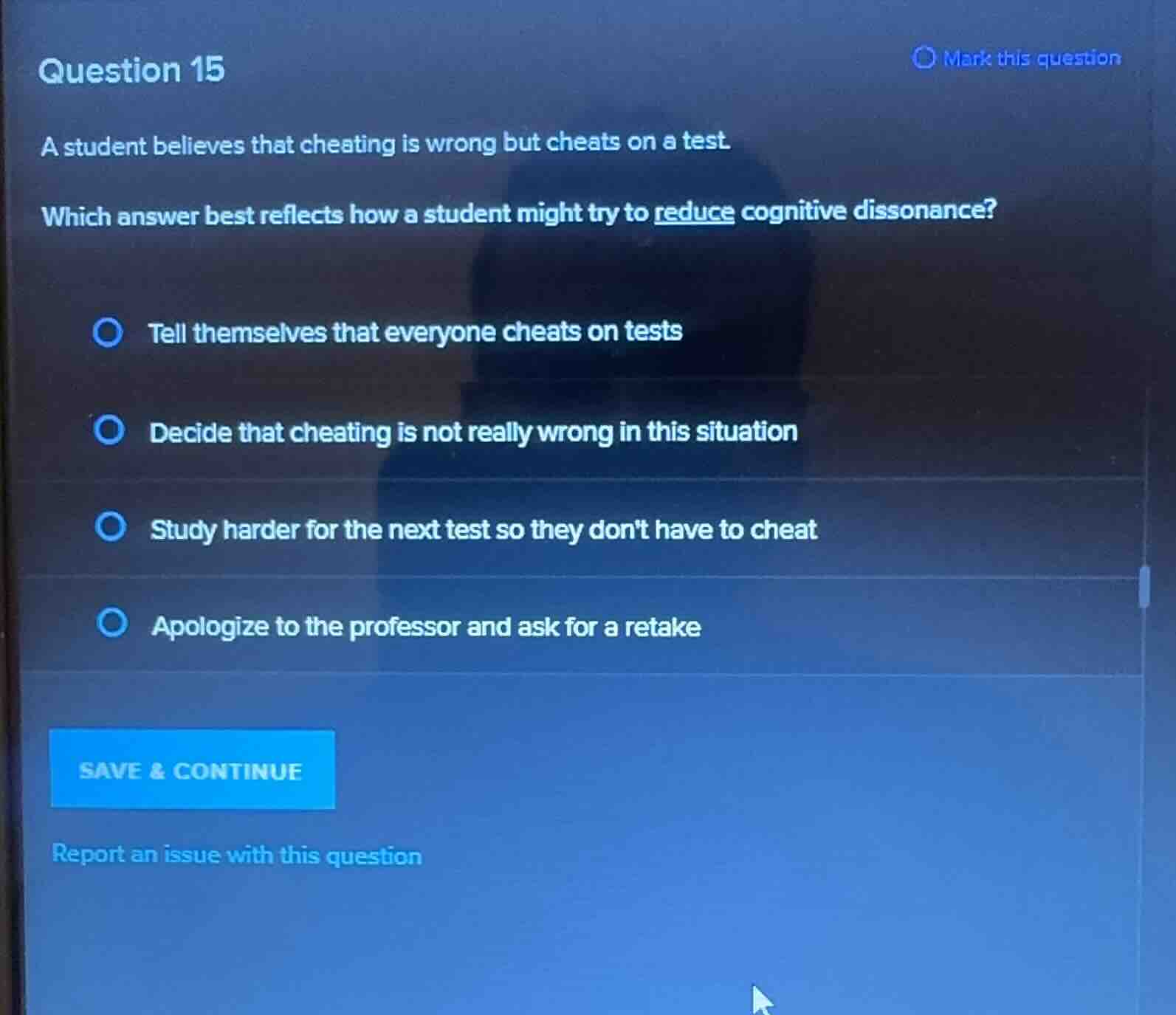
a student believes that cheating is wrong but cheats on a test.
which answer best reflects how a student might try to reduce cognitive dissonance?
- tell themselves that everyone cheats on tests
- decide that cheating is not really wrong in this situation
- study harder for the next test so they dont have to cheat
- apologize to the professor and ask for a retake
Define cognitive dissonance
Cognitive dissonance is the psychological discomfort a person experiences when holding two or more contradictory beliefs, ideas, or values, or when their behavior is inconsistent with their beliefs. In this scenario, the student's belief ("cheating is wrong") directly conflicts with their behavior ("cheating on a test").
Identify methods of reducing dissonance
To reduce this uncomfortable tension, individuals typically use one of three main cognitive strategies:
- Change the behavior to align with the belief (e.g., stop cheating).
- Change the belief to align with the behavior (e.g., decide cheating is actually acceptable).
- Rationalize or justify the behavior by adding new cognitions (e.g., "everyone does it" or "I had no choice because the test was unfair").
Evaluate the given options
- "Tell themselves that everyone cheats on tests": This is a classic rationalization strategy. By adding a new belief ("everyone does it"), the student minimizes the personal inconsistency and reduces the psychological discomfort.
- "Decide that cheating is not really wrong in this situation": This is another direct way to reduce dissonance by changing or qualifying the belief to match the behavior ("it's not wrong in this specific case").
- "Study harder for the next test so they don't have to cheat": This addresses future behavior but does not resolve the immediate cognitive dissonance regarding the act already committed.
- "Apologize to the professor and ask for a retake": This is a behavioral correction/confession, which is a way to resolve the situation but is less representative of the internal cognitive rationalization mechanisms typically studied under cognitive dissonance theory for an ongoing conflict.
Determine the best fit
Among the choices, changing the belief about the behavior in the specific situation ("Decide that cheating is not really wrong in this situation") directly alters the conflicting cognition to match the behavior, which is a primary, direct mechanism of cognitive dissonance reduction. Alternatively, rationalizing that "everyone cheats" is also a common justification. Let's look at standard textbook examples of cognitive dissonance:
When a person cheats despite believing it is wrong, they reduce dissonance by either changing their attitude ("cheating isn't that bad / is not really wrong in this situation") or rationalizing ("everyone does it").
Between the two, "Decide that cheating is not really wrong in this situation" directly targets the attitude toward the behavior itself to eliminate the conflict.

Snap & solve any problem in the app
Get step-by-step solutions on Sovi AI
Photo-based solutions with guided steps
Explore more problems and detailed explanations
- Tell themselves that everyone cheats on tests
- Decide that cheating is not really wrong in this situation (Correct answer)
- Study harder for the next test so they don't have to cheat
- Apologize to the professor and ask for a retake