QUESTION IMAGE
Question
question 15
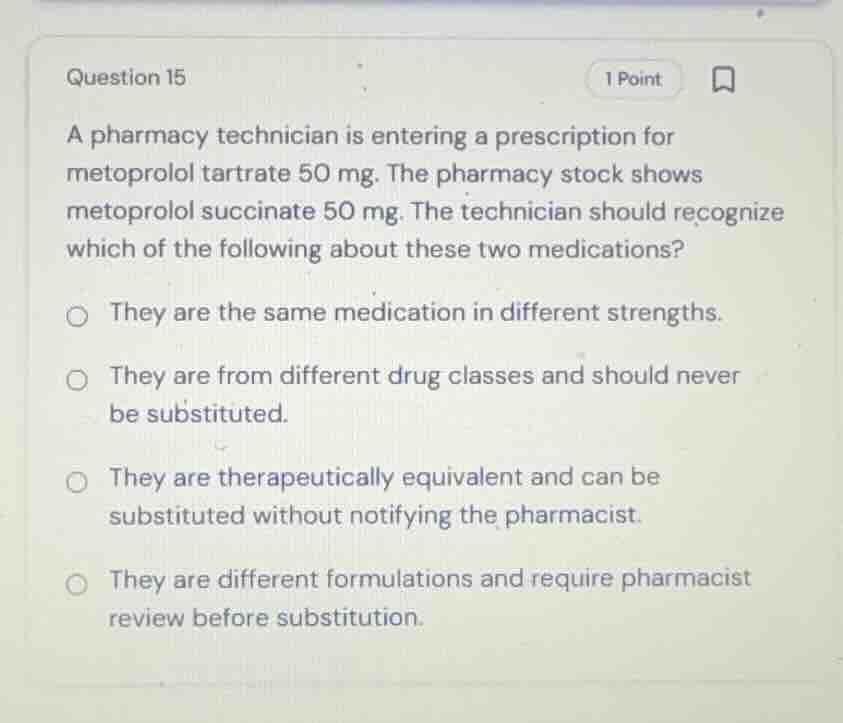
a pharmacy technician is entering a prescription for metoprolol tartrate 50 mg. the pharmacy stock shows metoprolol succinate 50 mg. the technician should recognize which of the following about these two medications?
they are the same medication in different strengths.
they are from different drug classes and should never be substituted.
they are therapeutically equivalent and can be substituted without notifying the pharmacist.
they are different formulations and require pharmacist review before substitution.
Compare the active ingredients and salt forms
Using the Salt Form Differences knowledge point
- Metoprolol tartrate and metoprolol succinate contain the same active moiety (metoprolol) but are bound to different salt forms (tartrate vs. succinate).
- These different salt forms result in different release profiles: metoprolol tartrate is an immediate-release formulation (usually dosed multiple times daily), whereas metoprolol succinate is an extended-release formulation (usually dosed once daily).
- Because of these different release kinetics, they are not interchangeable on a milligram-to-milligram basis.
Evaluate substitution regulations
Using the Generic Substitution Regulations knowledge point
- Since they are different formulations with different release rates, they are not therapeutically equivalent (they do not have an "AB" rating in the Orange Book).
- A pharmacy technician cannot substitute one for the other automatically.
- Any change between these two formulations requires a pharmacist's review and clinical judgment, and typically requires contacting the prescriber for a new prescription.
Analyze the given options
- Option 1: "They are the same medication in different strengths." This is incorrect because both are \(50\text{ mg}\), but they have different salt forms and release profiles.
- Option 2: "They are from different drug classes and should never be substituted." This is incorrect because both are beta-blockers (same drug class), and they can be switched if authorized by a prescriber.
- Option 3: "They are therapeutically equivalent and can be substituted without notifying the pharmacist." This is incorrect because they are not therapeutically equivalent.
- Option 4: "They are different formulations and require pharmacist review before substitution." This is correct because the different salt forms represent immediate-release vs. extended-release formulations, which are not therapeutically equivalent and require professional intervention.

Snap & solve any problem in the app
Get step-by-step solutions on Sovi AI
Photo-based solutions with guided steps
Explore more problems and detailed explanations
- (A) They are the same medication in different strengths.
- (B) They are from different drug classes and should never be substituted.
- (C) They are therapeutically equivalent and can be substituted without notifying the pharmacist.
- (D) They are different formulations and require pharmacist review before substitution. (Correct answer)