QUESTION IMAGE
Question
question 14
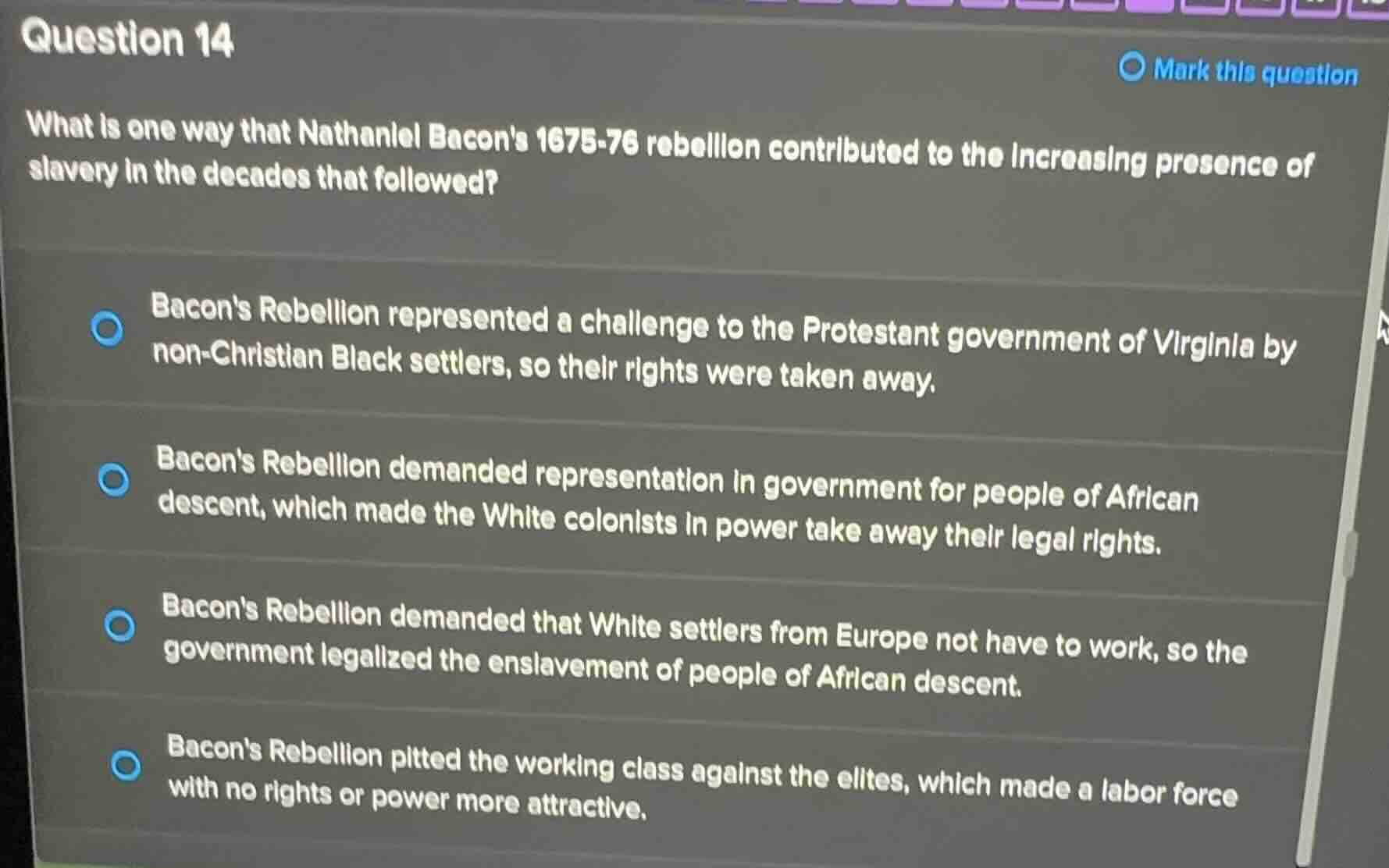
what is one way that nathaniel bacons 1675-76 rebellion contributed to the increasing presence of slavery in the decades that followed?
- bacons rebellion represented a challenge to the protestant government of virginia by non-christian black settlers, so their rights were taken away.
- bacons rebellion demanded representation in government for people of african descent, which made the white colonists in power take away their legal rights.
- bacons rebellion demanded that white settlers from europe not have to work, so the government legalized the enslavement of people of african descent.
- bacons rebellion pitted the working class against the elites, which made a labor force with no rights or power more attractive.
Analyze the historical context of Bacon's Rebellion
Using the Racialization of Slavery knowledge point
Bacon's Rebellion (1675–1676) united poor White indentured servants and enslaved Black laborers against the ruling planter elite in Virginia. This alliance deeply alarmed the wealthy colonial authorities, who feared future uprisings from a unified working class.
Evaluate the consequences on labor systems
To prevent future multi-racial alliances, Virginia's elite deliberately transitioned away from volatile indentured servitude toward racialized chattel slavery. By relying on enslaved Africans who had no legal rights, the elites created a permanent, controllable labor force and drove a legal wedge between poor White and Black laborers.
Assess the given options
- Option 1 is historically inaccurate; the rebellion was not a religious conflict led by non-Christian Black settlers.
- Option 2 is incorrect; the rebellion was not primarily a demand for representation for people of African descent.
- Option 3 is incorrect; the rebellion did not demand that White settlers not work, nor did it directly legalize slavery for that reason.
- Option 4 correctly identifies that the rebellion pitted the working class (servants and slaves) against the elites, making a completely disenfranchised labor force (enslaved Africans) far more attractive to the ruling class.

Snap & solve any problem in the app
Get step-by-step solutions on Sovi AI
Photo-based solutions with guided steps
Explore more problems and detailed explanations
- (A) Bacon's Rebellion represented a challenge to the Protestant government of Virginia by non-Christian Black settlers, so their rights were taken away.
- (B) Bacon's Rebellion demanded representation in government for people of African descent, which made the White colonists in power take away their legal rights.
- (C) Bacon's Rebellion demanded that White settlers from Europe not have to work, so the government legalized the enslavement of people of African descent.
- (D) Bacon's Rebellion pitted the working class against the elites, which made a labor force with no rights or power more attractive. (Correct answer)