Sovi.AI - AI Math Tutor

Scan to solve math questions

QUESTION IMAGE

question 13 of 26 why does sexual reproduction result in greater geneti…

Question

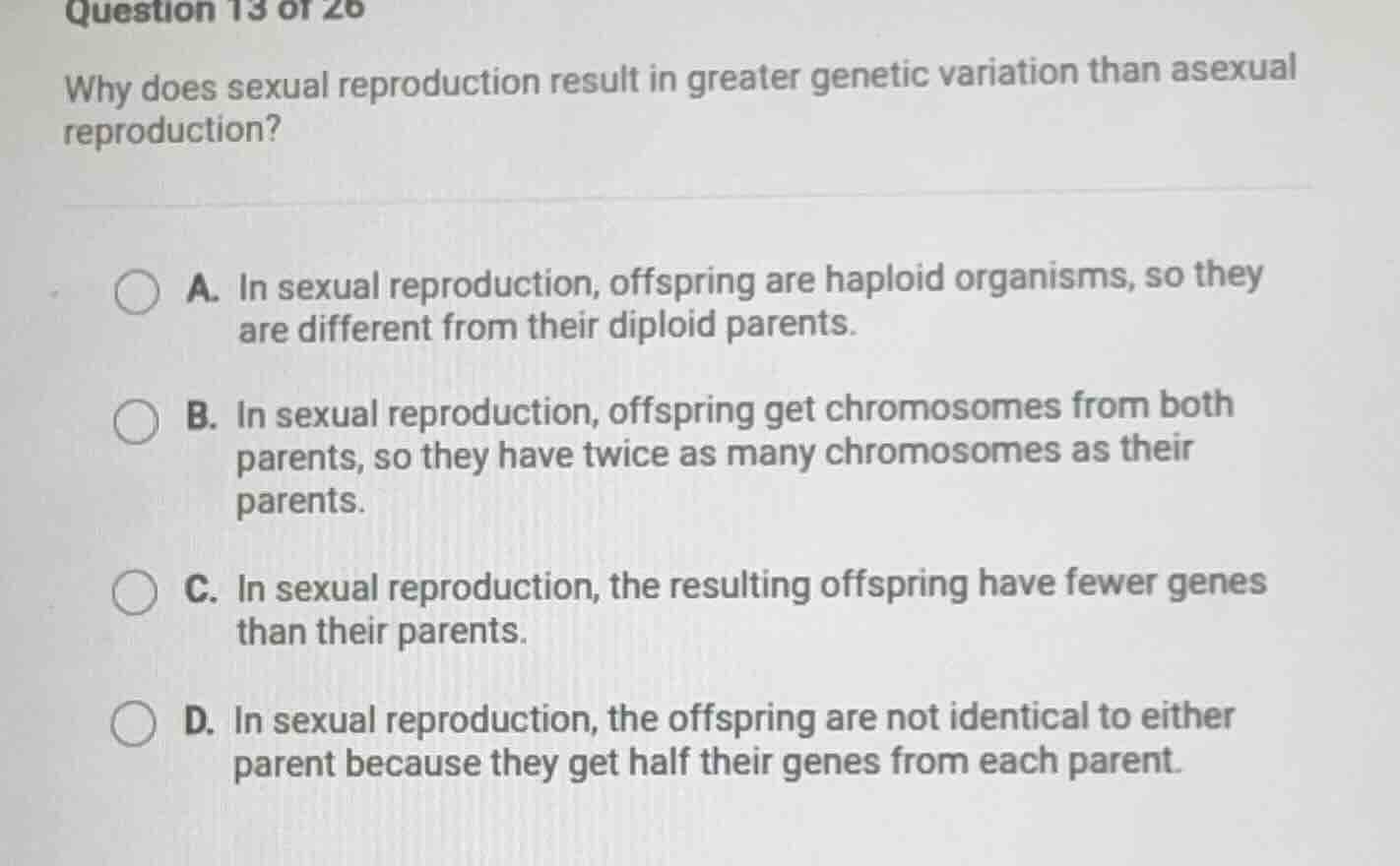
question 13 of 26

why does sexual reproduction result in greater genetic variation than asexual reproduction?

a. in sexual reproduction, offspring are haploid organisms, so they are different from their diploid parents.
b. in sexual reproduction, offspring get chromosomes from both parents, so they have twice as many chromosomes as their parents.
c. in sexual reproduction, the resulting offspring have fewer genes than their parents.
d. in sexual reproduction, the offspring are not identical to either parent because they get half their genes from each parent.

Explanation:

Response

<pre_analysis>
{
"quality": "clear",
"question_count": 1,
"skills_matched": [
"direct_cot",
"multiple_choice_formatter",
"explain_then_answer",
"tutor"
],
"needs_drawing": false,
"concepts_used": [
"Genetic Variation"
],
"new_concepts": [
"Sexual Reproduction",
"Asexual Reproduction"
],
"current_concepts": [
"Genetic Variation",
"Sexual Reproduction",
"Asexual Reproduction"
]
}
</pre_analysis>

<reasoning>

Analyze the question

The question asks why sexual reproduction results in greater genetic variation than asexual reproduction.

Evaluate Option A

Offspring in sexual reproduction are diploid, not haploid. This option is scientifically incorrect.

Evaluate Option B

Offspring do not have twice as many chromosomes as their parents. Fertilization combines two haploid gametes to maintain the diploid number. This option is incorrect.

Evaluate Option C

Offspring do not have fewer genes than their parents; they inherit a complete set of genes. This option is incorrect.

Evaluate Option D

This option correctly explains that offspring inherit half of their genetic material from each parent, creating a unique genetic combination. This process directly increases Genetic Variation.
</reasoning>

<answer>
<mcq-option>(A) In sexual reproduction, offspring are haploid organisms, so they are different from their diploid parents.</mcq-option>
<mcq-option>(B) In sexual reproduction, offspring get chromosomes from both parents, so they have twice as many chromosomes as their parents.</mcq-option>
<mcq-option>(C) In sexual reproduction, the resulting offspring have fewer genes than their parents.</mcq-option>
<mcq-correct>(D) In sexual reproduction, the offspring are not identical to either parent because they get half their genes from each parent.</mcq-correct>
</answer>

<post_analysis>
{
"subject": "Natural Science",
"question_type": "Multiple Choice",
"knowledge_point": [
"Natural Science",
"Biology",
"Sexual Reproduction"
]
}
</post_analysis>

Answer:

<pre_analysis>
{
"quality": "clear",
"question_count": 1,
"skills_matched": [
"direct_cot",
"multiple_choice_formatter",
"explain_then_answer",
"tutor"
],
"needs_drawing": false,
"concepts_used": [
"Genetic Variation"
],
"new_concepts": [
"Sexual Reproduction",
"Asexual Reproduction"
],
"current_concepts": [
"Genetic Variation",
"Sexual Reproduction",
"Asexual Reproduction"
]
}
</pre_analysis>

<reasoning>

Analyze the question

The question asks why sexual reproduction results in greater genetic variation than asexual reproduction.

Evaluate Option A

Offspring in sexual reproduction are diploid, not haploid. This option is scientifically incorrect.

Evaluate Option B

Offspring do not have twice as many chromosomes as their parents. Fertilization combines two haploid gametes to maintain the diploid number. This option is incorrect.

Evaluate Option C

Offspring do not have fewer genes than their parents; they inherit a complete set of genes. This option is incorrect.

Evaluate Option D

This option correctly explains that offspring inherit half of their genetic material from each parent, creating a unique genetic combination. This process directly increases Genetic Variation.
</reasoning>

<answer>
<mcq-option>(A) In sexual reproduction, offspring are haploid organisms, so they are different from their diploid parents.</mcq-option>
<mcq-option>(B) In sexual reproduction, offspring get chromosomes from both parents, so they have twice as many chromosomes as their parents.</mcq-option>
<mcq-option>(C) In sexual reproduction, the resulting offspring have fewer genes than their parents.</mcq-option>
<mcq-correct>(D) In sexual reproduction, the offspring are not identical to either parent because they get half their genes from each parent.</mcq-correct>
</answer>

<post_analysis>
{
"subject": "Natural Science",
"question_type": "Multiple Choice",
"knowledge_point": [
"Natural Science",
"Biology",
"Sexual Reproduction"
]
}
</post_analysis>