QUESTION IMAGE
Question
question 12
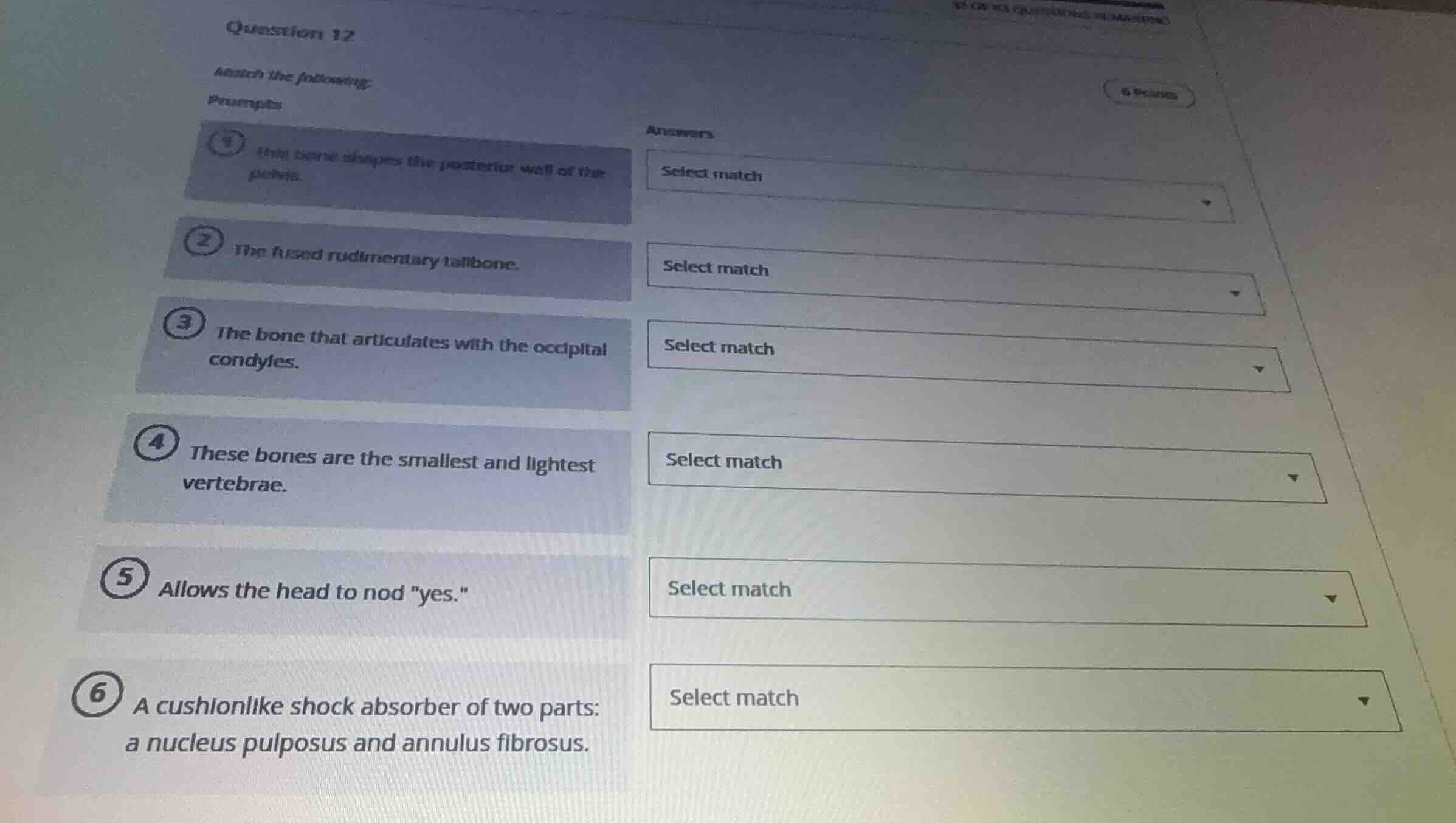
match the following:
prompts
1 this bone shapes the posterior wall of the pelvis.
2 the fused rudimentary tailbone.
3 the bone that articulates with the occipital condyles.
4 these bones are the smallest and lightest vertebrae.
5 allows the head to nod \yes.\
6 a cushionlike shock absorber of two parts: a nucleus pulposus and annulus fibrosus.
Identify pelvic and tailbone structures
Using the Vertebral Column Anatomy knowledge point
- Prompt 1: The bone forming the posterior wall of the pelvis is the sacrum.
- Prompt 2: The fused, rudimentary tailbone is the coccyx.
Analyze upper cervical vertebrae
- Prompt 3: The bone that articulates directly with the occipital condyles of the skull is the first cervical vertebra, known as the atlas (C1).
- Prompt 4: The smallest and lightest vertebrae in the vertebral column are the cervical vertebrae (C3-C7, and C1-C2 generally).
Determine head movement and disc structure
- Prompt 5: The joint between the occipital condyles and the atlas (atlanto-occipital joint) allows the head to nod "yes", which is a function of the atlas (C1).
- Prompt 6: A cushionlike shock absorber consisting of a nucleus pulposus and annulus fibrosus is an intervertebral disc.

Snap & solve any problem in the app
Get step-by-step solutions on Sovi AI
Photo-based solutions with guided steps
Explore more problems and detailed explanations
| No. | Problem | Answer |
|---|---|---|
| 2 | The fused rudimentary tailbone. | Coccyx |
| 3 | The bone that articulates with the occipital condyles. | Atlas (C1) |
| 4 | These bones are the smallest and lightest vertebrae. | Cervical vertebrae |
| 5 | Allows the head to nod "yes." | Atlas (C1) |
| 6 | A cushionlike shock absorber of two parts: a nucleus pulposus and annulus fibrosus. | Intervertebral disc |