QUESTION IMAGE
Question
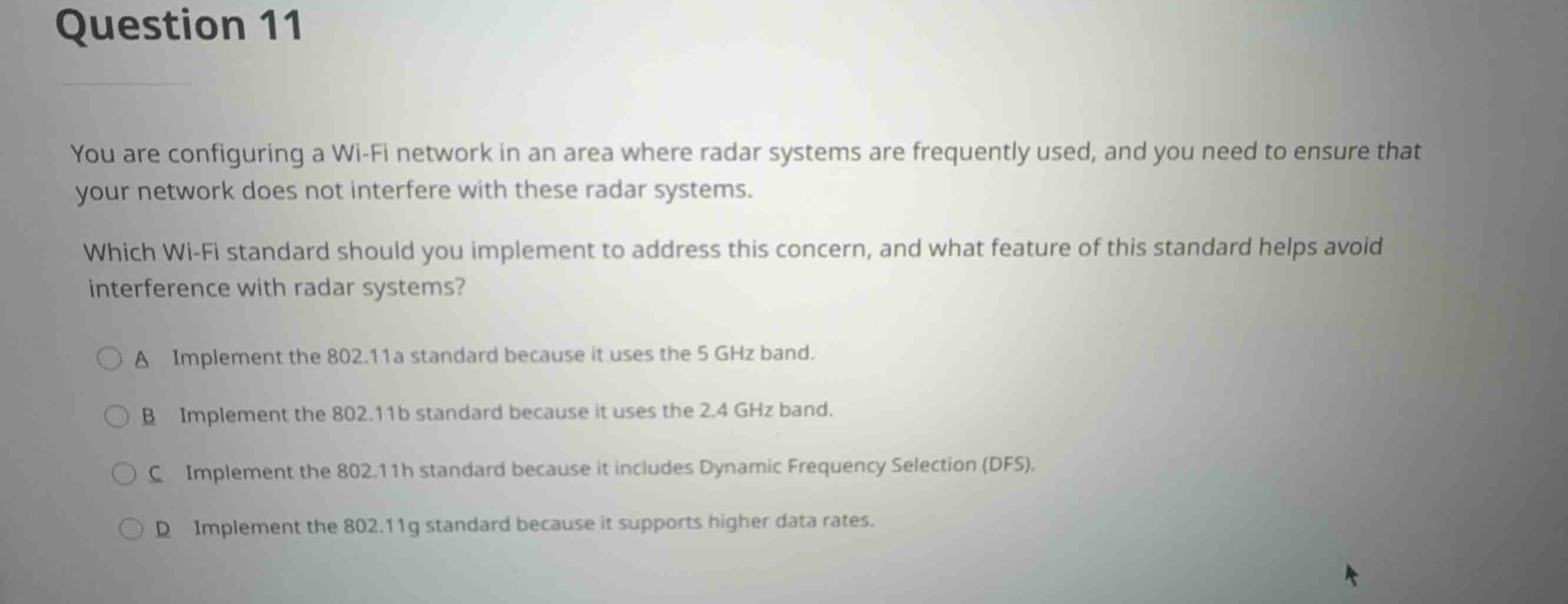
question 11
you are configuring a wi-fi network in an area where radar systems are frequently used, and you need to ensure that your network does not interfere with these radar systems.
which wi-fi standard should you implement to address this concern, and what feature of this standard helps avoid interference with radar systems?
a implement the 802.11a standard because it uses the 5 ghz band.
b implement the 802.11b standard because it uses the 2.4 ghz band.
c implement the 802.11h standard because it includes dynamic frequency selection (dfs).
d implement the 802.11g standard because it supports higher data rates.
Analyze the core requirement
The problem asks for a Wi-Fi standard and a specific feature that prevents interference with radar systems in the same frequency band.
Evaluate the options
- 802.11a operates in the \(5\text{ GHz}\) band but does not inherently include mechanisms specifically designed to dynamically detect and avoid radar systems.
- 802.11b operates in the \(2.4\text{ GHz}\) band, which is not the primary band where these specific radar interference issues and regulatory requirements (like DFS) apply.
- 802.11h was specifically designed as an amendment to 802.11a to resolve interference with radar and satellite systems in the \(5\text{ GHz}\) band. It introduces Dynamic Frequency Selection (DFS) and Transmit Power Control (TPC).
- 802.11g operates in the \(2.4\text{ GHz}\) band and focuses on higher data rates compared to 802.11b, without radar avoidance features.
Identify the correct feature
Dynamic Frequency Selection (DFS) is the regulatory requirement and feature that forces wireless devices to listen for radar signals. If radar is detected, the Wi-Fi device must automatically vacate the channel and select an alternative, non-interfering frequency. This matches option C.

Snap & solve any problem in the app
Get step-by-step solutions on Sovi AI
Photo-based solutions with guided steps
Explore more problems and detailed explanations
- (A) Implement the 802.11a standard because it uses the 5 GHz band.
- (B) Implement the 802.11b standard because it uses the 2.4 GHz band.</mcq-correct>
- (C) Implement the 802.11h standard because it includes Dynamic Frequency Selection (DFS). (Correct answer)
<mcq-option>(D) Implement the 802.11g standard because it supports higher data rates.