QUESTION IMAGE
Question
question 11 of 20
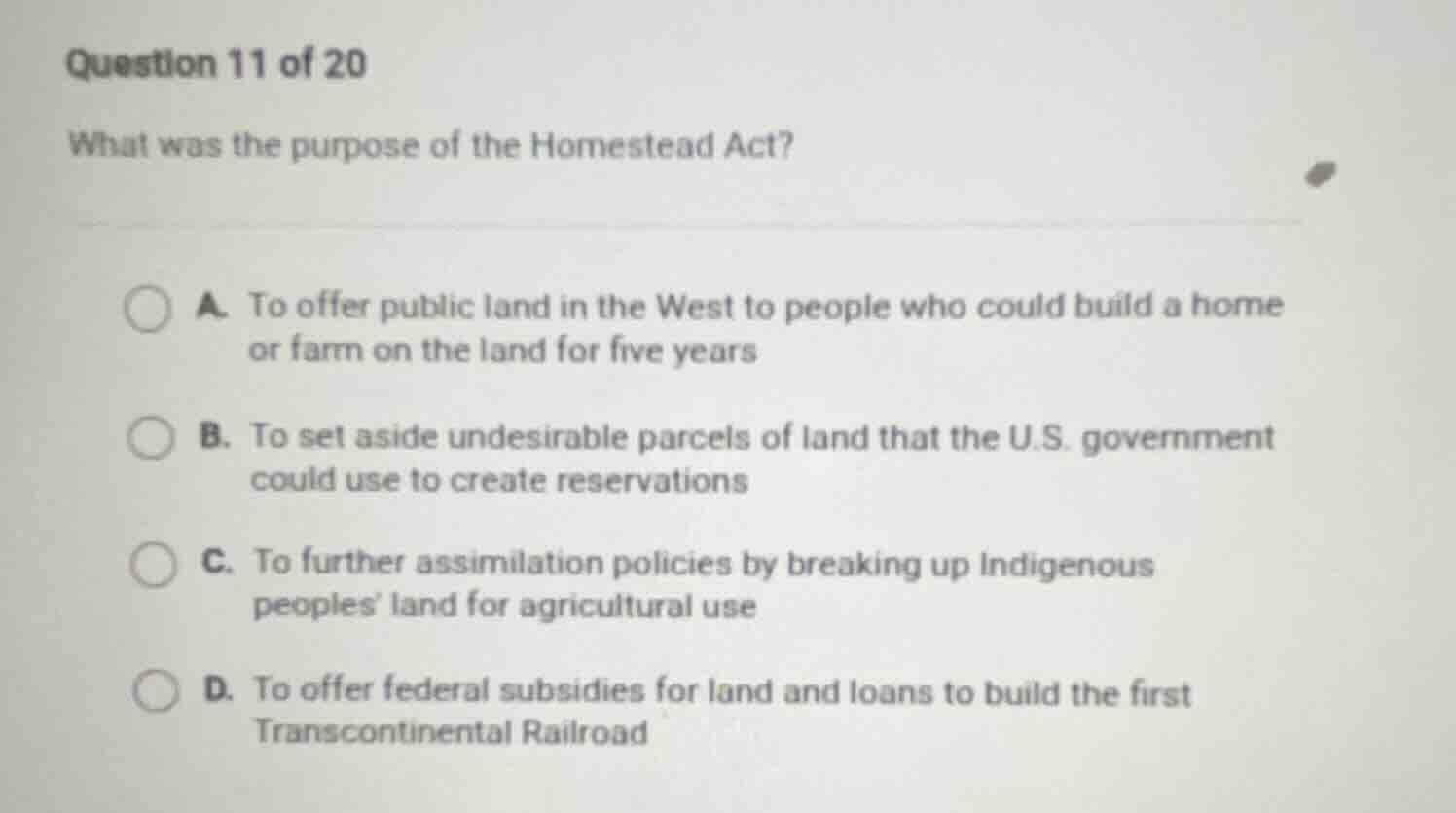
what was the purpose of the homestead act?
a. to offer public land in the west to people who could build a home or farm on the land for five years
b. to set aside undesirable parcels of land that the u.s. government could use to create reservations
c. to further assimilation policies by breaking up indigenous peoples land for agricultural use
d. to offer federal subsidies for land and loans to build the first transcontinental railroad
Analyze the question
The question asks for the primary purpose of the Homestead Act, a key piece of legislation passed in 1862 during the American Civil War.
Evaluate the options
- Option A states that the purpose was to offer public land in the West to people who would build a home or farm on the land for five years. This matches the historical provisions of the Homestead Act of 1862, which granted 160 acres of public land to citizens or intended citizens who paid a small registration fee, lived on the land, and improved it (by farming or building a home) for a continuous period of five years.
- Option B describes the creation of Indian reservations, which is associated with federal Indian policy and the reservation system, not the Homestead Act.
- Option C describes the Dawes Act of 1887, which aimed to assimilate Native Americans by breaking up tribal lands into individual allotments.
- Option D describes the Pacific Railway Act, which provided federal subsidies and land grants to build the Transcontinental Railroad.
Select the correct option
Option A is the correct description of the Homestead Act's purpose.

Snap & solve any problem in the app
Get step-by-step solutions on Sovi AI
Photo-based solutions with guided steps
Explore more problems and detailed explanations
- A. To offer public land in the West to people who could build a home or farm on the land for five years (Correct answer)
- B. To set aside undesirable parcels of land that the U.S. government could use to create reservations
- C. To further assimilation policies by breaking up Indigenous peoples' land for agricultural use
- D. To offer federal subsidies for land and loans to build the first Transcontinental Railroad