QUESTION IMAGE
Question
question 11 of 20
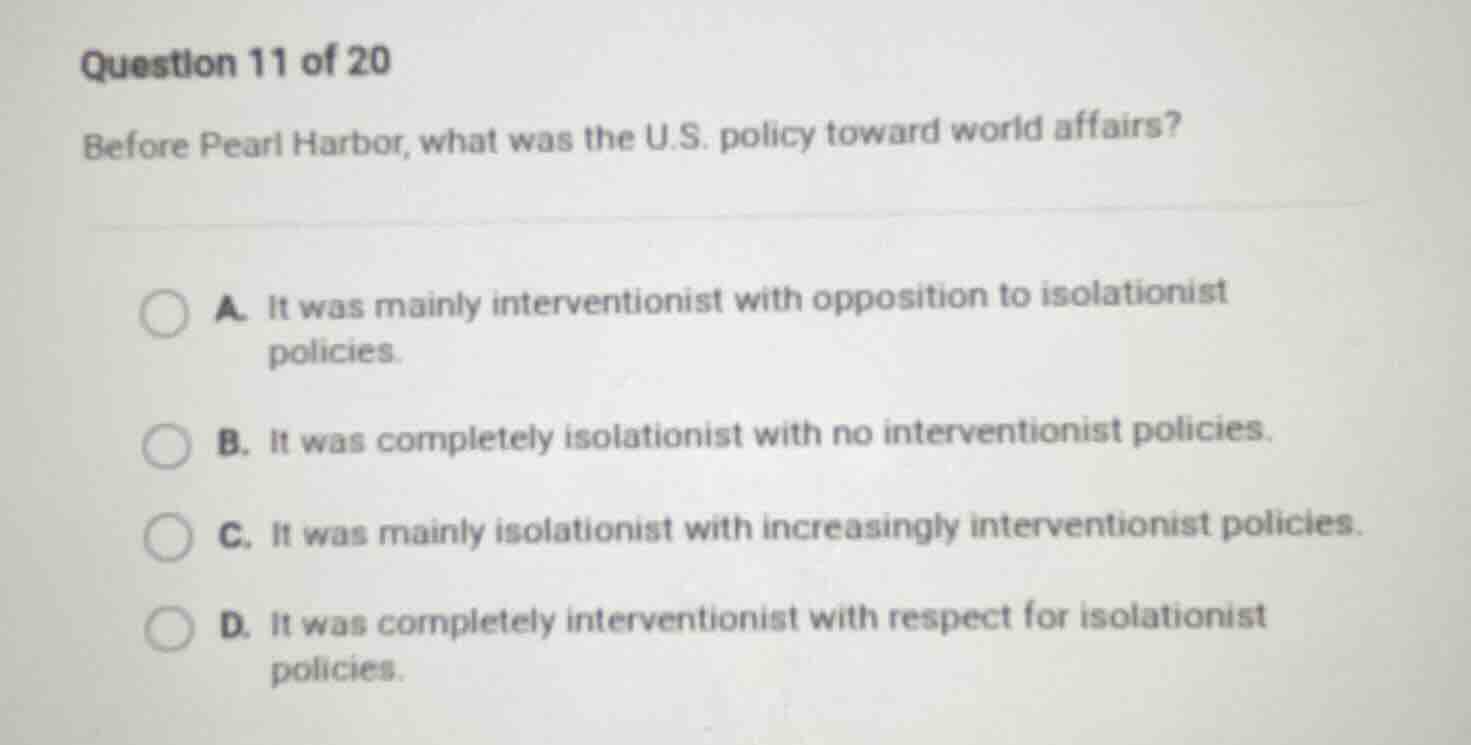
before pearl harbor, what was the u.s. policy toward world affairs?
a. it was mainly interventionist with opposition to isolationist policies.
b. it was completely isolationist with no interventionist policies.
c. it was mainly isolationist with increasingly interventionist policies.
d. it was completely interventionist with respect for isolationist policies.
Analyze interwar foreign policy
Using the Outbreak of World War II knowledge point, following World War I, the United States maintained a strong desire to avoid foreign entanglements, leading to a dominant policy of isolationism during the 1920s and 1930s. This was codified in legislative measures such as the Neutrality Acts.
Examine the shift toward intervention
Using the US Entry into World War II knowledge point, as totalitarian aggression escalated in Europe and Asia, the U.S. gradually shifted its stance. While remaining officially neutral, the government introduced increasingly interventionist policies to support the Allies, such as the Cash-and-Carry policy (1939) and the Lend-Lease Act (1941).
Evaluate the options
- Option A is incorrect because isolationism, not interventionism, was the dominant public and political sentiment.
- Option B is incorrect because the U.S. did not remain completely isolationist; programs like Lend-Lease were highly interventionist.
- Option C correctly describes the policy as mainly isolationist but with increasingly interventionist policies as the global crisis worsened.
- Option D is incorrect because the policy was not completely interventionist.

Snap & solve any problem in the app
Get step-by-step solutions on Sovi AI
Photo-based solutions with guided steps
Explore more problems and detailed explanations
- (A) It was mainly interventionist with opposition to isolationist policies.
- (B) It was completely isolationist with no interventionist policies.
- (C) It was mainly isolationist with increasingly interventionist policies. (Correct answer)
- (D) It was completely interventionist with respect for isolationist policies.