QUESTION IMAGE
Question
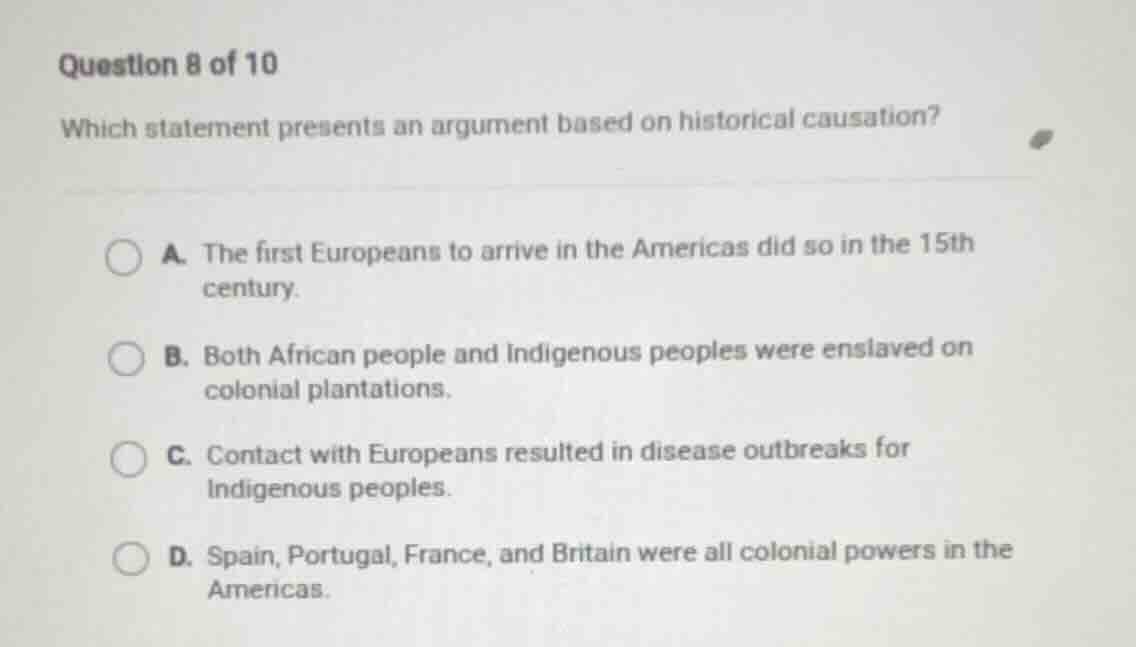
question 8 of 10
which statement presents an argument based on historical causation?
a. the first europeans to arrive in the americas did so in the 15th century.
b. both african people and indigenous peoples were enslaved on colonial plantations.
c. contact with europeans resulted in disease outbreaks for indigenous peoples.
d. spain, portugal, france, and britain were all colonial powers in the americas.
Define historical causation
Historical causation is the concept that events in history are linked by cause-and-effect relationships, where one event or action directly leads to or produces another outcome.
Analyze the given options
- Option A is a simple chronological statement of fact (when Europeans arrived).
- Option B is a descriptive statement comparing two historical groups (who was enslaved).
- Option C establishes a direct cause-and-effect link: contact with Europeans (cause) led to or "resulted in" disease outbreaks (effect).
- Option D is a descriptive list identifying colonial powers.
Identify the correct statement
Option C is the only statement that presents an argument based on cause and effect (causation).

Snap & solve any problem in the app
Get step-by-step solutions on Sovi AI
Photo-based solutions with guided steps
Explore more problems and detailed explanations
- (A) The first Europeans to arrive in the Americas did so in the 15th century.
- (B) Both African people and Indigenous peoples were enslaved on colonial plantations.
- (C) Contact with Europeans resulted in disease outbreaks for Indigenous peoples. (Correct answer)
- (D) Spain, Portugal, France, and Britain were all colonial powers in the Americas.