QUESTION IMAGE
Question
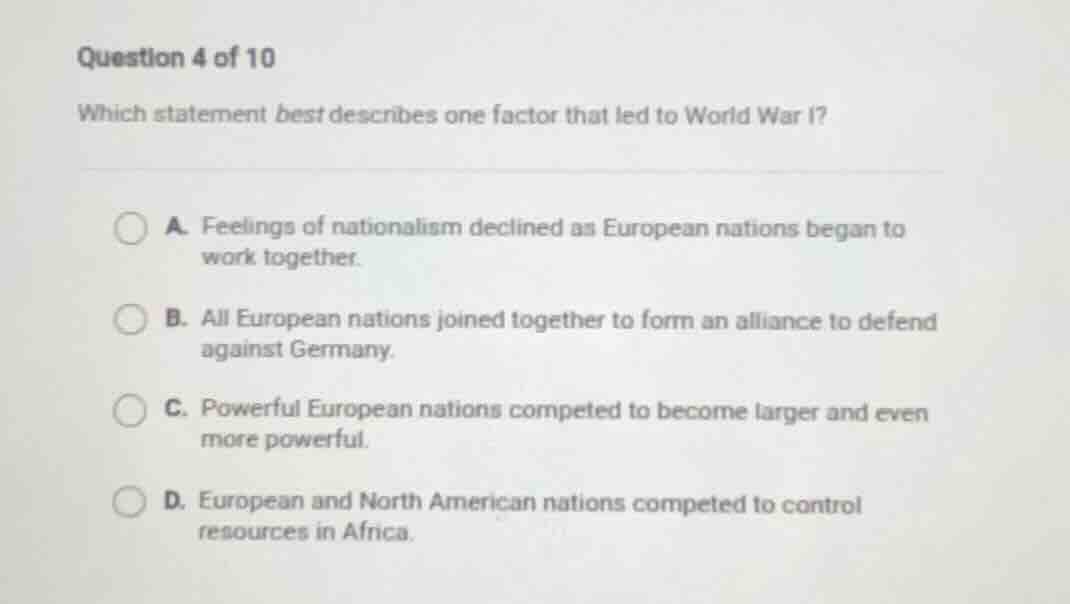
question 4 of 10
which statement best describes one factor that led to world war i?
a. feelings of nationalism declined as european nations began to work together.
b. all european nations joined together to form an alliance to defend against germany.
c. powerful european nations competed to become larger and even more powerful.
d. european and north american nations competed to control resources in africa.
Analyze the historical context of World War I
To understand the factors that led to the Outbreak of World War I, we must look at the long-term causes, often summarized by the acronym M-A-I-N: Militarism, Alliances, Imperialism, and Nationalism.
Evaluate each answer choice
- Option A: "Feelings of nationalism declined as European nations began to work together." This is historically inaccurate. Nationalism actually intensified in the late 19th and early 20th centuries, fueling intense rivalries and ethnic tensions (especially in the Balkans), rather than declining.
- Option B: "All European nations joined together to form an alliance to defend against Germany." This is incorrect. Europe was divided into two opposing alliance systems (the Triple Entente and the Triple Alliance), rather than a single unified alliance against Germany.
- Option C: "Powerful European nations competed to become larger and even more powerful." This statement accurately describes the intense imperialist and militaristic competition among European powers. Nations competed for colonies, global influence, military dominance, and economic superiority, which created a highly volatile environment.
- Option D: "European and North American nations competed to control resources in Africa." While European powers competed intensely for African territory (the "Scramble for Africa"), North American nations (like the United States) were not primary competitors in the colonization of Africa, making this choice less accurate than C.
Determine the best description
Option C best captures the overarching competitive dynamic—driven by imperialism, militarism, and nationalism—where major European powers sought to expand their empires and influence, directly leading to the heightened tensions that triggered the war.

Snap & solve any problem in the app
Get step-by-step solutions on Sovi AI
Photo-based solutions with guided steps
Explore more problems and detailed explanations
- (A) Feelings of nationalism declined as European nations began to work together.
- (B) All European nations joined together to form an alliance to defend against Germany.
- (C) Powerful European nations competed to become larger and even more powerful. (Correct answer)
- (D) European and North American nations competed to control resources in Africa.