QUESTION IMAGE
Question
question 3 of 10
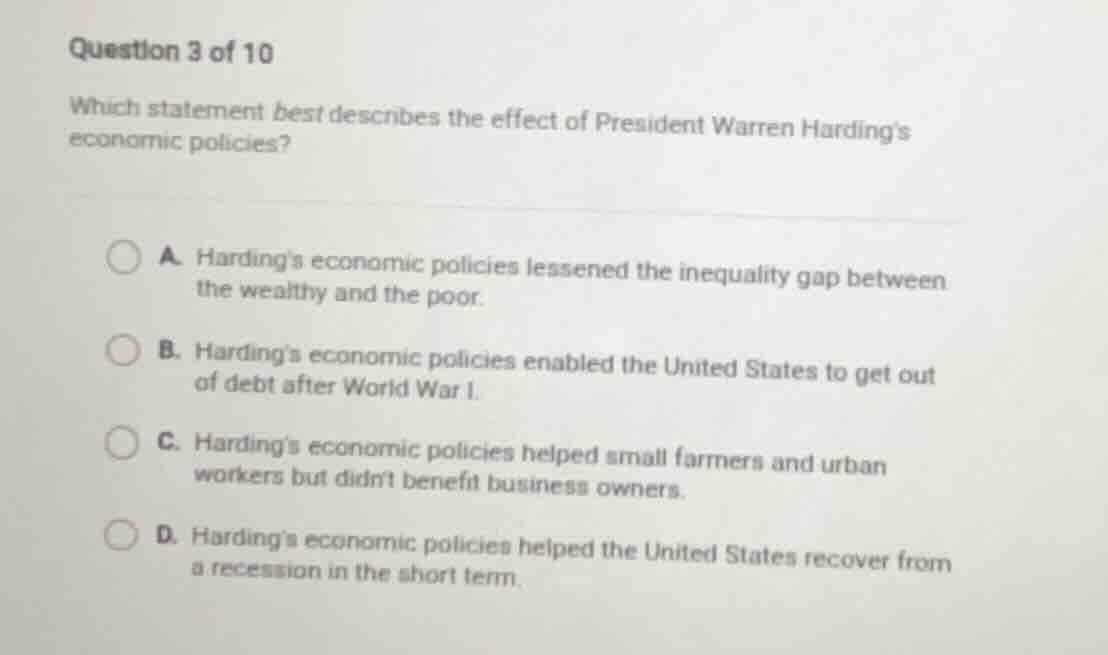
which statement best describes the effect of president warren hardings economic policies?
a. hardings economic policies lessened the inequality gap between the wealthy and the poor.
b. hardings economic policies enabled the united states to get out of debt after world war i.
c. hardings economic policies helped small farmers and urban workers but didnt benefit business owners.
d. hardings economic policies helped the united states recover from a recession in the short term.
Analyze the post-WWI economic context
Following World War I, the United States experienced a sharp economic downturn from 1920 to 1921, characterized by high unemployment and falling prices. When Warren G. Harding took office in 1921, his administration aimed to restore economic stability through conservative, pro-business policies.
Evaluate Harding's economic policies
Harding's "Return to Normalcy" agenda focused on reducing government spending, cutting tax rates for corporations and wealthy individuals (championed by Treasury Secretary Andrew Mellon), and raising protective tariffs (such as the Emergency Tariff Act of 1921 and the Fordney-McCumber Tariff of 1922).
Assess the short-term and long-term effects
These policies stimulated business investment and helped the United States quickly recover from the post-war recession, leading into the economic boom of the "Roaring Twenties." However, they did not reduce income inequality (which actually widened), did not eliminate the national debt, and did not favor small farmers or urban workers over business owners.
Match with the correct option
- A is incorrect because tax cuts for the wealthy and corporations widened the wealth gap rather than lessening it.
- B is incorrect because while the national debt was reduced, the United States did not completely get out of debt.
- C is incorrect because his policies heavily favored big business owners, while high tariffs and lack of direct aid hurt small farmers.
- D is correct because the pro-business policies successfully stimulated the economy, helping the nation recover from the 1920–1921 recession in the short term.

Snap & solve any problem in the app
Get step-by-step solutions on Sovi AI
Photo-based solutions with guided steps
Explore more problems and detailed explanations
- (A) Harding's economic policies lessened the inequality gap between the wealthy and the poor.
- (B) Harding's economic policies enabled the United States to get out of debt after World War I.
- (C) Harding's economic policies helped small farmers and urban workers but didn't benefit business owners.
- (D) Harding's economic policies helped the United States recover from a recession in the short term. (Correct answer)