QUESTION IMAGE
Question
question 10
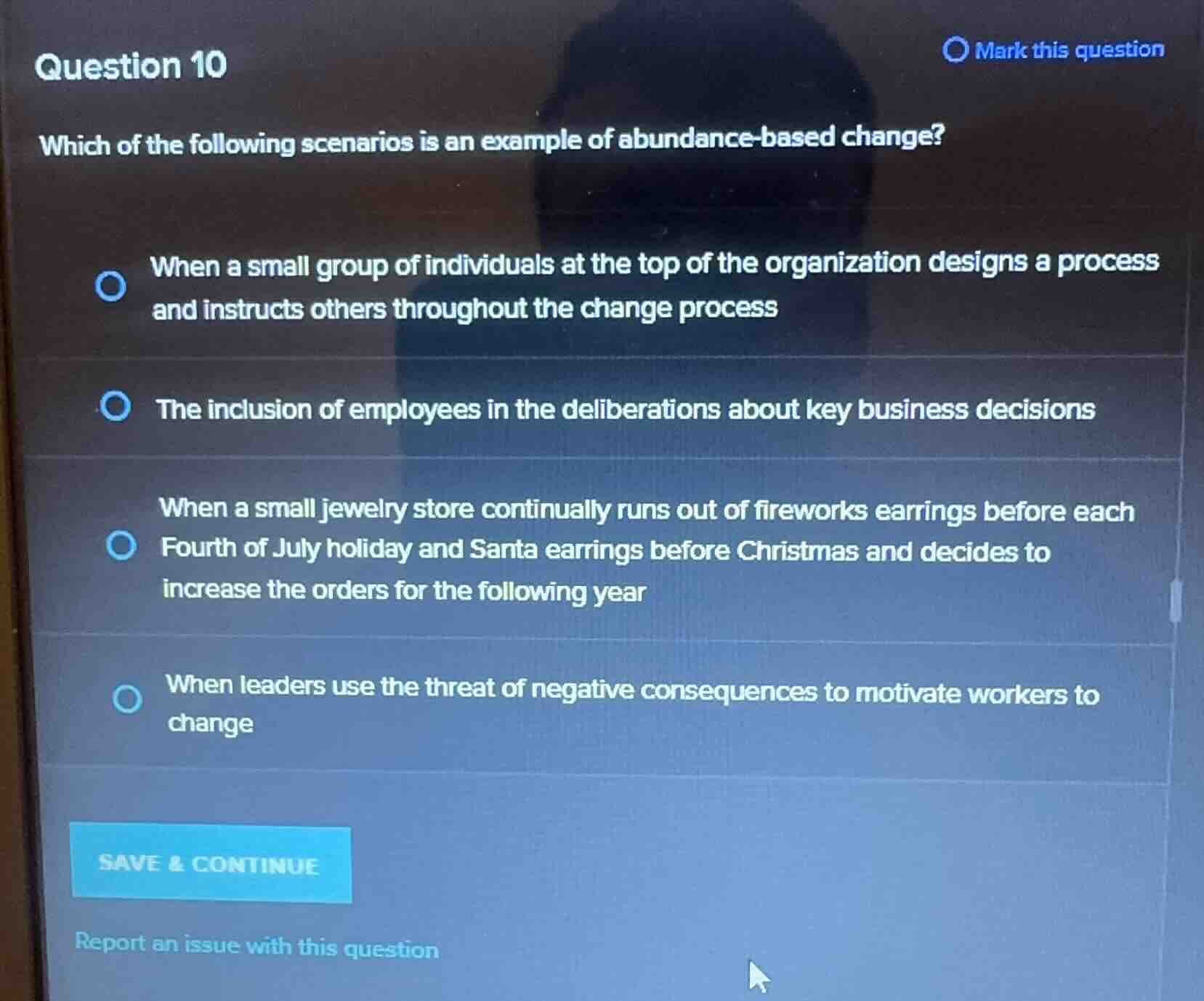
which of the following scenarios is an example of abundance-based change?
when a small group of individuals at the top of the organization designs a process and instructs others throughout the change process
the inclusion of employees in the deliberations about key business decisions
when a small jewelry store continually runs out of fireworks earrings before each fourth of july holiday and santa earrings before christmas and decides to increase the orders for the following year
when leaders use the threat of negative consequences to motivate workers to change
Define abundance-based change
Abundance-based change is an approach to Organizational Change that focuses on positive potential, strengths, and what is working well (an abundance of resources, capabilities, and positive energy) rather than focusing on deficits, problems, or threats. It is closely associated with appreciative inquiry and positive organizational scholarship, emphasizing employee engagement, inclusion, and fostering positive human potential.
Analyze the given options
- Option 1: "When a small group of individuals at the top of the organization designs a process and instructs others throughout the change process" describes a top-down, mechanistic, or deficit-based approach to change management.
- Option 2: "The inclusion of employees in the deliberations about key business decisions" aligns with the collaborative, participatory, and positive-potential nature of abundance-based change, which values the collective input and strengths of all organizational members.
- Option 3: "When a small jewelry store continually runs out of fireworks earrings... and decides to increase the orders..." describes a reactive, deficit-based operational adjustment to a shortage (a deficit of inventory).
- Option 4: "When leaders use the threat of negative consequences to motivate workers to change" is a classic deficit-based, fear-driven approach to change.
Select the correct scenario
The scenario that best represents an abundance-based approach is the inclusion of employees in key business decisions, as it leverages the collective strengths, ideas, and positive engagement of the workforce.

Snap & solve any problem in the app
Get step-by-step solutions on Sovi AI
Photo-based solutions with guided steps
Explore more problems and detailed explanations
- (A) When a small group of individuals at the top of the organization designs a process and instructs others throughout the change process
- (B) The inclusion of employees in the deliberations about key business decisions (Correct answer)
- (C) When a small jewelry store continually runs out of fireworks earrings before each Fourth of July holiday and Santa earrings before Christmas and decides to increase the orders for the following year
- (D) When leaders use the threat of negative consequences to motivate workers to change