Sovi.AI - AI Math Tutor

Scan to solve math questions

QUESTION IMAGE

question 10 which of the following illustrates an assertive response? a…

Question

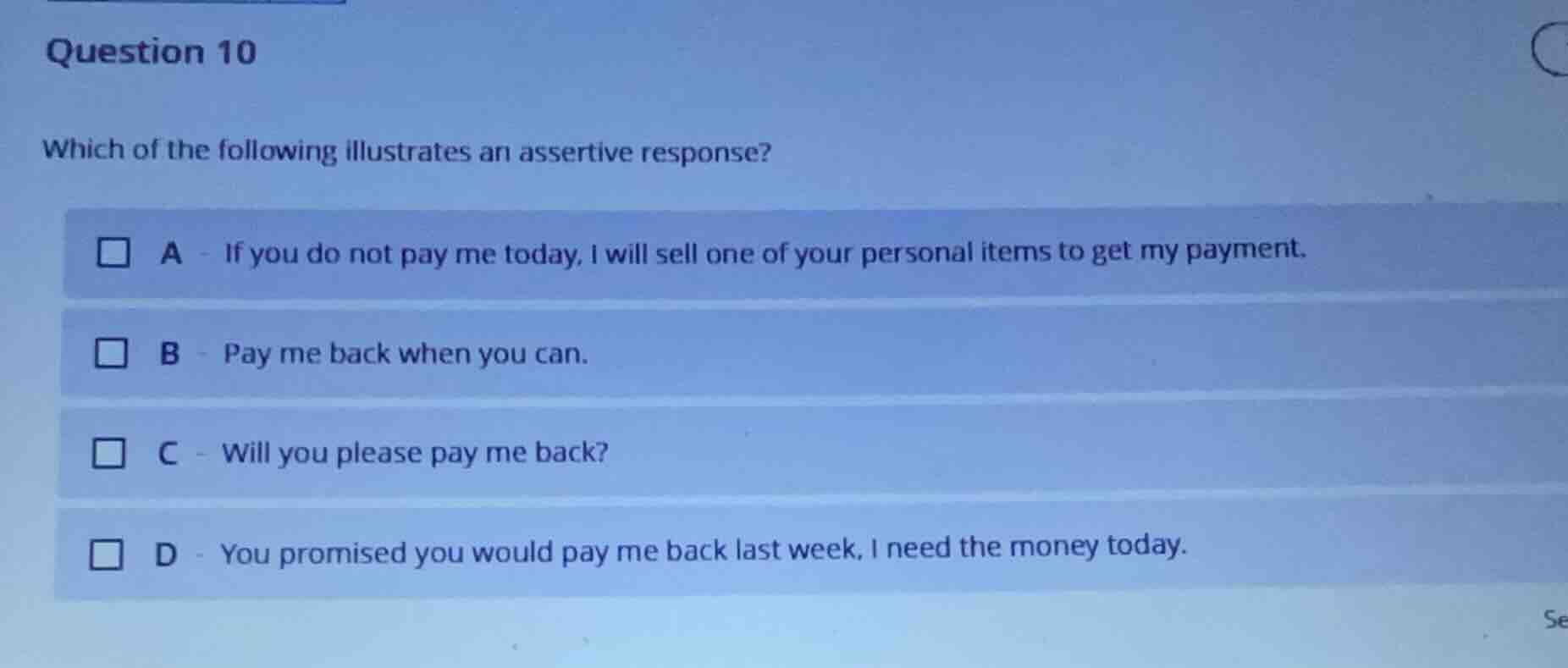
question 10

which of the following illustrates an assertive response?

a - if you do not pay me today, i will sell one of your personal items to get my payment.
b - pay me back when you can.
c - will you please pay me back?
d - you promised you would pay me back last week, i need the money today.

Explanation:

Response

<pre_analysis>
{
"quality": "clear",
"question_count": 1,
"skills_matched": [
"direct_cot",
"multiple_choice_formatter",
"explain_then_answer",
"tutor"
],
"needs_drawing": false,
"concepts_used": [
"Interpersonal Communication"
],
"new_concepts": [
"Assertive Communication",
"Communication Styles"
],
"current_concepts": [
"Interpersonal Communication",
"Assertive Communication",
"Communication Styles"
]
}
</pre_analysis>

<reasoning>

Define assertive communication

Assertive communication involves expressing your needs, boundaries, and feelings clearly, directly, and honestly, while maintaining respect for yourself and others. It avoids being passive (failing to express needs), aggressive (violating others' rights or threatening them), or passive-aggressive.

Analyze the response options

  • Option A: "If you do not pay me today, I will sell one of your personal items to get my payment." This is an aggressive response because it uses threats and violates personal boundaries.
  • Option B: "Pay me back when you can." This is a passive response because it lacks a clear boundary or firm timeline, leaving the speaker's needs unaddressed.
  • Option C: "Will you please pay me back?" This is a passive or overly tentative response that frames a firm boundary as a soft request.
  • Option D: "You promised you would pay me back last week, I need the money today." This is an assertive response. It states the facts directly ("You promised... last week") and clearly communicates the speaker's current need ("I need the money today") without being threatening or passive.

Apply interpersonal communication concepts

Using Interpersonal Communication principles, we evaluate how each message manages the relationship and the task. Option D balances task accomplishment (getting paid) with clear, respectful, and direct self-advocacy, which is the hallmark of assertive behavior.
</reasoning>

<answer>
<mcq-option>(A) If you do not pay me today, I will sell one of your personal items to get my payment.</mcq-option>
<mcq-option>(B) Pay me back when you can.</mcq-option>
<mcq-option>(C) Will you please pay me back?</mcq-option>
<mcq-correct>(D) You promised you would pay me back last week, I need the money today.</mcq-correct>
</answer>

<post_analysis>
{
"subject": "Social Science",
"question_type": "Multiple Choice",
"knowledge_point": [
"Social Science",
"Communication Studies",
"Assertive Communication"
]
}
</post_analysis>

Answer:

<pre_analysis>
{
"quality": "clear",
"question_count": 1,
"skills_matched": [
"direct_cot",
"multiple_choice_formatter",
"explain_then_answer",
"tutor"
],
"needs_drawing": false,
"concepts_used": [
"Interpersonal Communication"
],
"new_concepts": [
"Assertive Communication",
"Communication Styles"
],
"current_concepts": [
"Interpersonal Communication",
"Assertive Communication",
"Communication Styles"
]
}
</pre_analysis>

<reasoning>

Define assertive communication

Assertive communication involves expressing your needs, boundaries, and feelings clearly, directly, and honestly, while maintaining respect for yourself and others. It avoids being passive (failing to express needs), aggressive (violating others' rights or threatening them), or passive-aggressive.

Analyze the response options

  • Option A: "If you do not pay me today, I will sell one of your personal items to get my payment." This is an aggressive response because it uses threats and violates personal boundaries.
  • Option B: "Pay me back when you can." This is a passive response because it lacks a clear boundary or firm timeline, leaving the speaker's needs unaddressed.
  • Option C: "Will you please pay me back?" This is a passive or overly tentative response that frames a firm boundary as a soft request.
  • Option D: "You promised you would pay me back last week, I need the money today." This is an assertive response. It states the facts directly ("You promised... last week") and clearly communicates the speaker's current need ("I need the money today") without being threatening or passive.

Apply interpersonal communication concepts

Using Interpersonal Communication principles, we evaluate how each message manages the relationship and the task. Option D balances task accomplishment (getting paid) with clear, respectful, and direct self-advocacy, which is the hallmark of assertive behavior.
</reasoning>

<answer>
<mcq-option>(A) If you do not pay me today, I will sell one of your personal items to get my payment.</mcq-option>
<mcq-option>(B) Pay me back when you can.</mcq-option>
<mcq-option>(C) Will you please pay me back?</mcq-option>
<mcq-correct>(D) You promised you would pay me back last week, I need the money today.</mcq-correct>
</answer>

<post_analysis>
{
"subject": "Social Science",
"question_type": "Multiple Choice",
"knowledge_point": [
"Social Science",
"Communication Studies",
"Assertive Communication"
]
}
</post_analysis>